
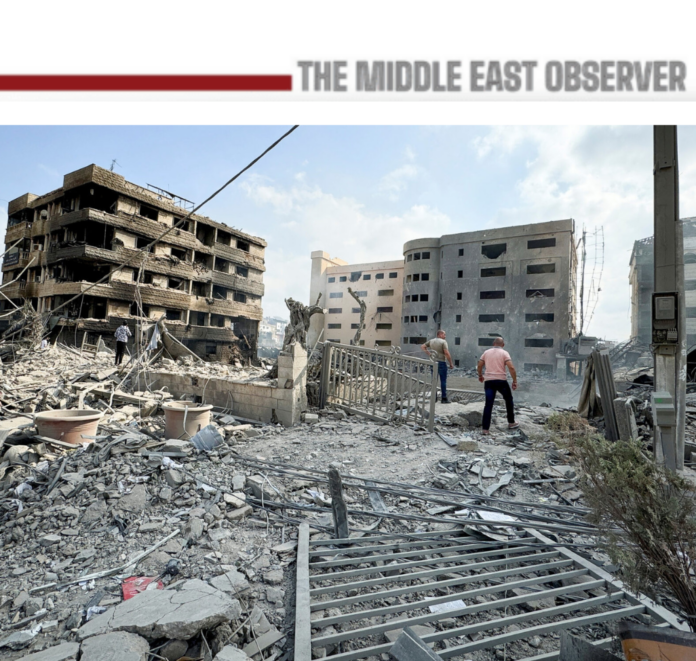
The recent escalation offers clear evidence of Iran‘s ability to mobilize multiple regional fronts and demonstrate a high degree of operational coordination among its allies. Yet the deeper motives behind this mobilization remain the subject of intense debate. Is Tehran acting according to a shared defensive doctrine and a genuine “unity of arenas” strategy, or is it primarily employing regional actors as instruments to strengthen its negotiating position and protect the Iranian heartland?
The answer largely falls within two competing interpretations.
The “Unity of Arenas” Perspective: Interconnectivity as Doctrine
Supporters of this view argue that the latest round of confrontation has demonstrated that the concept of the “unity of arenas” is no longer merely a political slogan but an operational reality.
Operational Interconnectivity
Iran’s recent missile intervention followed airstrikes targeting Beirut’s southern suburbs, reflecting a strategic decision in Tehran to link the security of allied capitals and movements directly to its own strategic calculations.
Activation of Multiple Fronts
The Iranian response coincided with missile and drone activity from Yemen, as well as attacks originating from Iraq and Syria. Proponents of this interpretation view such developments as evidence of coordinated action designed to stretch Israeli military resources and complicate defensive planning.
Imposing New Rules of Engagement
From this perspective, Iran’s objective is to establish a new deterrence framework in which future attacks on Beirut, Damascus, or allied actors would automatically risk triggering a wider regional confrontation rather than remaining confined to a single theatre.
The Alternative Perspective: Strategic Instrumentalization
Others reject the notion that current developments represent a purely doctrinal commitment to collective defense. Instead, they view the escalation as a calculated use of regional leverage in pursuit of Iranian national interests.
Negotiation Priorities
Advocates of this interpretation note that the escalation coincided with stalled diplomatic and political tracks, suggesting that Tehran may be using military pressure to strengthen its bargaining position in future negotiations with regional and international actors.
The Cost to Host Countries
Critics argue that the practical application of the “unity of arenas” concept imposes significant costs on countries such as Lebanon, including displacement, infrastructure destruction and economic disruption. In this view, regional fronts risk becoming instruments through which Iranian strategic interests are advanced at the expense of national sovereignty.
Restoring Direct Iranian Deterrence
The recent strikes are also interpreted as an attempt by Tehran to rebuild deterrence after previous attacks targeting Iranian military and strategic assets. Under this reading, the primary objective is the protection of Iran itself rather than the defense of allied actors.
Consolidating a New Deterrence Equation
Regardless of motivation, the latest escalation appears to have reinforced an equation long associated with Hezbollah‘s strategic discourse: that pressure on Beirut and its southern suburbs can be answered by pressure on Israeli population and military centers.
Iran’s direct involvement through missile strikes was widely interpreted as an effort to reinforce this concept following years of Israeli operations aimed at degrading the capabilities of allied groups across the region.
Restoring a Perceived Balance
Following major setbacks suffered by Hezbollah’s command structure and operational networks, many observers believed the balance had shifted decisively toward Israeli military and intelligence superiority. Direct Iranian intervention sought to demonstrate that Israeli cities and strategic infrastructure remain vulnerable to retaliation despite those setbacks.
Expanding the Protection Umbrella
The deterrence framework has also evolved beyond Hezbollah’s traditional missile capabilities. It increasingly encompasses a broader regional network capable of deploying long-range missiles and drones from multiple fronts, including Yemen, Iraq and Syria.
Israel’s Response: Adapting to a Multi-Front Threat
The emerging equation cannot be understood without examining Israel’s evolving response.
Leadership Targeting
Israel has increasingly relied on what it views as decapitation strategies, focusing on senior military and political figures rather than solely confronting armed groups on the battlefield. This approach reflects the belief that degrading command structures can weaken the broader network.
Strengthening Defensive Systems
At the same time, Israel continues investing heavily in air and missile defense systems, including Iron Dome and David’s Sling, while preparing for the possibility of simultaneous attacks from multiple directions.
Expanding Pre-emptive Operations
Israeli military doctrine has increasingly emphasized striking perceived threats before they materialize, extending operations deeper into Syria and Lebanon in an effort to shift the battlefield away from Israeli territory.
The War of Attrition Question
The durability of the emerging deterrence equation ultimately depends on a prolonged contest of endurance.
Iran and its allies often emphasize strategic patience and ideological commitment, while Israeli society has traditionally demonstrated a lower tolerance for prolonged insecurity and military casualties. Economically, Israel possesses a stronger and more advanced economy, while Iran continues to operate under sanctions but benefits from relationships with major international partners such as Russia and China.
Militarily, the balance remains mixed. The broader axis possesses extensive missile and drone capabilities, yet these assets remain vulnerable to intelligence penetration, aerial surveillance and pre-emptive strikes, areas in which Israel maintains significant advantages.
Conclusion: A Harsh but Entrenched Reality
The latest round of confrontation appears to have reinforced a reality that neither side can easily ignore. Tehran and its allies have sought to demonstrate that attacks on allied capitals and strongholds will carry direct consequences for Israel’s strategic depth. Israel, meanwhile, has shown that it retains the capability to strike sensitive military and strategic targets across the region, including inside Iran itself.
As a result, the emerging equation does not represent a decisive victory for either side. Rather, it reflects the consolidation of a broader war of attrition in which both parties seek to impose costs while avoiding a conflict that spirals beyond control.
The central question remains unresolved: will this evolving deterrence framework ultimately produce a form of uneasy stability resembling Cold War-style mutual deterrence, or will it become the foundation for a wider regional confrontation whose consequences neither side can fully predict?
Related news:
Insurance, Not Oil, Is Becoming the Iran War’s Biggest Trade Shock
“Trump’s Iran Pivot: A Red Line Instead of Regime Change”
Read also:
Egypt Targets 20% Rise in Gold Deliveries as Mining Expansion Accelerates
Iran War Deepens Currency Pressures as Oil Prices and Dollar Rise Together