
By : Ashraf Alsharkawi

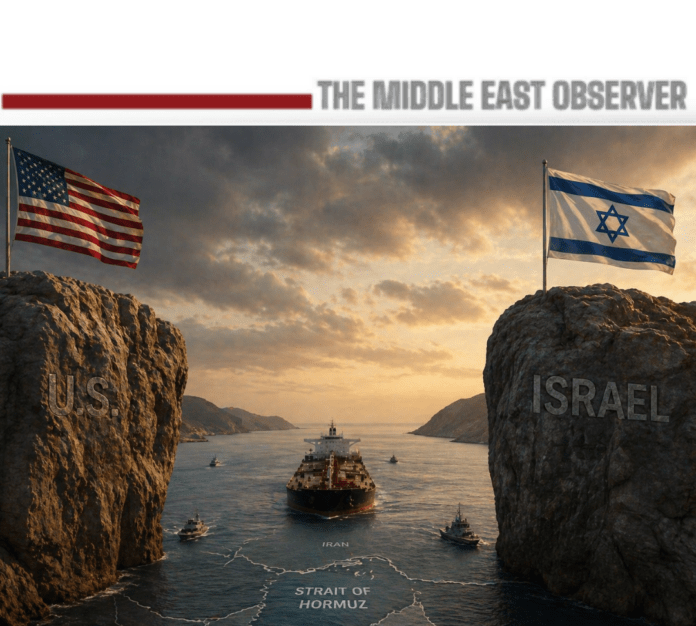
Ongoing tensions between the United States and Iran, along with their respective proxies, continue to disrupt the global economy, with repercussions extending to countries far removed from the conflict. Analysts suggest that several projected scenarios could place both the United States and Israel in a more challenging position than prior to the outbreak of hostilities.
Scenario One: Continuation of the Status Quo (War of Attrition)
In this scenario, both Iran and the United States maintain that the Strait of Hormuz is effectively under blockade, while their respective proxies in Lebanon and Israel assert that they are advancing their strategic objectives. This scenario carries significant political costs for the United States and Israel—particularly for Benjamin Netanyahu—as well as for the American and global economies, especially with oil prices reaching $106 per barrel. The situation may be evolving into a cold “war of attrition” on the Iranian front and a limited conflict on the Lebanese front, creating what could be described as a “strategic stalemate,” albeit with unevenly distributed costs.
The rise in oil prices to $106 per barrel represents a pronounced inflationary shock to the global economy and a political liability for the United States ahead of its midterm congressional elections. Elevated fuel costs are contributing to declining public support for the current administration and intensifying domestic pressure.
On the other side, Iran’s use of the Strait of Hormuz as a strategic lever has rendered it a high-risk navigational zone, embedding a persistent “risk premium” into global oil prices. Tehran appears to calculate that the threat alone can yield political leverage without necessitating a full closure that could escalate into a broader confrontation it may seek to avoid.
In Israel, Netanyahu faces mounting internal pressure. His political capital is diminishing amid growing public demands to end the conflict, which has triggered a crisis in northern Israel, including large-scale displacement both within the region and beyond.
More critically, the continuation of the status quo in the confrontation with Hezbollah risks eroding Israel’s deterrence posture. The conflict may be increasingly resembling a prolonged war of attrition, placing sustained strain on Israel’s economy and military, already burdened by the extended war in Gaza.
Under these conditions, the persistence of the status quo could constitute a “tactical advantage” for Iran and Hezbollah—so long as they can absorb the pressure—while potentially representing a “strategic setback” for the United States and Israel.
Scenario Two: Return to Mutual Bombing
The alternative scenario—a return to large-scale bombing—offers little improvement for the United States and Israel. Such escalation could trigger broader Iranian retaliation against Gulf states and Israel, and potentially extend to American targets worldwide, including, in extreme cases, within the United States itself.
Iran has demonstrated growing capabilities in targeting critical logistical and digital infrastructure. This may include the potential to disrupt systems connected to the internet—ranging from financial markets and banking networks to water management systems and electricity grids—posing a significant threat to the daily functioning of modern economies.
While Tehran appears to be reserving this capability as a strategic deterrent, its deployment could potentially inflict severe damage at the core of the American economy.
Compounding this scenario is the high financial burden of an expanded conflict, particularly if the United States is compelled to shoulder the cost largely alone amid limited participation from NATO. Under such conditions, escalation could risk reinforcing Iran’s strategic position while undermining U.S. global standing.
A central contradiction emerges: the sharp rise in oil prices—recently reaching $106 per barrel—is not merely an economic strain but a potential destabilizing factor within the United States and a systemic risk for the global economy. The financial cost of sustained military operations, combined with inflationary pressures, may render a “comprehensive military option” increasingly difficult to sustain.
Moreover, Iran’s posture suggests a shift beyond deterrence through rhetoric. Any direct strike on Iranian facilities could provoke a severe response, potentially including disruption of energy flows through the Strait of Hormuz, which could push oil prices significantly higher—posing a serious risk to global economic growth.
On the Lebanese–Israeli front, the principle of “unity of arenas” implies that any escalation involving Iran would likely translate into intensified pressure on Israel. In this context, Hezbollah has effectively imposed a new operational dynamic, responding to any perceived violation of ceasefire understandings. This may limit Israel’s room for maneuver and constrain its ability to achieve decisive outcomes.
For Benjamin Netanyahu, the situation presents acute political and strategic challenges. The absence of a clear military resolution, coupled with continued displacement in northern Israel, may weaken domestic confidence.
At the same time, entering a prolonged truce risks political backlash from within his governing coalition. This dual pressure—military and political—could place Netanyahu in an increasingly constrained and vulnerable position.
Scenario Three: Ground War
The third scenario—a ground war—could prove the most consequential, carrying the risk of a severe strategic setback for the United States and Israel. Any deployment of American ground forces into the Gulf could encounter intensive missile strikes capable of inflicting significant losses.
Attempts to seize and hold strategic islands may prove unsustainable, while efforts to establish a foothold along the Iranian coastline would expose forces to sustained bombardment from the Zagros Mountains. Breaching this terrain could entangle invading forces in a prolonged war of attrition, potentially comparable in complexity and duration to past conflicts such as Vietnam and Afghanistan.
Iran has spent decades reinforcing its defensive infrastructure. This may reduce the effectiveness of conventional airstrikes and raise the cost of any ground advance.
Additionally, Iranian-controlled islands in the Strait of Hormuz function as heavily fortified forward positions. Capturing them could be extremely costly and uncertain.
Geographically and demographically, Iran presents a formidable challenge. Any large-scale occupation would likely demand extensive manpower and resources beyond the practical reach of the United States.
Unlike Iraq in 2003, Iran possesses strong national cohesion in the face of external threats which could raise the likelihood of sustained asymmetric resistance.
Even limited escalation in such a scenario could push oil prices significantly higher, posing a serious threat to global financial stability.
Scenario Four: Flight Forward
No viable pathway appears to remain other than a “flight forward” scenario, whereby the United States and Israel seek to defer a decisive resolution. This approach may risk postponing confrontation rather than resolving it.
A possible course of action could involve a limited round of strikes targeting symbolic sites, followed by a unilateral ceasefire framed as a “mission accomplished. This has at times been observed as a recurring pattern when major powers face prolonged or inconclusive conflicts.
This scenario may present a politically attractive exit for a U.S. administration seeking to ease oil price pressures and for Netanyahu, who may require a narrative of victory.
The underlying objective would be narrative control. However, Iran and Hezbollah may interpret such a move as a strategic advantage and could use the pause to enhance military capabilities further.
This scenario carries broader geopolitical implications. A perceived retreat could weaken confidence in the American security umbrella and potentially accelerate regional realignment toward China, Russia, or Iran.
A further complication lies in Iran’s evolving response doctrine. Retaliation may now be immediate and economically disruptive. Even limited escalation may provoke a disproportionate response.
On the Lebanese–Israeli front, Hezbollah has altered the deterrence equation. Israel may face increasing constraints in unilaterally dictating ceasefire conditions.
From an economic perspective, war-risk insurance premiums for vessels transiting the Strait of Hormuz have surged significantly. A hypothetical system of Iranian transit fees could in some cases become economically preferable to insurers.
However, such a shift would challenge the framework of the United Nations Convention on the Law of the Sea. It could set a precedent for the monetization of global maritime chokepoints.
Acceptance of such an outcome could be interpreted as signaling a structural shift in global power dynamics and a relative decline in U.S. influence.
In this context, the United States and Israel face a constrained set of options, each carrying significant costs. Continuation may prolong pressure, escalation may amplify risk, and withdrawal could entail reputational loss. Within this complex equation, Iran may hold a degree of strategic leverage in certain scenarios, while its adversaries continue to search for an exit that preserves their political and strategic standing.
