
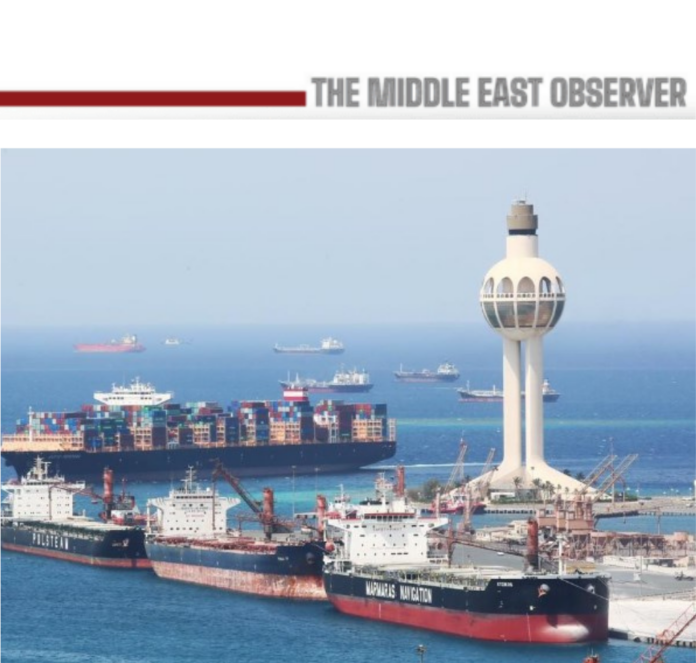
Saudi Arabia is accelerating its ambition to become one of the world’s leading logistics centres after the Saudi Ports Authority (Mawani) announced additional investments exceeding SAR641 million (US$171 million) in Jeddah Islamic Port over the past three months, strengthening infrastructure at the Kingdom’s principal maritime gateway amid growing regional demand for resilient supply chains and diversified trade routes.
The latest investment programme forms part of Saudi Arabia’s broader Vision 2030 and National Transport and Logistics Strategy, which seeks to transform the Kingdom into a global logistics platform linking Asia, Europe and Africa. Although the expansion was planned before recent geopolitical tensions in the Gulf, the disruption to shipping during the Iran-Israel crisis and the temporary impact on navigation through the Strait of Hormuz have reinforced the strategic importance of Red Sea ports as alternative gateways for international trade.
Under the programme, Mawani will deploy three new ship-to-shore cranes, 17 rubber-tyred gantry cranes, 91 terminal trucks and seven additional cargo-handling units, while expanding container terminal capacity by 200,000 square metres. The investment will also double refrigerated cargo capacity to 9,000 reefer plugs, strengthening Saudi Arabia’s ability to handle growing volumes of food, pharmaceutical and other temperature-sensitive cargo.
Beyond increasing capacity, the new equipment is expected to improve berth productivity, reduce vessel turnaround times and accommodate larger container vessels. These operational improvements are becoming increasingly important as shipping lines seek ports capable of handling larger fleets while minimising congestion and reducing logistics costs.
Jeddah Islamic Port serves as the Kingdom’s primary commercial gateway
Jeddah Islamic Port occupies a uniquely strategic position on the Red Sea, handling approximately 65% of Saudi Arabia’s seaborne imports and serving as the Kingdom’s primary commercial gateway. Situated along one of the world’s busiest east-west shipping corridors, the port connects markets across Europe, Asia and Africa and plays a pivotal role in supporting both domestic consumption and regional re-export activities.
The investment announcement came only one day after Mawani introduced Maersk’s Middle East–Central India–Levant (MECL) shipping service, expanding direct maritime connectivity between Jeddah and key regional and international ports. The addition reflects a broader trend among global shipping companies to strengthen network flexibility by increasing direct services to strategically located ports capable of supporting integrated regional supply chains.
The combination of infrastructure investment and enhanced shipping connectivity illustrates Saudi Arabia’s dual-track strategy: expanding physical port capacity while simultaneously attracting additional liner services. Together, these initiatives are expected to improve schedule reliability, shorten transit times and increase the competitiveness of Saudi exports, particularly as manufacturers continue to expand production under the Kingdom’s industrial diversification agenda.
The expansion also complements wider logistics reforms underway across Saudi Arabia, including investments in industrial zones, free trade areas, rail connectivity and inland logistics centres. These projects are designed to integrate maritime gateways with manufacturing clusters and distribution networks, enabling Saudi Arabia to capture a larger share of regional value-added logistics activities rather than functioning solely as a transit market.
Private-sector participation continues to play an increasingly significant role in this transformation. Earlier this year, APM Terminals, part of Denmark’s Maersk Group, acquired a 37.5% stake in the South Container Terminal at Jeddah Islamic Port from DP World. The transaction brought together one of the world’s largest container terminal operators with one of the industry’s leading shipping companies, strengthening operational integration while demonstrating sustained international investor confidence in Saudi port infrastructure.
For global shipping operators, continued investment in Jeddah offers several commercial advantages. Higher operational efficiency reduces vessel waiting times and port costs, while expanded refrigerated facilities support growth in agricultural, food and pharmaceutical trade. Enhanced connectivity also improves network resilience at a time when geopolitical uncertainty continues to influence routing decisions and freight planning across the Middle East.
The development is equally significant for regional competition. Ports across the Gulf and the Red Sea—including those in the United Arab Emirates, Oman and Egypt—are investing heavily to attract larger volumes of transshipment and gateway cargo. Against this backdrop, Saudi Arabia’s sustained investment programme signals its determination to secure a larger share of regional maritime trade by combining modern infrastructure, private-sector partnerships and expanded liner connectivity.
While short-term geopolitical events have highlighted the strategic value of Red Sea logistics, Mawani’s latest investment represents a long-term structural commitment rather than a temporary response to regional instability. By expanding capacity, improving operational efficiency and strengthening global shipping links, Saudi Arabia is positioning Jeddah Islamic Port not only as the Kingdom’s principal maritime gateway but also as an increasingly influential logistics hub within the evolving architecture of global trade.
As supply chains continue to diversify and shipping companies place greater emphasis on resilience, efficiency and network flexibility, sustained investment in strategic ports such as Jeddah is likely to become a defining feature of competition across the Middle East’s logistics sector. For Saudi Arabia, the latest expansion is another step towards converting geographic advantage into lasting economic competitiveness and establishing the Kingdom as one of the region’s foremost maritime and logistics centres.
Related news:
Saudi Arabia Seeks Private Capital for Major Makkah Development
S&P Affirms Saudi Arabia’s A+ Rating with Stable Outlook
Read also:
Central Bank Holds Policy Steady as Egypt’s June Inflation Slips to 14.3%
Egypt Secures $300m Chinese Investment to Deepen Automotive Supply Chain