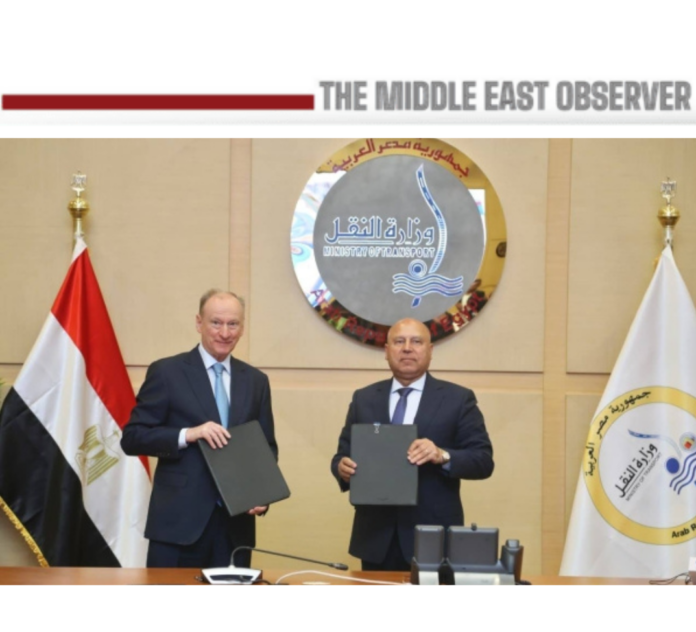
Cairo — A newly signed maritime memorandum of understanding between Egypt and Russia marks a significant step in Cairo’s evolving strategy to reposition itself as a fully integrated logistics and industrial hub, extending beyond its traditional role as a transit gateway.
The agreement, concluded between Egypt’s Ministry of Transport and Russia’s Maritime Board, establishes a framework for cooperation across shipping, port development, logistics infrastructure, and maritime industries. While still at an early stage, the deal reflects a broader policy direction aimed at capturing greater value from global trade flows rather than relying solely on transit revenues.
For decades, Egypt’s global trade relevance has been anchored in the Suez Canal, one of the world’s most critical maritime corridors. However, evolving global trade dynamics and intensifying competition among logistics hubs have shifted the focus toward efficiency, integration, and value-added services. According to UNCTAD, around 80% of global merchandise trade is transported by sea, reinforcing the importance of advanced maritime infrastructure and integrated logistics systems in shaping competitive advantage.
Within this context, the Egypt–Russia agreement signals a move toward building a coordinated logistics ecosystem linking Mediterranean and Red Sea ports through inland freight networks, dry ports, storage facilities, and industrial zones. The objective is to transform Egypt from a passage point into a platform for processing, storage, manufacturing, and redistribution, capable of handling diversified cargo flows, including Russian grain, industrial goods, and energy-related shipments, and channeling them into African and Middle Eastern markets.
The agreement also introduces a potential industrial dimension through discussions on maritime manufacturing and shipbuilding cooperation. Establishing shipyard capabilities in Egypt would mark a structural shift, enabling the country to localize high-value maritime services while generating spillovers across engineering, heavy industry, and workforce development. Such initiatives align with Egypt’s broader industrial policy aimed at deepening domestic production capacity and reducing reliance on imported services.
The timing of the agreement reflects mounting uncertainty across global shipping routes, particularly in the Middle East, where disruptions affecting key maritime corridors have underscored the risks associated with concentrated supply chains. In this environment, Egypt’s expansion of maritime partnerships with Russia forms part of a wider trade diversification strategy designed to secure alternative supply channels, stabilize critical imports, and enhance logistical resilience. Russia’s role as a major supplier of wheat to Egypt further elevates the strategic importance of efficient maritime integration in ensuring food security and import continuity.
Beyond its economic dimensions, the agreement carries geopolitical implications. Maritime partnerships increasingly serve as instruments of long-term