CAIRO – Egyptian archaeologists have uncovered 18 ancient tombs, a sealed granite sarcophagus, gold funerary artefacts and extensive remains of the ancient city of Marina El Alamein, in a discovery that is reshaping understanding of one of the Mediterranean’s most important multicultural urban centres during the Hellenistic and Roman periods.
The discoveries, made by an Egyptian archaeological mission working at Marina El Alamein on Egypt’s northwestern coast, highlight the city’s role as a thriving commercial and cultural hub where Egyptian, Greek and Roman traditions coexisted for centuries. The excavation forms part of the Ministry of Tourism and Antiquities’ broader programme to preserve the site while transforming it into a major cultural tourism destination.
Minister of Tourism and Antiquities Sherif Fathy described the finds as a significant scientific contribution that deepens understanding of the cultural identity of the city’s ancient inhabitants and reinforces Marina El Alamein’s historical importance as a gateway linking Egypt with the wider Mediterranean world.
The government is simultaneously implementing an extensive development project that will introduce visitor facilities, guided routes, electric transport, museum storage, an administrative centre and an open-air theatre, with completion expected during the first half of next year. The initiative forms part of Egypt’s strategy to diversify cultural tourism by expanding archaeological attractions beyond the Nile Valley and complementing the country’s established heritage destinations.
Well-Preserved Cemetery Reveals Ancient Burial Traditions
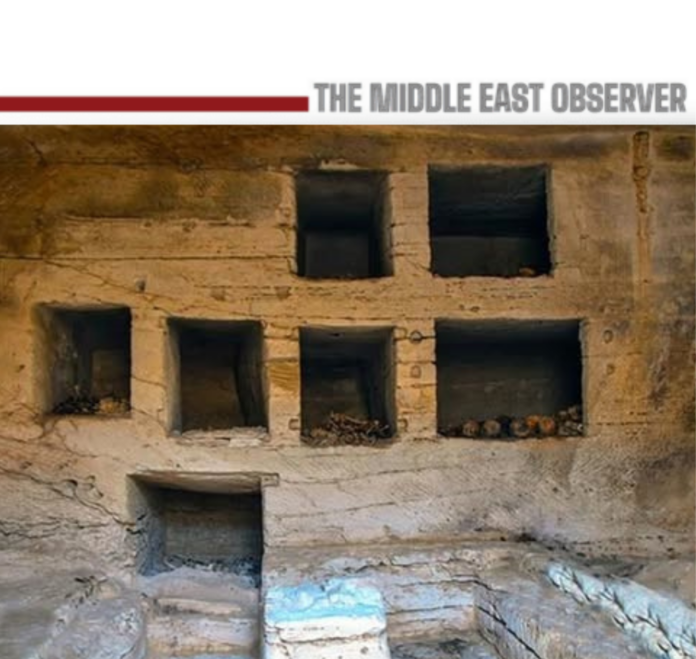
The newly excavated cemetery comprises 11 rock-cut underground tombs (hypogea) reaching depths of approximately eight metres and seven limestone-built surface tombs, several of which remained sealed by their original stone slabs since antiquity. Archaeologists also identified additional surface burials together with a water well later converted into a burial shaft, illustrating the continuity of ancient Egyptian funerary customs throughout the Ptolemaic and Roman eras.
Among the most remarkable discoveries is a 2.5-metre granite sarcophagus found with its original lid still sealed. Human remains recovered from the burial are undergoing scientific examination to provide further insight into the city’s ancient population. Nearby excavations also uncovered fragments of a plaster sphinx, reflecting the enduring influence of Egyptian religious symbolism within a city that flourished under Greco-Roman rule.
The mission recovered an exceptional collection of funerary objects, including golden funerary mouth pieces, believed to have been placed inside the mouths of the deceased to enable speech in the afterlife according to ancient Egyptian belief. Archaeologists also unearthed a rare gold Eye of Horus amulet, pottery vessels, amphorae, oil lamps, limestone altars, architectural elements, glass vessels and a limestone offering altar carved in the form of the traditional Egyptian “false door”—a distinctive feature of Pharaonic funerary architecture. An unfinished marble statue believed to depict Aphrodite further illustrates the cultural interaction between Egyptian and Greco-Roman artistic traditions.
Reconstructing an Ancient Mediterranean City
Located approximately 100 kilometres west of Alexandria, Marina El Alamein is widely believed to correspond to the ancient city of Leukaspis, referenced by the Greek geographer Strabo. Flourishing between the Hellenistic and Byzantine periods, particularly from the first to third centuries AD, the settlement developed into an important commercial, maritime and urban centre connecting Egypt with the eastern Mediterranean.
Since its discovery in 1986, archaeological excavations have revealed one of Egypt’s best-preserved ancient coastal cities, including residential districts, public buildings, harbour facilities, commercial quarters and extensive cemeteries that provide rare insight into daily life, trade and cultural exchange across the Mediterranean basin.
Strengthening Egypt’s Cultural Tourism Strategy
The latest discoveries reinforce Marina El Alamein’s growing importance within Egypt’s archaeological landscape while supporting wider efforts to diversify the country’s tourism offering beyond its traditional Pharaonic monuments.
As conservation and visitor development projects advance, the site is expected to emerge as one of Egypt’s leading Mediterranean heritage destinations, offering visitors and researchers alike a unique window into a cosmopolitan ancient city where Egyptian civilisation intersected with Greek and Roman cultures at one of antiquity’s most important crossroads.
Related news:
Archaeologists Discover 18th-Century Settlement in Upper Egypt
Archaeologists Uncover New Sacred Lake at Karnak in Luxor
Read also:
Gulf Investors Eye Stake in Egypt’s $150m Arab API Pharmaceutical Ingredients Project
Trade Barriers Are Rising—How Can Egypt Future-Proof Its Export Growth?