
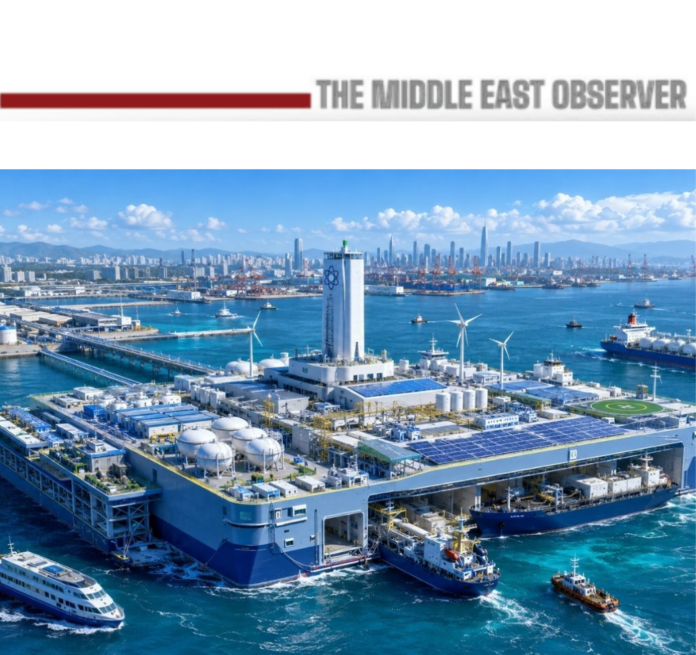
China has unveiled a conceptual design for a nuclear-powered floating maritime logistics hub, signalling how future ports could evolve from traditional cargo terminals into integrated energy, logistics and digital infrastructure platforms supporting the global transition to low-carbon shipping.
The concept, presented by Jiangnan Shipyard, a subsidiary of the China State Shipbuilding Corporation (CSSC), during the Posidonia International Shipping Exhibition in Athens, proposes a floating offshore logistics centre powered primarily by a fourth-generation molten salt reactor (MSR). While the project remains a design concept rather than an approved construction programme, it illustrates China’s long-term ambitions to combine advanced nuclear technology with maritime logistics and clean-energy infrastructure.
The proposal comes at a time when the shipping industry is undergoing one of its most significant technological transformations in decades. Global seaborne trade now transports more than 12 billion tonnes of cargo annually, while international shipping accounts for around 3% of global greenhouse gas emissions. Against that backdrop, ports are increasingly being redesigned not simply to move cargo but also to supply clean energy, support digital logistics and serve as industrial hubs for next-generation maritime transport.
The floating platform would function as a multi-purpose offshore logistics hub combining container transshipment facilities, electricity generation, shore-power services, hydrogen production and the manufacture of low-carbon marine fuels, including green ammonia. Designers envisage large ocean-going vessels transferring cargo offshore to smaller electric or alternative-fuel feeder ships while simultaneously refuelling and recharging through an integrated clean-energy system.
Unlike conventional ports that rely primarily on grid electricity and fossil-fuel-powered equipment, the proposed facility would integrate nuclear generation with offshore wind turbines and solar power. Excess electricity produced by the molten salt reactor could be used to generate hydrogen through electrolysis before being converted into ammonia and other synthetic fuels increasingly viewed as viable alternatives to conventional bunker fuel.
The International Maritime Organization’s (IMO) decarbonization strategy 2050
The proposal reflects the shipping industry’s broader response to the International Maritime Organization’s (IMO) decarbonisation strategy, which targets net-zero greenhouse gas emissions from international shipping by around 2050. Meeting that objective will require not only cleaner vessels but also entirely new port infrastructure capable of producing, storing and distributing alternative marine fuels at commercial scale.
Jiangnan Shipyard’s concept therefore extends beyond energy generation. The floating platform is designed as a fully integrated maritime ecosystem supporting cargo handling, energy storage, vessel charging, hydrogen production, synthetic fuel manufacturing and digital logistics management. Future facilities of this type could also incorporate artificial intelligence, autonomous cargo-handling systems, predictive maintenance technologies and intelligent vessel traffic management, significantly improving operational efficiency while reducing emissions.
The proposal builds upon Jiangnan Shipyard’s earlier work on nuclear-powered commercial vessels. In recent years, the company introduced conceptual designs for ultra-large nuclear-powered container ships using molten salt reactor technology, which subsequently received Approval in Principle from international classification society DNV. Although still years away from commercial deployment, the projects demonstrate China’s growing investment in advanced maritime nuclear applications.
Molten salt reactors are regarded by many nuclear engineers as one of the most promising next-generation reactor technologies because they operate at atmospheric pressure, achieve higher thermal efficiency and incorporate passive safety characteristics compared with conventional water-cooled reactors. China has become one of the world’s leading investors in advanced reactor technologies, including demonstration projects designed to accelerate future commercial deployment across power generation and industrial applications.
Beyond engineering, the proposal carries broader geopolitical significance. China already dominates global commercial shipbuilding and has expanded its international maritime footprint through the Belt and Road Initiative, investing in ports, logistics corridors and transport infrastructure across Asia, Africa, Europe and Latin America. Developing integrated nuclear-powered logistics hubs could further strengthen Beijing’s influence over future maritime infrastructure standards while reinforcing its leadership in advanced shipbuilding, clean-energy technologies and global supply chains.
The concept also emerges amid intensifying international competition to modernise port infrastructure. Major maritime hubs including Singapore, Rotterdam and several Gulf ports are investing heavily in hydrogen production, ammonia bunkering, digital logistics platforms and automated cargo handling as they prepare for the transition towards cleaner shipping. Future competitiveness is increasingly expected to depend not only on cargo throughput but also on the ability to provide reliable low-carbon energy, digital services and integrated logistics ecosystems.
For multinational shipping companies, ports are gradually evolving from cargo gateways into comprehensive energy providers. Tomorrow’s maritime hubs may generate revenue from electricity sales, hydrogen exports, synthetic fuel production, carbon management services and digital logistics platforms alongside traditional cargo-handling activities. That shift is expected to fundamentally reshape the economics of global port operations over the coming decades.
Despite its technological ambition, substantial challenges remain before floating nuclear-powered ports could become commercially viable. The proposal remains at the conceptual stage and would require extensive engineering validation, international nuclear safety certification, environmental approvals, financing structures and internationally accepted liability frameworks governing offshore nuclear facilities.
Public acceptance may prove equally important. While advanced reactors promise enhanced safety characteristics, locating nuclear infrastructure within busy international shipping corridors would require close cooperation among maritime regulators, nuclear authorities, insurers and port operators, together with internationally harmonised regulatory standards.
Commercial economics will ultimately determine whether such facilities become reality. Although molten salt reactors could deliver continuous carbon-free electricity for several decades, the initial capital investment would be considerable, requiring confidence that future demand for hydrogen, ammonia and electrified shipping infrastructure can support viable long-term returns.
Nevertheless, Jiangnan Shipyard’s proposal illustrates how rapidly strategic thinking within global shipping is changing. The next generation of ports is increasingly expected to integrate clean energy production, digital technologies and advanced logistics rather than simply expand cargo capacity.
Whether China’s floating nuclear-powered port progresses from concept to construction remains uncertain. Yet the proposal demonstrates that competition within global shipping is extending well beyond vessel size and port efficiency towards mastery of advanced nuclear technology, alternative marine fuels, artificial intelligence and integrated logistics ecosystems. In the decades ahead, competitive advantage may belong not simply to the ports that handle the greatest volume of cargo, but to those capable of producing the clean energy required to power the world’s next generation of maritime trade.
Related news:
Energy Security Drives China’s Response to Gulf Oil Crisis
China’s $2 Billion Trade City Plan Positions Egypt at the Core of Global Supply Chains
Read also:
WE Partners with Grofa to Deliver Smart Infrastructure for New Urban Development
New Clay Technology Challenges Traditional Cement Production