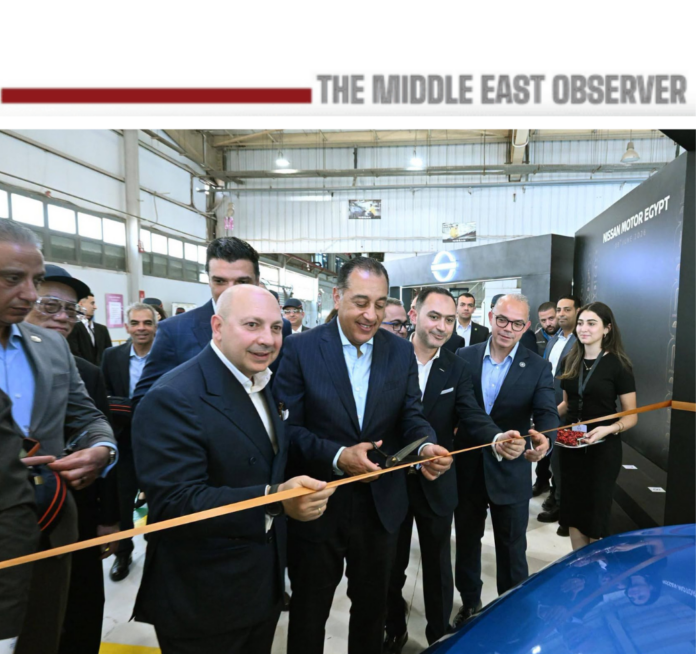
Egypt’s automotive expansion strategy entered a new phase this week as Prime Minister Mostafa Madbouly inaugurated production of the Nissan Magnite at Nissan Egypt’s facility in 6 October City, marking the first African production line for the compact SUV. More significantly, the launch highlights Cairo’s broader ambition to transform Egypt from a vehicle assembly market into a regional automotive manufacturing and export hub serving Africa, the Middle East and beyond.
The Magnite rollout comes as Egypt accelerates efforts to localise vehicle production under its Automotive Industry Development Programme, which aims to increase annual vehicle output to 100,000 units, raise local value-added to around 60%, and expand domestic industrial content beyond 35%. According to Fitch Solutions, vehicle production is expected to grow by 5.9% in 2026, supported by localisation incentives, expanding foreign investment and growing interest from international manufacturers.
Today, Egypt hosts production and assembly operations for several global automotive brands, including Nissan, Geely, Chery, Exeed, MG, General Motors, BAIC and Proton. While industry production remains well below the levels achieved by Africa’s leading automotive centres, momentum has accelerated markedly over the past two years as manufacturers seek new production bases closer to emerging markets.
Morocco currently produces more than half a million vehicles annually and has established itself as Africa’s largest automotive exporter through investments by Renault and Stellantis. South Africa remains the continent’s leading automotive manufacturing economy by value, while Turkey has developed into one of Europe’s most important automotive production platforms. Against this backdrop, Egypt’s ambitions remain significant but achievable, given its strategic geographic location and expanding industrial infrastructure.
Building the Supplier Ecosystem
Industry specialists increasingly argue that the long-term success of automotive localisation depends not only on vehicle assembly but also on the development of a competitive supplier base encompassing tyres, batteries, electronics, glass, wiring systems and engineering components.
Evidence of this shift is already emerging. Prometeon Tyre Egypt recently announced plans to invest approximately $550 million in a major expansion project in Alexandria’s Amreya industrial zone. The investment includes a new manufacturing facility alongside upgrades to existing production lines, adding capacity of up to 1.5 million heavy-duty truck, engineering equipment and agricultural tractor tyres annually, with operations expected to commence in early 2028.
The project illustrates a broader industrial transition. Rather than focusing solely on assembling imported components, Egypt is increasingly targeting higher-value manufacturing activities capable of strengthening domestic supply chains, raising local content levels and improving export competitiveness.
China Drives Investment Momentum
A significant share of recent automotive investment has originated from Chinese manufacturers seeking strategic production platforms closer to African, Middle Eastern and European markets. Companies including Geely, Chery, Exeed and MG have expanded their Egyptian operations as part of wider efforts to diversify manufacturing footprints amid shifting global trade patterns.
Egypt’s position is strengthened by preferential access to more than one billion consumers through trade arrangements including the African Continental Free Trade Area (AfCFTA), COMESA, the Greater Arab Free Trade Area and partnership agreements with the European Union.
Electric vehicles are also expected to play a growing role in the sector’s future. Fitch Solutions forecasts average annual growth of nearly 24% in Egyptian EV sales between 2026 and 2035, supported by government incentives, expanding charging infrastructure and local manufacturing initiatives.
Part of a Broader Industrial Strategy
Analysts note that Egypt’s competitiveness will ultimately depend on its ability to achieve deeper localisation while maintaining cost efficiency against established manufacturing centres. Success will require continued investment in supplier industries, workforce skills, logistics networks and technology transfer.
The automotive sector’s growth forms part of a wider industrial strategy visible across renewable energy equipment, textiles, logistics and advanced manufacturing. Recent investments, including Chinese textile projects in Port Said and SANY’s planned wind-turbine manufacturing facility in the Suez Canal Economic Zone, reflect a common objective: positioning Egypt as a regional production platform amid ongoing global supply-chain diversification.
Challenges remain, including high financing costs, currency volatility and dependence on imported components. Yet the trajectory of the sector increasingly suggests that Egypt is moving beyond traditional assembly operations toward a more integrated manufacturing model.
The launch of the Egyptian-made Nissan Magnite may therefore represent more than the introduction of a new vehicle. It signals the emergence of a broader industrial ecosystem that policymakers hope will secure Egypt a larger role in Africa’s next generation of automotive production, supplier manufacturing and export-led growth.
Related news:
Honda, Hitachi Automotive say to form EV motor joint venture
Great Wall Motors to Launch Major Automotive Manufacturing Hub in Egypt’s Suez Canal Economic Zone
Orascom, China’s Guide Automotive to Build EV and Desalination Complex in Ain Sokhna
Read also:
Europe is Leading the race towards 100% Renewable Energy
How Many More Lives Must Illegal Migration Claim?
Egypt–South Africa Relations: Brotherhood and Solidarity on a Shared African Path