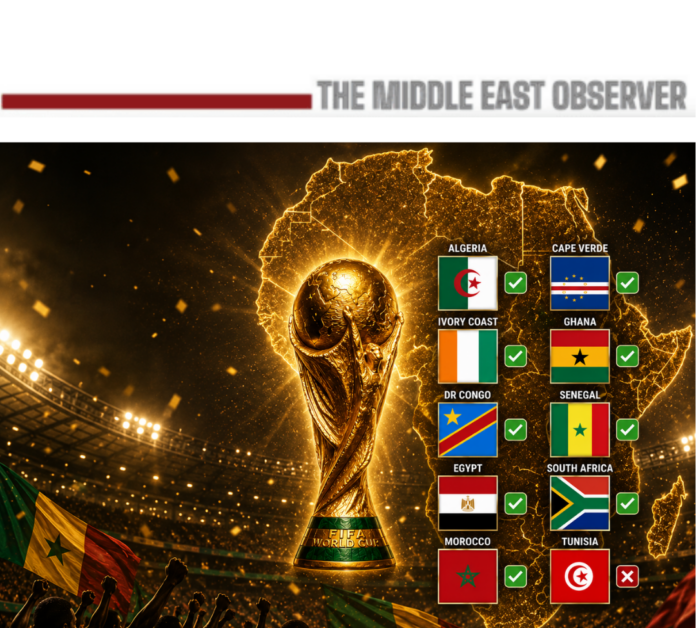
Africa has emerged as the defining success story of the 2026 FIFA World Cup, with nine of its ten representatives reaching the knockout stage and delivering the strongest qualification rate of any continent in the expanded tournament.
The achievement marks a profound reversal in African football’s World Cup fortunes. In 2018, none of the continent’s five teams progressed beyond the group stage in Russia. Eight years later, Africa has produced a 90% knockout qualification rate, outperforming Europe, South America, North and Central America, Asia and Oceania in one of the clearest signs yet that the global football hierarchy is shifting.
The Confederation of African Football confirmed that it was the first time 90% of African teams had advanced from a World Cup group stage, with CAF president Patrice Motsepe hailing the achievement as evidence of sustained investment in youth football, coaching, professional leagues and infrastructure. Reuters identified the nine African qualifiers as Cape Verde, Egypt, Ivory Coast, Morocco and South Africa as group runners-up, while Algeria, DR Congo, Ghana and Senegal advanced among the best third-placed sides. Only Tunisia failed to progress.
From 2018 Collapse to 2026 Breakthrough
The scale of Africa’s transformation is striking. In Russia 2018, the continent’s representatives recorded only three wins from 15 group matches and all five exited early. That failure weakened the argument that Africa had been under-represented at previous World Cups. The 2026 tournament has turned that debate on its head.
Expansion to 48 teams undoubtedly created more openings, but it did not guarantee performance. Africa converted opportunity into results at a rate unmatched by any other confederation. The same wider format was available to Asia, which sent nine teams to the tournament but produced only two knockout qualifiers, Japan and Australia. That contrast is what makes Africa’s success more than a statistical quirk.
The turning point came in Qatar four years ago. Morocco became the first African nation to reach a World Cup semi-final, defeating Belgium, Spain and Portugal before losing to France. What appeared then to be a one-off historic run now looks more like the beginning of a continental rebalancing.
Morocco’s model has become a reference point: long-term academy investment, elite coaching structures, diaspora integration, stronger domestic infrastructure and a squad core sharpened by European-club competition. In 2026, the benefits are no longer confined to one team. Egypt reached the knockouts for the first time in its history, Cape Verde exceeded expectations, DR Congo and Ghana survived demanding groups, while Senegal, Algeria, Ivory Coast and South Africa all helped broaden the African footprint.
Africa Outperforms Every Confederation
Measured by group-stage conversion, Africa now leads the tournament’s continental table. Its 90% progression rate is ahead of South America, where five of six teams reached the Round of 32, and Europe, where 13 of 16 advanced. UEFA remains the deepest confederation by volume, but the exits of several European sides — and Paraguay’s penalty-shootout elimination of Germany — underline that Europe’s middle tier is no longer insulated from emerging football powers.
South America again demonstrated its traditional efficiency. Argentina, Brazil, Colombia, Paraguay and Ecuador progressed, confirming CONMEBOL’s reputation for compact but high-quality competitiveness. Paraguay’s victory over Germany added substance to the numbers, showing that South American depth remains capable of unsettling the old European order.
CONCACAF delivered a mixed tournament. Co-hosts the United States, Canada and Mexico advanced, supported by home advantage and growing investment in domestic football systems. Yet the wider confederation still lacks the depth shown by Africa, with smaller representatives failing to sustain a knockout challenge.
Asia, by contrast, endured the tournament’s most uncomfortable examination. Japan and Australia advanced, but the elimination of several established AFC sides raised deeper questions about player development, tactical exposure and domestic league competitiveness. The gap with Africa was especially visible in the final group-stage picture: Africa had produced depth across almost its entire field, while Asia’s performance remained concentrated in two teams with stronger international experience.
Oceania’s representative, New Zealand, remained competitive but exited at the group stage, leaving the confederation still searching for a breakthrough under the expanded format.
The European Exposure Factor
One explanation for Africa’s surge lies in the changing profile of its players. African squads are increasingly built around footballers competing in Europe’s major leagues, where they absorb elite tactical standards, physical intensity and tournament-level pressure on a weekly basis.
Morocco, Senegal, Ghana, Algeria and DR Congo have all benefited from players developed partly or wholly in European systems, while Egypt’s progress has shown that even teams with a stronger domestic-league base can compete when supported by tactical discipline and elite attacking talent.
This hybrid model — African identity, European exposure and stronger federation planning — has produced teams that are no longer dependent solely on moments of individual brilliance. They are better organised, more tactically flexible and more emotionally resilient under tournament pressure.
The psychological barrier has also changed. Before 2022, only Cameroon in 1990, Senegal in 2002 and Ghana in 2010 had reached World Cup quarter-finals for Africa. Morocco’s semi-final run broke that ceiling. In 2026, African sides are no longer arriving as romantic outsiders; they are entering knockout matches expecting to compete.
Morocco’s penalty victory over the Netherlands in the Round of 32 reinforced that shift, setting up a Round of 16 meeting with Canada after the co-hosts eliminated South Africa. The result again showed that African teams can defeat established European opponents not only through physical power, but through tactical patience and pressure management.
A Vindication of Expansion — But Not Only Expansion
FIFA’s expanded World Cup format will inevitably be debated. Critics warned that adding 16 teams could dilute quality. The early evidence from 2026 suggests a more nuanced conclusion: expansion has exposed weakness in some confederations, but it has also revealed hidden depth in others.
Africa is the strongest argument in favour of the new format. The continent had long argued that five places were insufficient for a region with 54 member associations and a deepening pool of professional talent. The 2026 results support that case. More African teams did not mean weaker competition; it meant more competitive teams finally had a platform.
Yet the format alone cannot explain why Africa outperformed Asia so decisively. The difference lies in development pathways. Africa’s best teams have benefited from improved federation management, internationalised squads, academy investment, coaching reform and the credibility created by Morocco’s 2022 run. Asia’s weaker return suggests that greater representation must be matched by deeper structural reform if it is to translate into results.
A New Global Football Map
The knockout rounds will determine how far Africa’s representatives can go. Another semi-final appearance remains difficult, particularly with elite European and South American teams still strongly positioned in the bracket. But the broader story is already clear.
Africa has moved from under-representation to overperformance. Europe remains powerful, South America remains efficient, North America is improving, Asia faces scrutiny and Oceania is still developing. The 2026 World Cup has not simply expanded the field; it has redrawn the competitive map.
For decades, the question around African football was whether the continent deserved more World Cup places. In 2026, that question has been answered on the pitch. The more relevant question now is how far African football’s new generation can go — and whether the continent’s 90% breakthrough is the start of a lasting challenge to football’s established powers.
Related news:
Egypt’s World Cup Awakening: Why One Victory Means Far More Than Three Points
Joint Satellite Project Strengthens Saudi-Egyptian Push into Space Economy
Read also:
Media Reports Link Mohamed Salah to Saudi Pro League
Arab Teams Land Mixed Challenges as FIFA Confirms 2026 Groups