
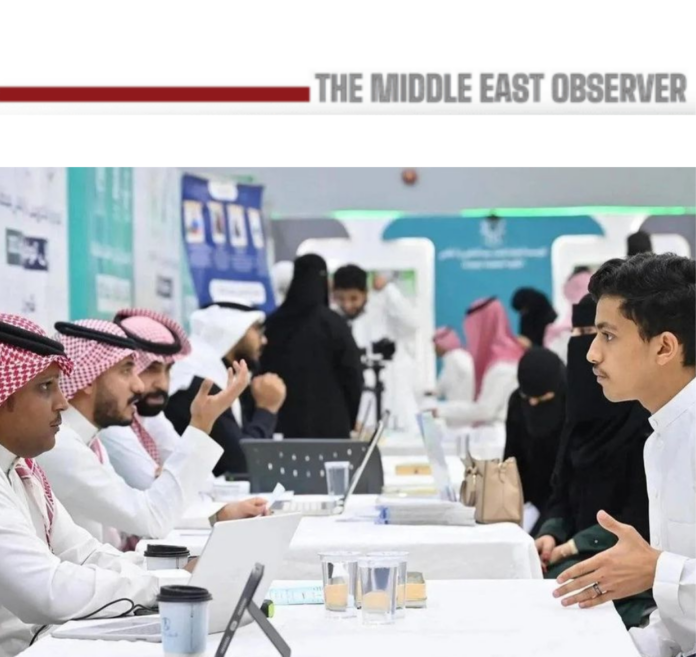
As women’s workforce participation reaches record levels, Gulf labour strategies shift from quota-driven localisation towards productivity, AI and human-capital competitiveness
Saudi Arabia’s labour market has entered a new phase, with unemployment among Saudi nationals falling to 6.4% in the first quarter of 2026 and unemployment among Saudi women declining to 9%, their lowest level on record, according to the Saudi General Authority for Statistics (GASTAT). The figures represent one of the clearest signs yet that Vision 2030 is moving from headline reform targets into measurable labour-market outcomes, particularly through the growing economic contribution of women.
The decline in female unemployment is far more than a social indicator. It expands household income, strengthens domestic consumption, broadens the national talent pool and gives the private sector greater access to skilled Saudi professionals across tourism, healthcare, education, finance, technology, professional services and administration. In a country of approximately 37.6 million people, the increasing participation of women is becoming a structural driver of non-oil economic growth and long-term productivity rather than simply a labour-market milestone.
Yet the speed of change should not obscure the scale of the challenge. Olivier Badard, Chief Executive Officer of Riyadh-based Armada Holding, recently observed that Saudi Arabia’s workforce nationalisation will require “a generation or two” despite the rapid progress achieved under Vision 2030. His assessment reflects the reality that developing national leadership, transferring specialised expertise and building globally competitive human capital are generational objectives rather than short-term policy targets.
The same principle increasingly applies across the GCC. Accelerating localisation too aggressively would not necessarily benefit Gulf economies; instead, it could undermine the sustainability of economic growth by creating skills shortages, increasing labour costs and weakening competitiveness. GCC countries must continue attracting international expertise—not only to remain globally competitive, but also to compete increasingly with one another in artificial intelligence, financial services, advanced manufacturing, logistics, defence, healthcare and the digital economy. The challenge is therefore to balance localisation with knowledge transfer, ensuring expatriate expertise becomes a catalyst for developing national talent rather than a permanent dependency.
Saudi Arabia emerges as the first GCC economy to enter Phase Two
Based on measurable progress in national employment, the breadth of localisation policies, private-sector participation, exposure to high-value industries and AI readiness, Saudi Arabia is emerging as the first GCC economy to move into the second phase of workforce nationalisation.
Phase One (2016–2026) focused on reducing unemployment, increasing private-sector participation and expanding employment opportunities for Saudi nationals, particularly women. According to GASTAT, national unemployment declined to 6.4% in Q1 2026, while female unemployment reached a historic low of 9%, reflecting one of the most significant labour-market transformations since the launch of Vision 2030.
Beyond improving employment statistics, higher female labour-force participation is strengthening domestic consumption, increasing household incomes, expanding the skilled labour pool and improving labour productivity. These gains are becoming an increasingly important contributor to Saudi Arabia’s non-oil economy, reinforcing growth across services, tourism, finance, healthcare and technology.
Phase Two (2026–2040) is expected to focus less on localisation quotas and more on labour productivity, AI adoption, leadership development, advanced technical skills and higher-value private-sector employment. The objective is to create a workforce capable of competing not only within the Gulf but increasingly across global knowledge-based industries.
The long-term challenge, as highlighted by Badard, is that this transformation will require one to two generations. Developing engineers, AI specialists, executives, researchers and industrial leaders cannot be compressed into a single economic cycle. Maintaining international expertise throughout this transition will therefore remain essential to preserving economic competitiveness while accelerating knowledge transfer to national talent.
Methodology
The comparative GCC assessment below is based on five indicators: measurable progress in national employment, policy intensity, private-sector absorption, exposure to high-value economic sectors, and readiness to deploy artificial intelligence and digital systems to improve workforce productivity. Rather than measuring localisation solely through employment quotas, the ranking evaluates each country’s progress towards building an innovation-driven national workforce capable of sustaining long-term economic diversification.
Saudi Arabia ranks first. With a population of 37.6 million, Saudization has become the Gulf’s most comprehensive localisation programme, extending across engineering, healthcare, tourism, logistics, defence, marketing, procurement, technology and AI-related industries. The Kingdom’s strength lies in combining ambitious policy reforms with measurable labour-market outcomes and rapidly expanding digital capabilities. The next challenge is ensuring that productivity grows alongside localisation.
The UAE ranks second. With a population of approximately 11.6 million, Emiratisation has evolved into the Gulf’s most sophisticated private-sector localisation model. According to the Ministry of Human Resources and Emiratisation (MoHRE) and the Nafis Programme, the number of Emiratis employed in the private sector now exceeds 100,000, supported by mandatory localisation targets, wage subsidies, training programmes and career development initiatives. Emiratisation primarily targets banking, financial services, technology, healthcare, real estate and professional services, creating highly skilled private-sector employment while encouraging long-term career development.
Oman ranks third. Home to around 5.4 million people, Omanisation is more interventionist, with the government restricting expatriate employment across more than 200 professions, according to the Ministry of Labour. The programme focuses on administration, human resources, tourism, customer services, management and selected technical occupations. Oman’s approach reflects higher youth-employment pressures while seeking to preserve economic competitiveness.
Bahrain ranks fourth. With a population of approximately 1.7 million, Bahrainisation relies more heavily on skills development than quotas. Through Tamkeen, Bahrain has expanded employment support, workforce training and enterprise development, targeting financial services, ICT, entrepreneurship, professional services and SMEs. The strategy emphasises raising workforce capability rather than replacing expatriate labour at speed.
Qatar ranks fifth. In a country of around 3.4 million people, Qatarization remains concentrated in energy, aviation, finance, infrastructure and government-linked entities. Rather than addressing unemployment, Qatar’s policy seeks to increase national participation in leadership positions and specialised knowledge-economy sectors while strengthening private-sector engagement.
Kuwait ranks sixth. With a population of approximately 5.2 million, Kuwaitisation continues to advance more gradually than elsewhere in the GCC. The policy concentrates on banking, oil and gas, administration and selected private-sector activities, while ongoing labour-market reforms seek to encourage greater private-sector participation among Kuwaiti nationals.
Forward-looking analysis: AI and the next generation of localisation
Artificial intelligence is unlikely to shorten workforce nationalisation into a few years. Instead, it is expected to determine which GCC economies successfully complete the transition over the next one to two generations.
Initially, AI will strengthen labour-market management through skills forecasting, workforce planning, compliance monitoring and job matching. Over time, however, AI will reshape the structure of employment itself, moving national workers into supervisory, analytical, technical, research, managerial and customer-facing roles where productivity increasingly depends on digital capability rather than workforce size.
Saudi Arabia and the UAE are best positioned to lead this transition because they combine localisation programmes with substantial investment in AI, digital infrastructure and innovation ecosystems. Oman and Bahrain could accelerate progress by using AI to improve workforce training and SME productivity, while Qatar’s sophisticated infrastructure provides a strong platform for future expansion. Kuwait’s success will depend largely on broader private-sector reform alongside digital transformation.
The future of Gulf labour markets is therefore unlikely to be defined by the disappearance of expatriate workers. Instead, the region is expected to evolve towards a complementary workforce model in which nationals increasingly occupy higher-value, AI-enabled and leadership positions, while expatriate professionals continue to provide specialised expertise, facilitate knowledge transfer and support economic competitiveness.
For investors, localisation has become much more than a regulatory requirement. It is emerging as a critical indicator of market resilience, investment attractiveness, productivity growth and long-term competitiveness. Companies that integrate workforce nationalisation with AI adoption, continuous skills development and structured knowledge transfer are likely to be best positioned to succeed across the Gulf’s next phase of economic transformation.
Ultimately, the GCC’s nationalisation race will not be won by the country that replaces expatriates fastest, but by the one that most successfully transforms its citizens into an innovative, productive and globally competitive workforce while sustaining the economic momentum created by diversification.
Related news:
Saudi-Qatari Summit Delivers historic Infrastructure and Security Deals
Saudi Arabia Approves Rules for Foreign Property Ownership
Read also:
Hypatia of Alexandria The Last Light of the Ancient World
Egypt Secures $300m Chinese Investment to Deepen Automotive Supply Chain
