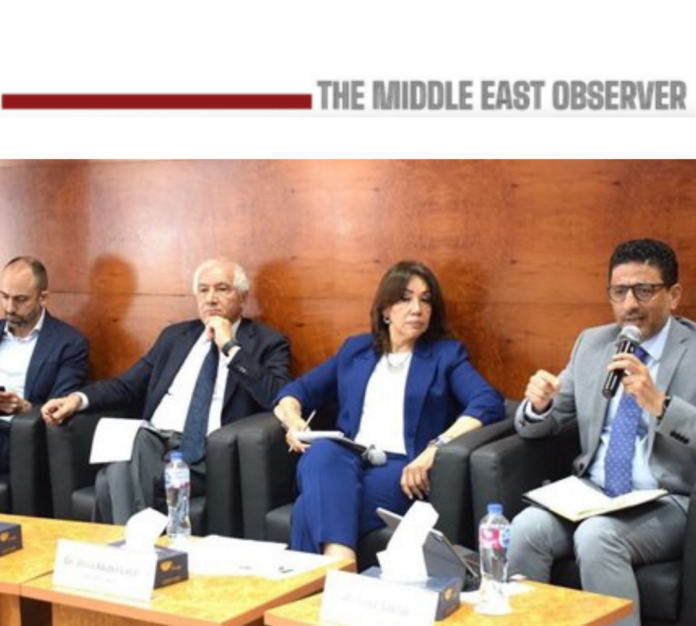
Experts Call for Faster Structural Reforms Through Greater Private-Sector Participation, Stronger Competitiveness and Deeper Integration into Global Value Chains
CAIRO — Geopolitical shocks are no longer exceptional events but an enduring feature of the global economy, fundamentally reshaping trade, investment and capital flows, according to economists participating in a high-level seminar organised by the Egyptian Center for Economic Studies (ECES) in partnership with the World Bank Group.
The consensus among policymakers, international financial institutions and leading economists was that Egypt has emerged from recent regional turmoil in a stronger macroeconomic position than during previous crises. However, they warned that sustaining this advantage will depend less on short-term stabilisation measures than on accelerating structural reforms capable of attracting investment, boosting competitiveness and integrating the economy more deeply into global value chains.
Despite approaching the discussion from different perspectives, speakers converged around three strategic priorities that will determine whether Egypt can convert today’s geopolitical uncertainty into long-term economic gains: expanding private-sector participation as the principal engine of investment and employment; improving national competitiveness through regulatory, infrastructure and logistics reforms; and integrating Egypt more deeply into global value chains to generate higher exports, attract productive investment and secure more sustainable foreign currency earnings.
Miguel Eduardo Sánchez Martín, Lead Economist for Egypt, Djibouti and Yemen at the World Bank, said Egypt entered the current Middle East crisis from a considerably stronger macroeconomic position than during previous regional shocks, reflecting reforms implemented over the past two years.
He noted that the flexible exchange-rate regime had absorbed much of the external shock without significant depletion of international reserves—a marked departure from previous crises. Although the conflict triggered portfolio outflows of approximately $9.2 billion and initially wiped about 12% off the Egyptian Exchange’s market value, financial markets subsequently recovered much of those losses as regional tensions eased.
Martín highlighted improving economic fundamentals, including 5.3% GDP growth during the first half of 2026, compared with an average of 2.4% in 2024, alongside stronger labour market conditions, rising non-oil exports, a 30% increase in workers’ remittances, a 15% rise in first-quarter tourism revenues, and improving fiscal performance supported by tax administration reforms.
Collectively, these indicators suggest that Egypt’s macroeconomic reforms have significantly strengthened the economy’s capacity to absorb external shocks, shifting the policy focus from crisis stabilisation towards sustaining long-term, investment-driven growth.
Martín cautioned that inflationary pressures driven by higher energy and utility prices continue to require close monitoring, particularly food inflation, stressing that lasting poverty reduction depends on creating productive private-sector employment rather than temporary policy interventions.
Saad Sabra, Country Manager of the International Finance Corporation (IFC) in Egypt, argued that the regional conflict should be viewed not simply as an economic downturn but as a structural test of national competitiveness in an era where geopolitical considerations increasingly shape global investment decisions.
With the IFC investing more than $1 billion annually in Egyptian projects, Sabra said investor interest remained strong across manufacturing and services despite heightened regional uncertainty. He urged policymakers to accelerate structural reforms, strengthen competition, improve the business environment and expand access to finance, while repositioning the state’s role towards regulation and market facilitation rather than direct economic participation.
He also identified energy diversification, electricity-sector reform and logistics development as essential priorities if Egypt is to capitalise on shifting global supply chains and attract long-term private investment. For the IFC, the challenge is no longer restoring macroeconomic stability but translating that stability into higher levels of productive private investment.
Perhaps the seminar’s clearest strategic message came from former Finance Minister Ahmed Galal, who argued that political and economic shocks have become the “new normal”, requiring governments to build resilience before crises emerge rather than merely responding once they occur.
Galal described Egypt’s recent economic performance as occupying a “grey zone”: successful in stabilising short-term macroeconomic conditions through exchange-rate flexibility, fiscal discipline and expanded social protection, but still facing deeper structural challenges.
He argued that raising Egypt’s long-term growth rate to between 7% and 8% is essential to deliver meaningful improvements in living standards, warning that current growth rates, while encouraging, remain insufficient to achieve broad-based economic transformation. He identified redefining the state’s economic role, strengthening competition, improving debt management and integrating Egypt more deeply into global value chains as the principal reforms required to sustain higher growth and generate durable foreign currency earnings.
Closing the seminar, ECES Executive Director and Director of Research Dr Abla Abdel Latif said Egypt’s relative political and economic stability had made it increasingly attractive to international investors at a time when much of the region faces heightened uncertainty. However, she cautioned that this competitive advantage could prove temporary unless reforms are implemented with greater urgency.
She identified the availability of fully serviced industrial land, continued infrastructure development and the removal of investment bottlenecks among the most immediate priorities, arguing that sustainable job creation depends fundamentally on expanding productive private investment rather than public employment programmes.
Abdel Latif also called for greater policy attention to Egypt’s middle class and urged policymakers to draw lessons from successful international reform experiences, particularly Poland’s economic transformation. Looking ahead, she highlighted the proposed India–Middle East–Europe Economic Corridor (IMEC) as a strategic development requiring close monitoring, while maintaining that Egypt’s geography, logistics infrastructure and the Suez Canal continue to provide significant competitive advantages capable of reinforcing its position as a regional trade and logistics hub.
She argued that Egypt’s strategic location, industrial base and logistics infrastructure provide a narrowing but significant window to capture investment relocating amid global geopolitical fragmentation, warning that this opportunity will diminish unless structural reforms are implemented decisively and at greater speed.
The seminar concluded that the Middle East conflict should not be viewed solely as a source of economic risk but as a catalyst accelerating profound changes in global production, trade and investment patterns. For Egypt, participants agreed, the defining policy challenge is no longer whether reform is necessary, but whether it can be implemented quickly enough to transform today’s geopolitical upheaval into sustained, private sector-led economic growth.
Related news:
World Bank Backs Egypt with $1 Billion Reform Financing
Egypt Targets EGP 24.5trn GDP in FY 2026/27 as Private Investment Gains Momentum
Read also:
Trump Won the Battles Against Iran. But Is He Losing the War?