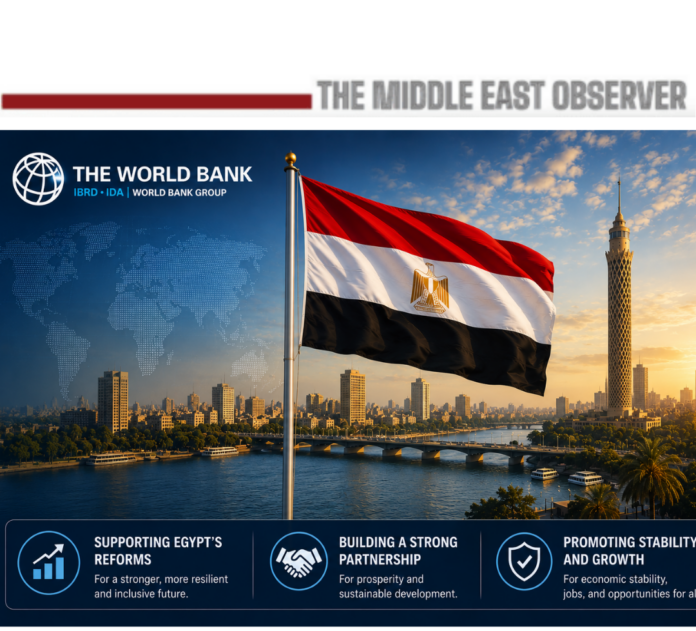
The World Bank has approved a $1 billion financing operation supporting Egypt’s ongoing economic reform program, with a focus on private sector-led job creation, fiscal resilience, and green transition policies.
According to official statements, the financing includes a $200 million credit guarantee backed by the United Kingdom as part of the “Building Resilience, Opportunities, and Wealth for Egypt’s Prosperity and Stability (BROWS)” program.
The operation represents the second phase of the World Bank’s development policy financing initiative for Egypt and is designed to support reforms aimed at stimulating investment, improving public financial management, and accelerating sustainable economic expansion.
The financing comes as Egypt continues implementing economic reform measures while navigating regional instability, elevated financing costs, and ongoing pressures linked to global energy markets. The operation also complements broader reform efforts supported by international financial institutions.
Stefan Guimbert, the World Bank’s Country Director for Egypt, Yemen, and Djibouti, said Egypt is advancing “an ambitious reform agenda” focused on encouraging private sector investment, generating employment opportunities, and strengthening social protection despite challenging global conditions.
Meanwhile, Egypt’s Deputy Foreign Minister for International Cooperation, Samar al-Ahdal, stated that the reforms supported under the program are expected to create better employment opportunities, support vulnerable groups, and promote more inclusive and sustainable development.
UK Ambassador to Egypt Mark Bryson-Richardson said the financing operation would help unlock investments, strengthen macroeconomic stability, and support long-term economic expansion benefiting the Egyptian economy.
The program also highlights Egypt’s growing focus on renewable energy and green transition policies. Mahmoud Abul-Eyoun, professor of economics at Zagazig University and former Governor of the Central Bank of Egypt, stressed the importance of accelerating renewable energy projects to reduce pressure from rising energy import costs and global price volatility.
He noted that expanding renewable energy capacity could help ease the burden of imported energy costs on both the government and consumers, particularly as energy prices continue influencing broader inflationary pressures across the Egyptian economy.
As The Middle East Observer notes, the latest World Bank financing reflects continued international backing for Egypt’s reform and green transition strategy at a time when the country seeks to strengthen private sector participation, enhance economic resilience, and reduce vulnerability to external energy and market shocks.