
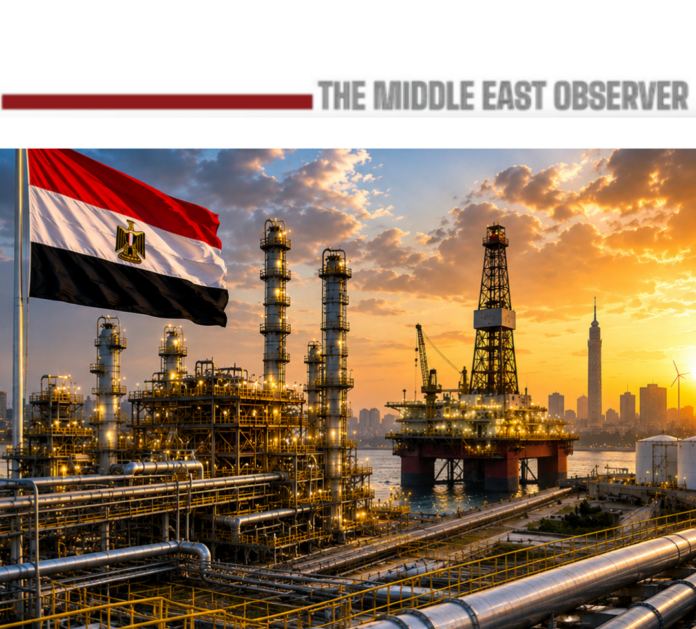
Egypt is reshaping its energy sector through a dual strategy of reviving hydrocarbon production while accelerating renewable energy investment, strengthening its ambition to become a regional energy hub and a key supplier of both natural gas and clean electricity.
Official data show that between July 2024 and June 2026 Egypt brought 591 new production wells online and recorded 113 oil and gas discoveries, adding around 1.6 billion cubic feet of natural gas per day and 280,000 barrels per day of crude oil and condensates. The recovery follows years of declining output, fuel shortages and mounting arrears to international energy companies, marking the first sustained improvement in domestic production in four years.
Investor confidence has strengthened after Egypt cleared overdue payments to foreign petroleum partners, signed 27 new exploration agreements with minimum commitments exceeding $1.4 billion, and launched more than 70 exploration opportunities. International energy companies including Eni, BP and Arcius Energy are expected to contribute to an investment pipeline exceeding $17 billion over the next four years.
The country has also expanded LNG import capacity through floating regasification units capable of processing 2.75 billion cubic feet per day, helping meet peak seasonal electricity demand. At the same time, Egypt retains a strategic advantage through its LNG export terminals at Idku and Damietta—the only large-scale LNG export facilities in the Eastern Mediterranean—which underpin its ambition to become a regional gas trading and export hub.
In parallel, Egypt is rapidly expanding renewable energy. Installed renewable capacity has increased from around 3.7 GW in 2015 to more than 9 GW, with a target of 24 GW by 2030 and renewables expected to account for 42% of electricity generation. The government has allocated more than 40,000 square kilometres for renewable energy projects, while major developments at Ras Ghareb, Gabal El-Zeit and Zafarana, together with a proposed 10 GW wind project west of Sohag, position Egypt among the Middle East and North Africa’s leading renewable energy investment destinations.
The economic impact extends well beyond electricity generation. Higher gas production can reduce fuel import costs, strengthen foreign currency earnings through LNG exports when surplus volumes become available, and support energy-intensive industries including fertilisers, petrochemicals, steel and cement. At the same time, renewable energy is expected to reduce fuel consumption, lower emissions and improve industrial competitiveness. The government’s 1,000 MW “Solar Industry” initiative, covering around 7,000 factories, alone could save an estimated 244 million cubic metres of natural gas annually, freeing additional volumes for higher-value domestic use or export.
Challenges remain, including declining output from mature gas fields, financing requirements for new infrastructure, electricity grid upgrades and a still-tight domestic gas balance reflected in seasonal LNG imports. Nevertheless, Egypt’s strategy increasingly aligns with global energy trends as countries seek to balance energy security with decarbonisation while meeting rising electricity demand driven by industrial expansion, desalination, transport electrification and AI-powered data centres.
If execution matches ambition, Egypt could emerge as one of the few countries in the region capable of combining large-scale natural gas production, LNG exports and renewable electricity generation within a single integrated energy system—strengthening its economic resilience, enhancing export competitiveness and reinforcing its geopolitical importance at the crossroads of Africa, the Eastern Mediterranean and the Middle East.
Related news:
Egypt Lands $300m Sany Investment for First Wind Turbine Factory
Read also:
Egypt, Eritrea Reaffirm Coordination on Red Sea Security and Horn of Africa Stability
A Common Arab Strategic Vision in an Era of Regional Blocs
