The global monetary system is undergoing one of its most profound transformations since the 2008 financial crisis. For more than a decade, the world’s leading central banks relied on extraordinary monetary measures—including quantitative easing, emergency liquidity facilities and large-scale asset purchases—to stabilise economies through successive crises. Today, that era is gradually giving way to a more conventional framework in which interest rates are once again the principal instrument for controlling inflation.
At the same time, digital finance is experiencing its own transformation. Technologies originally conceived to operate outside the traditional financial system—including stablecoins, tokenized deposits and blockchain-based payment networks—are increasingly being brought within the regulatory framework of central banks and financial authorities. What once appeared to be a challenge to monetary sovereignty is rapidly becoming an instrument for reinforcing it.
This apparent paradox presents one of the most significant strategic opportunities facing the Middle East and North Africa (MENA). Rather than viewing digital money as a threat to financial stability, governments have an opportunity to transform it into a cornerstone of next-generation monetary infrastructure—strengthening policy transmission, deepening financial markets and accelerating regional economic integration.
The timing could scarcely be more significant. As the United States, the European Union and China pursue increasingly distinct models for digital finance, global monetary influence is becoming progressively linked to digital financial infrastructure rather than conventional banking alone. This creates a rare strategic opening for MENA economies to adopt internationally compatible regulatory frameworks while developing interoperable regional payment and settlement networks. Countries that move decisively today will not simply modernise their financial systems; they will help shape the rules governing the next generation of global finance.
From Financial Innovation to Monetary Infrastructure
The original vision behind cryptocurrencies was to bypass central banks and reduce reliance on governments and commercial banks. However, widespread adoption has also exposed new risks, including fragmented regulation, financial instability and the growing possibility of digital dollarisation. Policymakers have consequently shifted from debating whether digital assets should exist to determining how they should operate within regulated financial systems.
The emerging global consensus is increasingly clear. Stablecoins, tokenized deposits and digital payment platforms are likely to coexist with traditional banking, but under prudential supervision, reserve requirements and transparent regulatory oversight. Rather than replacing sovereign money, regulated digital finance is evolving into a modern extension of it.
For MENA economies, this shift offers benefits that extend well beyond technological innovation. Digital financial infrastructure has the potential to strengthen one of the weakest aspects of monetary policy: transmission. Today, central banks influence inflation through a lengthy chain that runs from policy rates to commercial banks, financial institutions, businesses and finally consumers. Each stage introduces delays and inefficiencies that can weaken the effectiveness of monetary policy.
Tokenized deposits, licensed stablecoins and interoperable digital payment systems can shorten this transmission mechanism considerably. Changes in benchmark interest rates can flow more rapidly into lending costs, deposit pricing and financial markets, enabling central banks to respond to inflationary pressures with greater precision while reducing reliance on repeated emergency interventions.
Equally important, digital financial systems generate continuous, high-quality economic data. Instead of relying primarily on delayed statistical reporting, policymakers can gain near real-time visibility into payment flows, liquidity conditions, consumer spending and credit creation. Combined with advances in artificial intelligence and data analytics, this enables central banks to monitor inflationary pressures more accurately, identify emerging financial risks earlier and calibrate policy decisions with greater confidence.
A Once-in-a-Generation Opportunity for MENA
For MENA countries, this convergence of digital finance and artificial intelligence represents an opportunity to leap beyond legacy financial architectures rather than simply modernising them. Unlike many advanced economies burdened by decades-old payment systems, several countries across the region are still building the next generation of financial infrastructure. This provides a rare opportunity to integrate digital identity, AI-driven compliance, programmable payments and tokenized financial markets into a unified ecosystem from the outset.
Financial inclusion represents another major strategic dividend. Millions of people across the region remain outside the formal banking system despite widespread smartphone adoption. Regulated digital wallets and tokenized payment platforms can significantly broaden access to financial services while bringing more economic activity into the regulated economy. Greater transparency strengthens tax administration, reduces reliance on cash transactions and improves the effectiveness of fiscal and monetary policy alike.
However, successful implementation requires careful governance. Unregulated foreign-currency stablecoins could weaken domestic monetary policy by encouraging digital dollarisation, particularly in economies facing inflationary pressures or exchange-rate volatility. Stablecoins operating within national markets should therefore be fully licensed, transparently reserved and integrated into central bank oversight. Local-currency digital instruments and tokenized commercial bank deposits can reinforce confidence in domestic monetary systems while preserving the benefits of financial innovation.
Beyond national reforms lies an even larger opportunity: regional integration. Interoperable digital payment and settlement systems across Gulf Cooperation Council countries and wider Arab economies could substantially reduce the cost and time required for cross-border trade, investment and remittances. A common framework for regulated digital finance would deepen regional capital markets, improve trade finance and strengthen economic connectivity without requiring monetary union. For a region seeking greater economic integration, digital financial infrastructure may prove as strategically important as transport, energy and logistics networks.
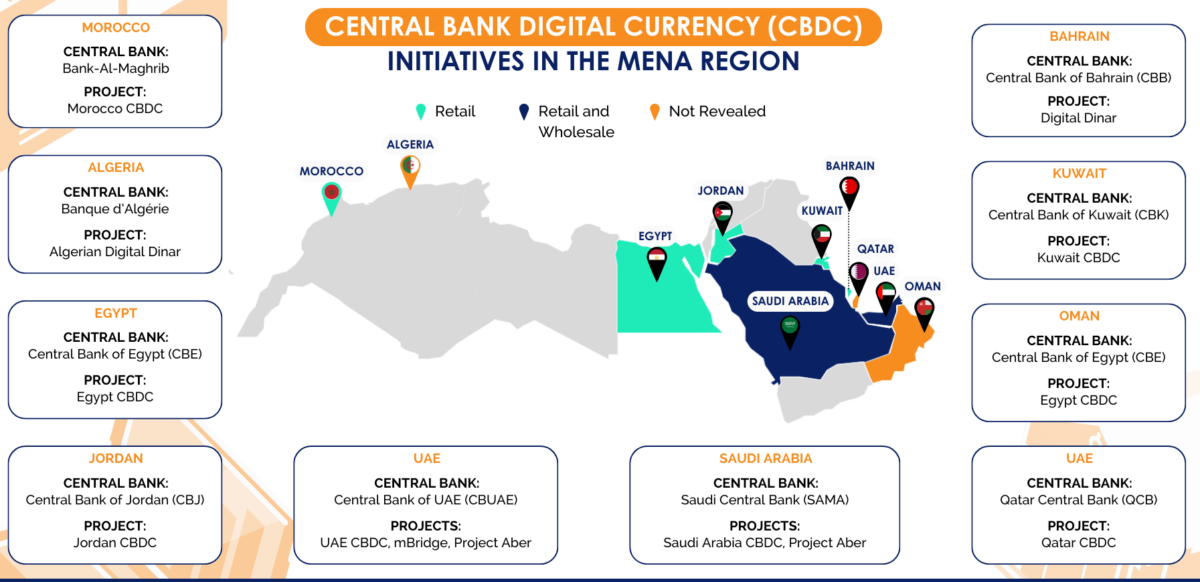
The Gulf states are particularly well positioned to lead this transition. Their advanced banking sectors, ambitious digital transformation programmes and growing investments in financial technology provide a strong platform for developing regulated tokenized markets. Larger emerging economies—including Egypt, Morocco and Jordan—can also leverage digital finance to improve monetary credibility, strengthen SME financing, modernise government payment systems and attract long-term investment by increasing confidence in macroeconomic management.
The Future of Monetary Sovereignty
The strategic significance extends beyond payments. The future of monetary sovereignty will increasingly depend on who governs the infrastructure through which money, data and financial transactions move. Digital payment systems generate vast quantities of economic information that are becoming strategic national assets. Countries capable of securely managing this financial data while integrating artificial intelligence into monetary supervision will possess a significant advantage in maintaining financial stability, attracting investment and responding to economic shocks.
The next chapter of monetary policy will therefore be defined not only by higher interest rates but by the infrastructure through which those rates influence economic activity. Digital money, artificial intelligence and tokenized financial markets are converging into a new monetary architecture in which payments, data and policy become increasingly inseparable.
History may ultimately judge cryptocurrencies not as the technologies that weakened central banks, but as the catalyst that compelled them to modernise. For the MENA region, success will depend not on choosing between innovation and regulation, but on combining both to build a monetary system that is digital, sovereign and globally competitive. Those countries that successfully integrate regulated digital finance into their monetary frameworks will be better positioned to control inflation, deepen capital markets, strengthen regional financial integration and emerge as leading financial hubs in an increasingly digital global economy.
Related news:
Crypto Revolution in the Desert: UAE’s Bold Bid to Lead Global Digital Finance
IMF Signals Structural Economic Shift Across MENA
Read also:
How Hollywood and Luxury Brands Created a Win-Win Business Model
Ericsson Sees Sub-Saharan Africa’s 5G Subscriptions Surging from 30m in 2025 to 370m by 2031