
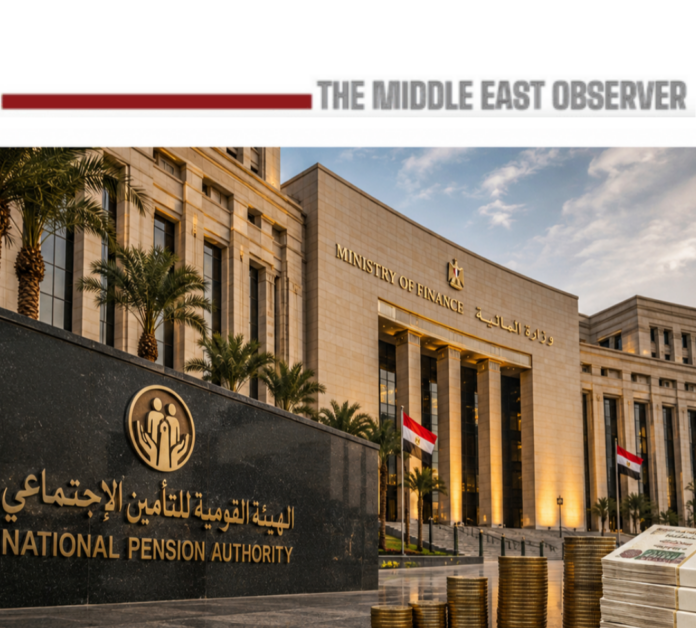
Cairo — President Abdel Fattah El-Sisi has ratified amendments to Egypt’s Social Insurance and Pensions Law, raising the annual payment made by the state treasury to the National Organization for Social Insurance (NOSI) as the government seeks to strengthen pension financing and continue settling long-standing obligations to the country’s social insurance system.
The amendments, issued as Law No. 11 of 2026 and published in the Official Gazette, modify Article 111 of the 2019 Social Insurance and Pensions Law. They increase the treasury’s annual installment to EGP 238.55 billion in fiscal year 2025/26, up from an estimated EGP 227.08 billion previously, representing an increase of approximately EGP 11 billion.
Beginning on 1 July 2026, the installment will rise at a compound annual rate of 6.4%. The annual growth rate will then increase by 0.2 percentage points starting in July 2027 until reaching 7% compound growth from July 2029. The legislation also adds a fixed EGP 1 billion to the annual installment for five consecutive years beginning in July 2026.
The repayment mechanism will remain in place for 50 years, reflecting the scale of historical obligations accumulated between Egypt’s public treasury and the social insurance system. The 2019 pension reform law established a framework for gradually settling these liabilities, which stemmed from decades of intertwined financing arrangements between pension funds and government budgets.
Government officials and lawmakers backing the amendment argue that the revised payment schedule will provide the National Organization for Social Insurance with more predictable and sustainable funding, enabling it to meet obligations to insured workers and pensioners while strengthening the long-term financial position of the pension system.
The amendment also carries significant fiscal implications. By committing to a higher and steadily growing annual payment stream, the government is expanding future budget obligations at a time when Egypt continues to manage elevated debt-servicing costs and pursue fiscal consolidation measures aimed at improving public finance sustainability.
The reform comes within the broader context of Egypt’s economic adjustment programme and efforts to strengthen fiscal credibility. In recent years, Cairo has sought to reduce budget deficits, lengthen debt maturities and improve the transparency of public financial obligations while implementing reforms supported by international financial institutions, including the International Monetary Fund. The revised pension funding mechanism aligns with these objectives by formalising long-term treasury commitments and reducing uncertainty surrounding future pension liabilities.
For pensioners and future retirees, the amendment reinforces the funding base underpinning retirement benefits. For the state treasury, however, it represents a legally binding expenditure commitment extending over multiple decades, making pension financing an increasingly important component of Egypt’s medium- and long-term fiscal planning.
The issue remains highly significant from a social policy perspective. Egypt’s pension system serves more than 10 million beneficiaries, making it one of the country’s largest social protection programmes. Supporters of the amendment argue that stronger treasury contributions are essential to preserving the system’s financial stability and safeguarding future benefit payments.
According to figures presented during parliamentary deliberations on the legislation, the National Organization for Social Insurance currently manages investment assets valued at approximately EGP 732 billion, generating estimated annual investment returns of around EGP 124 billion in 2025. These figures highlight the institution’s growing role not only as a pension administrator but also as one of Egypt’s largest domestic institutional investors.
Some opposition lawmakers nevertheless argued that the amendment focuses primarily on the financial relationship between the treasury and the insurance authority rather than addressing broader concerns over pension adequacy and retirees’ purchasing power amid elevated living costs.
Ultimately, the legislation represents more than a technical adjustment to pension financing. It reflects Cairo’s broader effort to reconcile two competing priorities: strengthening social protection commitments while maintaining fiscal discipline. As Egypt’s population ages and demand for pension spending gradually increases, the sustainability of the system will depend not only on the treasury’s ability to meet its long-term obligations, but also on the capacity of the pension authority to generate investment returns that preserve the real value of retirement benefits. In that respect, the amendment underscores a wider challenge facing many emerging economies: financing future social obligations without undermining debt sustainability or economic stability.
