
Overseas Buyers Absorb Domestic Selling as Confidence in Egypt’s Medium-Term Outlook Remains Intact
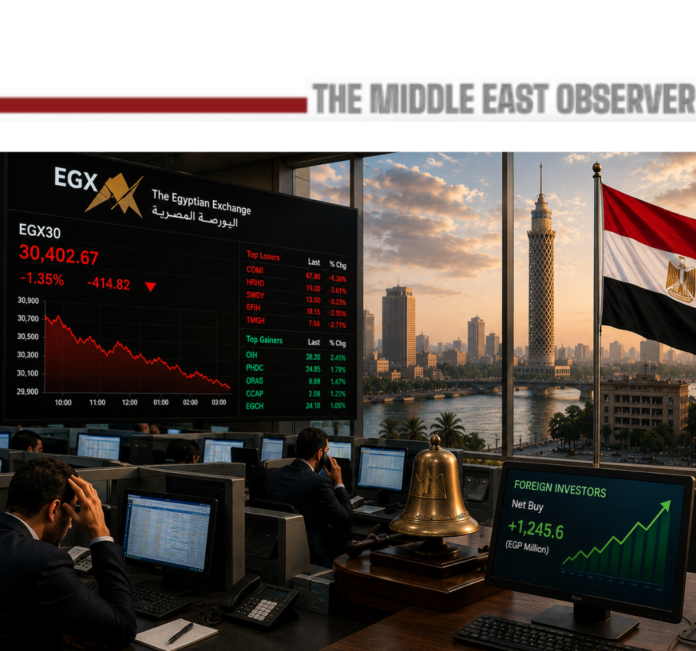
Cairo — Egyptian stocks ended the trading week on a weaker note on Thursday, extending the market’s recent correction despite continued buying by foreign and Arab investors, as domestic selling pressure weighed heavily on broader market performance.
The session reinforced a pattern that has emerged over recent days: international investors continue to selectively accumulate Egyptian assets, while local investors increasingly lock in gains following the market’s strong rally earlier this year.
While the benchmark index showed relative resilience compared with the broader market, the overall direction of trading remained negative. Small- and mid-cap shares extended their recent decline and total market capitalization continued to contract, indicating that investor caution remained widespread despite selective buying in several large-cap counters.
The divergence between the benchmark index and broader market indicators suggests investors increasingly concentrated activity in a narrower group of stocks while reducing exposure to more speculative segments of the market.
The benchmark EGX30 closed at 50,818.84 points, while the EGX70 index of small- and mid-cap stocks fell 1.44% to 14,986.99 points. The broader EGX100 declined 1.41% to 20,616.31 points, while the EGX33 Sharia Index dropped 1.69% and the EGX35-LV lost 1.52%.
Market capitalization declined further to approximately EGP 3.648 trillion, highlighting the extent of the recent pullback across Egyptian equities.
Foreign Investors Continue to Buy
The most important signal from Thursday’s session was the continued willingness of foreign and Arab investors to accumulate Egyptian equities despite persistent market weakness.
Non-Arab foreign investors recorded net purchases exceeding EGP 8.1 billion, while Arab investors added nearly EGP 2 billion. Egyptian investors, by contrast, were net sellers with transactions totaling more than EGP 10.1 billion, effectively providing much of the liquidity absorbed by overseas buyers.
The pattern suggests international investors continue to view recent market weakness as a buying opportunity, while domestic investors increasingly lock in gains following the strong rally witnessed earlier in the year.
The continued foreign buying comes against a backdrop of improving external liquidity conditions. Recent data showed Egypt’s foreign-exchange reserves reached a record $53.13 billion, while Kuwait renewed its $2 billion deposit at the Central Bank of Egypt. Foreign investors have also continued increasing exposure to Egyptian treasury bills, attracted by some of the highest real yields among major emerging markets.
Investors appear increasingly focused on Egypt’s improving external liquidity position and its ability to attract foreign capital despite regional uncertainty. Rising reserve buffers, continued support from Gulf partners and sustained foreign participation in local debt markets have helped reinforce confidence in the country’s medium-term financing outlook.
Combined with recent purchases of Egyptian treasury bills and improving sovereign-risk indicators, these developments suggest many international investors view Egypt’s external position as materially stronger than it was a year ago.
For institutional investors, the persistence of foreign inflows into both debt markets and selected equity positions suggests confidence in Egypt’s broader macroeconomic trajectory remains intact despite short-term volatility in stocks.
Divergence Between Large and Small Caps
A notable feature of Thursday’s session was the growing divergence between segments of the market.
While selected large-cap stocks demonstrated resilience, losses across the EGX70 and EGX100 indicate investors continued reducing exposure to smaller and more speculative stocks that had outperformed during recent rallies.
The trend suggests a shift toward selectivity, with investors increasingly favouring companies perceived as having stronger fundamentals, greater liquidity and more direct exposure to Egypt’s improving macroeconomic environment.
Financial and Industrial Shares Remain Active
Among the session’s top performers, KORRA rose 19.53%, while Tycoon Holding Company for Financial Investments gained 9.62%, extending a strong run that has made it one of the market’s standout performers this week. Arab Valves Company advanced 8.92%, reflecting continued interest in selected industrial names.
Tycoon’s continued advance is particularly noteworthy as investors increasingly position for a potentially more active capital-market environment supported by planned IPOs, state-ownership offerings and corporate restructuring initiatives expected over the coming year.
On the downside, Subscription Rights of Aspire Capital Holding for Financial Investments-3 fell 7.56%, while Creast Mark for Contracting and Real Estate Development lost 7.20%. Aspire Capital Holding for Financial Investments declined 6.91%, continuing a period of heightened volatility.
Capital-Market Expansion Remains the Bigger Story
Despite the market’s recent weakness, investors continue to focus on a broader set of structural developments that could reshape the Egyptian Exchange over the coming 12 to 18 months.
These include the planned listings of subsidiaries owned by Qalaa Holdings, the eventual offering of Banque du Caire, anticipated petroleum-sector flotations and a growing pipeline of private-sector issuers.
The expansion of Egypt’s IPO pipeline comes alongside continued government efforts to deepen capital markets, increase private-sector participation and broaden the range of investable companies available to institutional investors.
Recent announcements from Fawry, Talaat Moustafa Group and other major corporates have further reinforced expectations that Egyptian capital markets could enter their most active issuance cycle in years.
Market View
The key takeaway from Thursday’s session was not the market’s decline, but the continued willingness of foreign and Arab investors to accumulate Egyptian assets despite persistent domestic selling.
The divergence between foreign buying and local profit-taking suggests international investors remain focused on Egypt’s improving external position, stronger reserve buffers and ongoing capital-market reforms. At the same time, domestic investors appear to be reassessing valuations following the market’s strong performance earlier in the year.
The sustained foreign demand seen over recent sessions also complements continued purchases of Egyptian government debt, indicating investors remain broadly constructive on Egypt’s macroeconomic outlook even as they become more selective within equities.
For investors, the combination of rising foreign participation, an expanding IPO pipeline and improving external liquidity remains more significant than short-term fluctuations in stock prices. The continued willingness of overseas investors to add exposure while domestic investors take profits suggests confidence in Egypt’s medium-term outlook remains stronger than headline index performance implies.
If sustained, that trend could provide important support for Egypt’s capital-market expansion story, particularly as new listings, state-ownership offerings and private-sector transactions move closer to execution over the coming year.