
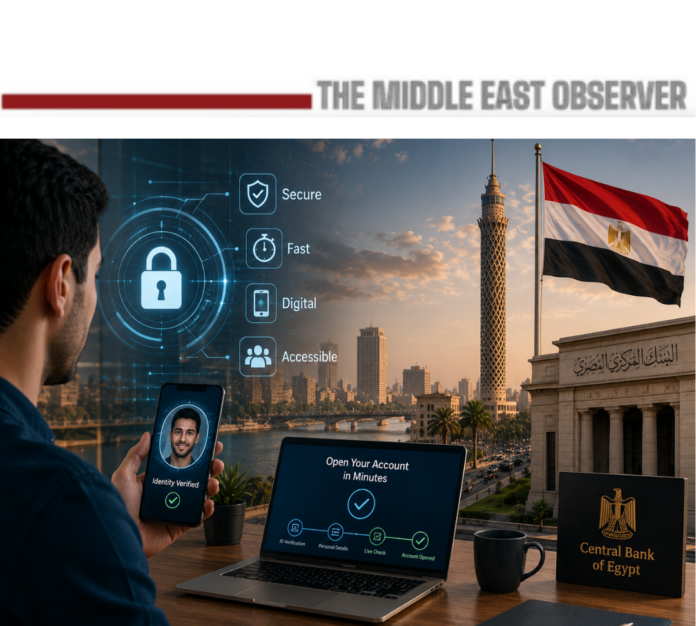
Financial inclusion is set to enter a new phase in Egypt after banks completed preparations to allow customers to open bank accounts remotely for the first time, a move that could fundamentally reshape customer acquisition, accelerate digital banking adoption and reduce reliance on traditional branch networks.
According to a central bank official cited by Asharq Business, the technical and operational infrastructure required to support remote account opening using electronic signatures has been completed, paving the way for implementation during the 2026-2027 fiscal year. Once launched, customers will be able to open bank accounts electronically without visiting a branch, marking one of the most significant changes to Egypt’s banking model in decades.
The move reflects a broader transformation underway across Egypt’s financial sector. While banks have progressively digitised payments, transfers and account management, onboarding new customers has remained one of the last major services requiring physical presence and paper-based verification.
From Digital Payments to Digital Onboarding
Egypt’s banking sector has undergone rapid digitalisation over the past five years, driven by regulatory reforms, mobile-wallet adoption, instant-payment systems and growing consumer acceptance of digital financial services.
The next frontier is digital onboarding. Industry specialists view remote account opening as one of the most effective tools for lowering customer-acquisition costs, reducing operational expenses and extending banking services to populations beyond major urban centres.
The timing is significant. Egypt’s financial-inclusion rate reached 77.6% by the end of 2025, equivalent to 54.7 million citizens holding active financial accounts. Yet approximately 15.8 million eligible Egyptians remain outside the formal financial system, highlighting the scale of the opportunity still available to banks and fintech providers.
Remote account opening directly addresses one of the traditional barriers to financial inclusion: the need for customers to physically visit branches and complete lengthy documentation procedures. By removing these obstacles, banks can expand their reach while significantly lowering the cost of acquiring new customers.
Digital Banks Intensify Competition
The initiative coincides with the emergence of Egypt’s digital-banking sector and an intensifying race to attract customers through technology rather than branch expansion.
The country’s largest private-sector lender, Commercial International Bank (CIB), recently announced plans to launch its digital bank “Yomo” during the final quarter of 2026. Meanwhile, One Bank, backed by Banque Misr, became the first institution to receive a digital-banking licence from the Central Bank of Egypt.
The shift suggests competition is moving beyond mobile applications and online payments toward a complete redesign of the customer journey. Increasingly, banks are competing on onboarding speed, digital lending, integrated payments, savings products and seamless customer experiences rather than the size of their branch networks.
This transition mirrors developments in regional markets including the UAE, Saudi Arabia and Bahrain, where digital onboarding has become a cornerstone of banking-sector modernisation and a catalyst for fintech growth.
Beyond Banking: Building Egypt’s Digital Economy
The significance of remote account opening extends beyond the banking sector itself.
A fully digital onboarding process creates the foundation for broader adoption of digital payments, e-commerce, embedded finance and fintech services. It also supports long-term efforts to integrate informal economic activity into the formal financial system while improving access to savings, credit and investment products.
Perhaps more importantly, remote account opening lays the groundwork for the next stage of financial-sector development: digital identity verification, open-banking ecosystems and increasingly personalised financial services delivered entirely through digital channels.
Historically, Egyptian banks expanded by opening new branches. Increasingly, future growth will depend on how effectively institutions can attract, verify and serve customers remotely. In that sense, remote account opening is more than a new banking service—it is a foundational building block for Egypt’s emerging digital financial architecture.
As competition between banks, fintech firms and digital lenders intensifies, the ability to onboard customers seamlessly may become as important as the products those institutions ultimately offer.
