
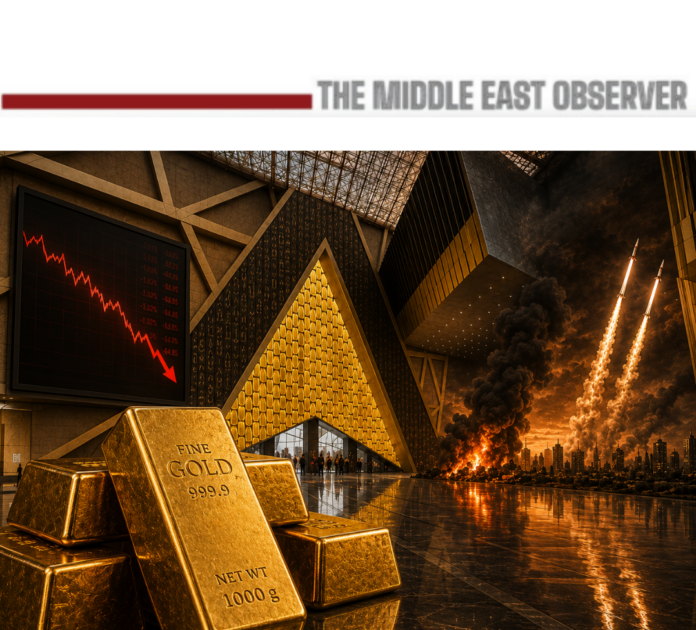
Gold extended its decline as Gold Price Retreats on Wednesday, falling below the $4,200-per-ounce threshold as renewed military exchanges between the United States and Iran unsettled financial markets and complicated expectations for inflation, interest rates and global trade.
Spot gold dropped as much as 2% to below $4,175 an ounce after losing 1.6% in the previous session, according to market data cited by Bloomberg. The decline came despite escalating geopolitical tensions following U.S. strikes on Iranian positions near the Strait of Hormuz in response to the reported downing of a U.S. military helicopter off the coast of Oman.
The latest developments have threatened efforts to preserve a fragile ceasefire and raised concerns about a prolonged disruption to shipping through the Strait of Hormuz, one of the world’s most strategically important energy corridors.
Despite the recent decline, gold remains near historically elevated levels. Even below $4,200 an ounce, bullion continues to trade far above levels seen before the conflict intensified earlier this year and remains one of the strongest-performing major asset classes over recent years, supported by geopolitical uncertainty, reserve diversification and persistent demand for safe-haven assets.
While geopolitical crises traditionally support demand for gold, investors are increasingly focused on the inflationary consequences of rising energy prices and the potential response from central banks.
Oil, Inflation and Interest Rates
The renewed confrontation triggered another rise in oil prices, with Brent crude briefly climbing above $93 per barrel before easing after Washington indicated that its retaliatory operation had concluded.
Higher oil prices have intensified concerns about inflation at a time when many central banks were hoping to move gradually toward looser monetary policy. Rising energy costs increase the likelihood that policymakers may maintain elevated interest rates for longer or delay anticipated rate cuts.
That dynamic has become a significant headwind for gold. Unlike bonds or interest-bearing deposits, bullion generates no income, making it less attractive when borrowing costs remain high.
The latest market reaction highlights an unusual dynamic. Traditionally, escalating geopolitical tensions boost demand for safe-haven assets such as gold. This time, however, investors appear more concerned about the inflationary impact of higher oil prices and the prospect of prolonged monetary tightening. As a result, fears of higher interest rates are outweighing the traditional war premium that would normally support bullion prices.
The market’s response suggests that investors are increasingly treating gold not only as a hedge against geopolitical risk, but also as an asset whose value is heavily influenced by the outlook for monetary policy.
Technical Pressures Accelerate Selling
The decline has also been amplified by technical factors.
Gold has recently fallen beneath its widely followed 200-day moving average, a key indicator used by institutional investors to assess long-term market momentum. The breach of this level triggered additional selling pressure from quantitative funds and momentum-driven investors.
Market analysts say the move encouraged further liquidation among investors seeking to protect gains accumulated during gold’s powerful rally earlier in the year.
Suki Cooper, Global Head of Commodities Research at Standard Chartered, warned that bullion could remain vulnerable in the short term if expectations for tighter monetary policy continue to build.
According to Cooper, additional exchange-traded fund holdings linked to gold may move into loss-making territory should prices continue to decline, increasing the risk of further selling across the market.
Analysts also identify the area around $4,100 an ounce as the next major technical support level, making upcoming geopolitical and monetary-policy developments particularly important for investors.
Asia Remains a Bright Spot
Despite weaker investor sentiment in some markets, physical demand trends remain mixed rather than uniformly negative.
India, traditionally one of the world’s largest gold consumers, has shown signs of softer demand amid elevated prices and changing consumer behavior. China, however, continues to provide support for the market.
Premiums in the Chinese domestic market have remained relatively stable, suggesting that demand from retail investors and institutional buyers continues to underpin consumption despite recent price volatility.
Analysts also point to continued central-bank purchases as a structural pillar supporting the gold market. Monetary authorities across several emerging economies have steadily increased gold holdings in recent years as part of broader efforts to diversify foreign-exchange reserves and reduce dependence on traditional reserve currencies.
The resilience of official-sector demand helps explain why gold has remained near record levels despite recent volatility. While short-term price movements are increasingly influenced by interest-rate expectations and technical trading, long-term support continues to come from central-bank accumulation, geopolitical uncertainty and concerns about the future trajectory of global debt and currencies.
Meanwhile, other precious metals also moved lower. Silver declined more than 2%, while platinum and palladium posted losses amid a stronger focus on interest-rate expectations and slowing industrial demand.
Hormuz Risks and Market Outlook
Beyond gold itself, investors remain focused on the wider economic implications of the conflict.
The Strait of Hormuz carries roughly one-fifth of globally traded oil supplies and remains a critical route for energy exports from Gulf producers to international markets. Any prolonged disruption could push energy prices higher, increase shipping and insurance costs and place additional pressure on inflation worldwide.
For policymakers, the challenge lies in balancing inflation risks against concerns about economic growth. For investors, the key question is whether geopolitical uncertainty or monetary policy will prove the dominant force in shaping asset prices during the months ahead.
Looking forward, gold’s trajectory is likely to depend less on battlefield developments alone and more on how those developments affect oil prices, inflation expectations and central-bank decisions. If energy markets remain volatile and interest rates stay elevated, bullion could face continued pressure despite ongoing geopolitical risks. Conversely, any easing of tensions or signs of future monetary-policy accommodation could help restore support for the precious metal.
In the current environment, gold is increasingly trading not simply as a safe haven, but as a barometer of how markets interpret the economic consequences of geopolitical conflict. The lesson from recent trading is that wars may still drive investors toward gold, but when they simultaneously fuel inflation and higher interest rates, the traditional relationship between crisis and bullion demand becomes far more complex.