
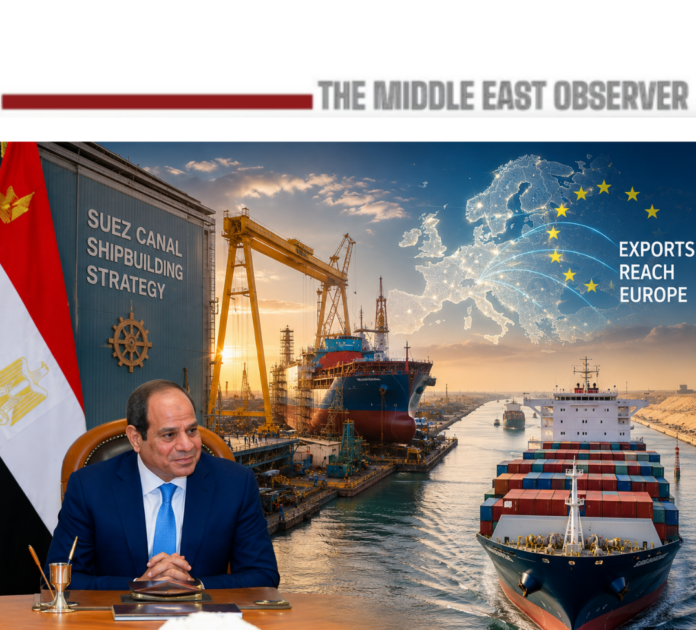
President Abdel Fattah El-Sisi has reinforced Egypt’s ambition to transform the Suez Canal Authority (SCA) from a global waterway operator into a regional maritime manufacturing and export hub, as the Authority secured its first exports of locally built tug boats to Europe while reporting a recovery in canal traffic and revenues during fiscal year 2025/26.
During a meeting with SCA Chairman Admiral Osama Rabie and South Red Sea Shipyard Company Chairman Mostafa El-Dougishy, President El-Sisi reviewed navigation performance, maritime industrial projects and plans to expand domestic shipbuilding. He directed continued efforts to localise the manufacture of marine vessels and equipment, deepen private-sector partnerships, adhere to international quality and safety standards, and strengthen technical workforce training to support both domestic demand and export markets.
Egypt’s Maritime Manufacturing Push Gains Export Momentum
The meeting highlighted what has become the SCA’s most significant strategic shift in recent years: expanding beyond canal transit services into high-value maritime manufacturing. Rabie announced that Egypt has exported four locally manufactured tugboats to Italy’s Neri Group, marking the country’s first entry into the European tugboat market. Contracts have also been signed to export two additional tugboats and a custom-built yacht, reflecting growing international confidence in Egypt’s shipbuilding capabilities.
The export breakthrough forms part of a broader industrial programme centred on the South Red Sea Shipyard Company, which has produced 16 tugboats over the past two and a half years. Ten vessels have been delivered to the SCA, while exports are beginning to position Egypt as an emerging supplier of specialised marine vessels beyond its domestic market.
President El-Sisi also reviewed progress on two fibreglass manufacturing facilities established under the Suez Canal Company for Modern Boats, a joint venture between the SCA and the South Red Sea Shipyard Company. Production is under way on three tourist launches designed to support both maritime and Nile tourism, while work continues on a new generation of passenger river buses for Cairo Governorate.
The meeting further assessed implementation of the first phase of the REZK programme, involving the construction of twelve technologically advanced deep-sea fishing vessels. Rabie said the initiative forms part of a broader presidential directive to develop a fleet of 100 fishing vessels ranging between 25 and 50 metres, supporting Egypt’s fishing industry while expanding the country’s marine engineering capabilities.
Construction also continues on the Azm-class 90-ton bollard-pull tugboats, among the most powerful vessels produced locally. President El-Sisi instructed that all projects comply with the highest international quality standards, established delivery schedules and occupational safety requirements, underlining the government’s objective of establishing internationally competitive shipbuilding capabilities.
Canal Traffic Recovery Supports Diversification Strategy
Alongside the industrial expansion, the Suez Canal’s core navigation business is showing signs of recovery following months of disruption caused by attacks on commercial shipping in the Red Sea. According to Admiral Rabie, canal revenues rose approximately 23% year-on-year to US$4.67 billion during fiscal year 2025/26, while vessel transits increased by around 10% and cargo volumes climbed 22%. Although traffic remains below pre-crisis levels, the figures indicate a gradual return of shipping activity as regional security conditions improve.
Rabie attributed part of the recovery to easing geopolitical tensions and the gradual return of vessels to the Red Sea route as war-risk insurance costs moderated. Nevertheless, major international shipping lines continue to assess regional security conditions before fully restoring pre-crisis schedules, indicating that the canal’s recovery remains a gradual process rather than a complete rebound.
The Authority is simultaneously broadening its commercial activities beyond transit services. It recently added the Fakhr 1 marine survey vessel to support geological investigations, offshore engineering and petroleum services, while signing agreements with Cairo Governorate to manufacture five river buses and four tourist launches. These projects complement the Authority’s expanding portfolio in marine engineering, shipbuilding, vessel maintenance and inland water transport.
The strategy mirrors a broader trend among leading global maritime hubs. From Singapore and Rotterdam to Dubai, major port and canal operators have diversified beyond transit revenues into shipbuilding, repair, marine engineering, logistics and specialised maritime services to create more resilient and higher-value income streams. Egypt’s latest initiatives suggest the SCA is pursuing a similar model, leveraging the country’s strategic location to build an integrated maritime industrial ecosystem.
From Canal Operator to Maritime Industrial Hub
The diversification strategy reflects a broader effort to reduce dependence on transit fees alone. The Suez Canal remains one of Egypt’s largest sources of foreign currency alongside tourism, workers’ remittances and merchandise exports. By expanding into shipbuilding, specialised marine services and vessel exports, the Authority is creating new industrial revenue streams capable of generating higher value-added manufacturing, technology transfer and skilled employment.
The recovery in canal traffic provides immediate support for Egypt’s external accounts, but the government’s longer-term objective extends well beyond restoring shipping volumes. Through sustained investment in maritime manufacturing, engineering and export-oriented production, Cairo is repositioning the Suez Canal Authority as a diversified maritime industrial group rather than solely a global shipping corridor.
If successfully implemented, the strategy could strengthen Egypt’s position as a regional centre for shipbuilding, marine engineering and specialised vessel exports, broaden its manufacturing base and reinforce the SCA’s role as a strategic contributor to national industrial development. The Authority’s first tugboat exports to Europe therefore represent more than a commercial milestone—they signal the emergence of a broader industrial strategy aimed at converting one of the world’s most important waterways into a competitive maritime manufacturing platform with growing international reach.
Related news:
Egypt develops an integrated maritime framework to expand regional trade role
The Asymmetry Paradigm : Redefining Military Power in the Iran Conflict
Read also:
Egypt–Russia Maritime Deal Signals Strategic Shift Toward Integrated Logistics Power
Aydhab: Egypt’s Lost Red Sea City of Pilgrims, Gold, Porcelain and Forgotten Empires