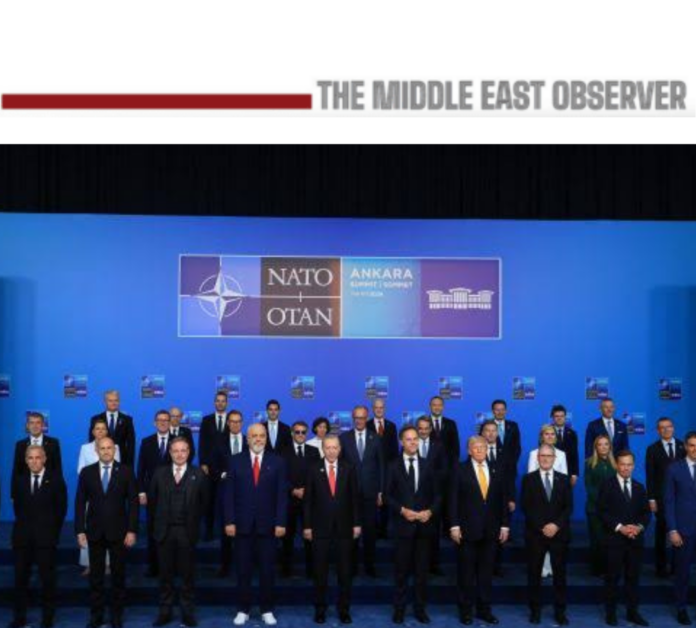
NATO leaders concluded their two-day summit in Ankara with a comprehensive package of decisions aimed at reinforcing collective defence, expanding military capabilities, sustaining long-term support for Ukraine and adapting the Alliance to an increasingly complex security environment stretching from Eastern Europe to the Middle East.
Hosted by Turkey at a time of heightened geopolitical uncertainty, the gathering brought together leaders of the Alliance’s 32 member states to assess evolving security challenges, coordinate defence planning and reaffirm NATO’s strategic unity amid Russia’s continuing war in Ukraine, persistent instability across the Middle East and the rapid transformation of modern warfare through emerging technologies.
The summit reflected a broad consensus that the Alliance must move beyond political declarations towards accelerating defence production, strengthening military readiness and enhancing resilience across the Euro-Atlantic region.
The most significant outcome was the unanimous reaffirmation of NATO’s commitment to collective defence under Article 5 of the North Atlantic Treaty, with Allied leaders describing the principle as the Alliance’s “ironclad” foundation. The declaration reaffirmed that an armed attack against one member remains an attack against all, sending a clear strategic signal of unity and deterrence at a time of increasing global security uncertainty.
Alongside this political commitment, leaders endorsed continued military assistance for Ukraine, announcing approximately €70 billion in support for 2026 while expressing their intention to sustain comparable levels of assistance in the years ahead. The package includes military equipment, training, ammunition and support for Ukraine’s defence industrial base, reflecting NATO’s assessment that Ukraine’s security remains integral to Euro-Atlantic stability.
The summit also marked a significant shift towards expanding NATO’s industrial capacity. Allied governments committed to increasing joint procurement, accelerating defence manufacturing and strengthening transatlantic defence supply chains to ensure that production capacity keeps pace with evolving operational requirements. NATO officials said new procurement initiatives worth more than US$50 billion would support this effort, while encouraging closer cooperation between governments and industry to reduce production bottlenecks and improve interoperability.
Recognising the changing nature of warfare, NATO announced new initiatives to accelerate investment in autonomous systems, artificial intelligence, integrated air and missile defence, advanced intelligence capabilities and precision-strike technologies. Secretary General Mark Rutte also presented the Alliance’s Drone Edge initiative, aimed at expanding NATO’s collective capabilities in uncrewed systems over the coming years as drones increasingly redefine both conventional and hybrid warfare.
Military mobility and logistics formed another major pillar of the summit. NATO announced plans to modernise strategic fuel storage and transportation infrastructure, including upgrades to pipeline networks supporting the Alliance’s eastern flank, recognising that resilient logistics have become as critical to deterrence as combat capabilities themselves.
The Alliance further broadened its strategic focus beyond Europe by addressing developments across the Middle East. Leaders reiterated that Iran must never acquire a nuclear weapon while emphasising the importance of safeguarding freedom of navigation through critical maritime routes, particularly the Strait of Hormuz, whose security remains vital to global energy markets and international trade.
Security cooperation in the Black Sea also featured prominently. Turkey, Romania and Bulgaria agreed to deepen coordination in protecting critical maritime infrastructure, including ports, subsea cables, energy facilities and shipping routes against conventional, hybrid and cyber threats, reflecting growing concern over the vulnerability of strategic infrastructure.
As summit host, President Recep Tayyip Erdoğan used the meeting to advocate deeper defence-industrial cooperation among Allies, calling for the removal of restrictions affecting defence trade within NATO and urging greater integration of Turkey into Europe’s evolving defence architecture. Ankara also reaffirmed its commitment to increasing defence investment while continuing to expand indigenous capabilities in missile defence, aerospace technologies and advanced military systems.
Beyond its immediate policy decisions, the choice of Ankara as summit host underscored Turkey’s growing geopolitical significance within the Alliance. Positioned at the crossroads of Europe, Asia and the Middle East and controlling access between the Mediterranean and the Black Sea through the Turkish Straits, Turkey occupies one of NATO’s most strategically important locations. It serves as a critical bridge linking the Alliance’s European, Black Sea and Middle Eastern security priorities while maintaining NATO’s second-largest armed forces.
Strategically, the summit demonstrated NATO’s evolution from a predominantly territorial defence alliance into a broader security organisation addressing conventional warfare, cyber threats, critical infrastructure protection, technological competition, supply-chain resilience and maritime security. The emphasis on defence industrial capacity, innovation and resilience reflected recognition that future strategic competition will depend as much on sustained industrial output and technological superiority as on military force itself.
The Ankara Summit ultimately reinforced the Alliance’s enduring principle that collective security remains indivisible. Yet the long-term effectiveness of NATO’s southern flank will depend not only on defence spending and military capabilities but also on sustained political cohesion among its members. In this regard, continued efforts to strengthen dialogue and practical cooperation between Turkey and Greece represent an important strategic opportunity. As neighbouring Allies occupying pivotal positions in the Eastern Mediterranean, improved bilateral relations can enhance maritime security, facilitate regional energy cooperation, strengthen NATO-EU coordination and reduce tensions along one of the Alliance’s most strategically sensitive frontiers. A stable and cooperative relationship between Ankara and Athens would reinforce NATO’s southeastern flank while contributing to wider regional prosperity, connectivity and long-term Euro-Atlantic security.
The Ankara Summit therefore concluded not only with renewed commitments to deterrence and defence, but also with a broader recognition that enduring security is achieved through a combination of military strength, technological innovation, resilient alliances and sustained diplomatic engagement among partners sharing common strategic interests.
Related news:
Egypt, Saudi Arabia, Turkey & Pakistan Signal Push for New Regional Security Framework
How Egyptian Companies Can Compete for a Share of Horizon Europe’s €14bn Innovation Programme
Read also:
Egyptian Drilling Company Secures $80m Contract in Turkey
Trade Barriers Are Rising—How Can Egypt Future-Proof Its Export Growth?