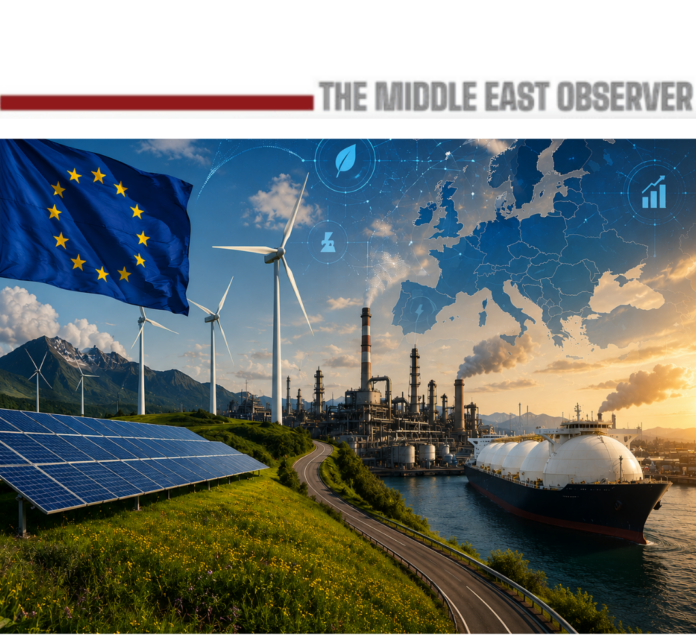
Europe’s energy transition has moved beyond the emergency replacement of Russian gas into one of the largest geopolitical and industrial restructurings attempted by the European Union since the end of the Cold War. The continent is no longer asking only how to replace Russian hydrocarbons, but how to build an energy system that is secure, affordable, decarbonised and sufficiently independent to protect Europe’s industrial base in a more fragmented global economy.
Before Russia’s invasion of Ukraine, Moscow supplied a major share of Europe’s gas needs, giving European industry access to large pipeline volumes that were often cheaper and more predictable than globally traded LNG. Since 2022, Russian pipeline flows have collapsed and the EU has moved toward a formal phase-out of Russian fossil-fuel imports. This forced Europe to redesign its supply architecture around Norwegian pipeline gas, US LNG, Algerian pipeline and LNG supplies, Qatari LNG, Azerbaijani gas through the Southern Gas Corridor and expanded LNG terminals. The shift reduced Moscow’s leverage, but it did not eliminate Europe’s exposure to external energy shocks.
The United States has become Europe’s dominant LNG supplier, helping stabilise supply after the Russian shock while creating concern over a new form of dependency. This dependence is politically different from reliance on Russia, but it still exposes Europe to global LNG prices, US export policy, Asian demand competition, shipping costs and maritime disruption. European regulators have repeatedly warned that energy security cannot rest on overreliance on any single supplier, route or technology.
Other suppliers strengthen Europe’s position but cannot fully replace the strategic depth once provided by Russian pipeline gas. Norway is Europe’s most reliable large-scale gas partner, yet its mature fields limit major long-term expansion. Algeria has regained importance through the TransMed pipeline to Italy, Medgaz to Spain and Mediterranean LNG shipments. This has quietly restored North Africa’s strategic relevance within Europe’s energy-security calculations, particularly for Southern Europe, where geography, pipelines and Mediterranean proximity matter. Yet Algeria also faces rising domestic consumption, infrastructure needs and limited export scalability. Qatar remains a major LNG supplier with future expansion potential, but its exports are exposed to the Strait of Hormuz. Azerbaijan provides useful diversification, although its capacity remains modest relative to Europe’s total demand.
This is why renewable energy has become a security strategy as much as a climate policy. The revised EU Renewable Energy Directive sets a binding target of at least 42.5% renewables in gross final energy consumption by 2030, with an ambition to reach 45%. However, the challenge is not merely generating more clean electricity. Europe must decarbonise transport, buildings, heating, industry, chemicals, steel, fertilisers, shipping and aviation — sectors where fossil fuels remain deeply embedded.
The electricity sector is moving fastest, but it remains only one part of the system. Wind, solar, hydro and nuclear are reshaping Europe’s power mix, while electrification is expected to carry a growing share of final energy demand. Yet renewable expansion cannot succeed without grids capable of absorbing decentralised generation, balancing cross-border flows and supporting electric vehicles, heat pumps, storage and industrial demand. The European Commission estimates that around €584 billion in grid investment is needed by 2030, illustrating that Europe’s transition is as much an infrastructure challenge as a generation challenge.
Industrial competitiveness is now the central pressure point. Europe cannot claim a successful transition if high energy prices push energy-intensive industries abroad while the continent imports the same products from lower-cost jurisdictions. The transition must therefore deliver affordable clean power, not only cleaner power. Otherwise, Europe risks reducing domestic emissions while weakening its manufacturing base and increasing external dependence on industrial imports, technologies and raw materials.
Nuclear power is re-entering the European debate in this context, not as a replacement for renewables, but as a stabilising low-carbon pillar where politically accepted. France and several Central and Eastern European states increasingly view nuclear generation as essential for balancing intermittent renewables and preserving industrial baseload supply. The practical European model is therefore unlikely to be purely renewable in the narrow sense. It is more likely to combine renewables, nuclear, grids, batteries, hydrogen, demand management and limited backup fuels.
Hydrogen is becoming part of this long-term architecture, particularly for hard-to-electrify sectors such as steel, chemicals, fertilisers, heavy transport and shipping. The EU’s REPowerEU strategy set the ambition of producing 10 million tonnes and importing 10 million tonnes of renewable hydrogen by 2030, while the European Commission sees renewable hydrogen covering around 10% of EU energy needs by 2050. This creates a future role for Mediterranean and North African partnerships, including potential hydrogen corridors linking North Africa and Southern Europe. The Italy-Germany-Austria cooperation on a southern hydrogen link reflects this direction, with the planned corridor intended to move renewable hydrogen from the southern Mediterranean toward industrial demand centres in Central Europe.
Yet hydrogen also illustrates the difficulty of Europe’s transition. It requires cheap renewable electricity, electrolysers, storage, ports, pipelines, certification systems and long-term offtake contracts. North Africa may become strategically important in this field, but hydrogen imports will depend on cost competitiveness, infrastructure readiness, water availability, political stability and whether exporting countries can balance domestic development needs with European demand.
Europe also faces a second dependency risk: the clean-energy supply chain. Moving away from Russian hydrocarbons could increase reliance on imported solar panels, batteries, rare earths, lithium, cobalt, nickel and refining capacity. The Council of the EU notes that China supplies all of the EU’s heavy rare earth elements, underlining how the energy transition can shift dependency from fuel suppliers to technology and mineral suppliers. For Europe, true energy sovereignty therefore requires not only wind farms and solar parks, but also mining partnerships, recycling, domestic manufacturing, battery production, critical-minerals processing and clean-tech industrial policy.
The realistic timetable is staged rather than immediate. Europe may achieve renewable-dominant electricity between 2035 and 2045, while deeper industrial electrification, large-scale hydrogen integration and major reductions in gas demand are more likely to extend toward 2050. Complete domestic renewable self-sufficiency is unlikely, because modern economies remain connected to global flows of technology, minerals, fuels and industrial materials. What is achievable is a strategically resilient low-carbon system that reduces dangerous dependencies, diversifies external partnerships and lowers the role of imported fossil fuels.
As The Middle East Observer observes, Europe’s post-Russian energy transition is not simply an environmental project; it is a test of strategic autonomy. Its success will depend on whether Europe can secure affordable power, preserve industrial competitiveness, modernise infrastructure, reduce exposure to new external dependencies and build a renewable-led system capable of sustaining economic strength. The ultimate question is whether Europe remains an industrial power in the emerging global energy order — or gradually becomes dependent on external suppliers not only for energy, but also for the technologies intended to replace it.