
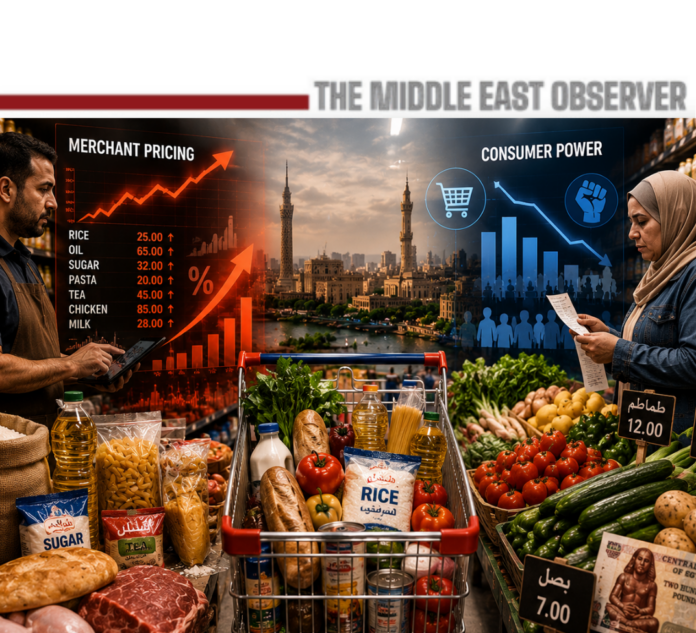
Egypt’s consumer markets are witnessing a growing confrontation between rising prices and increasingly organized consumer resistance. As households struggle with persistent inflation and declining purchasing power, boycott campaigns have emerged as an unconventional market force, challenging merchants whose pricing practices many consumers believe are unjustified.
While it remains too early to judge whether these campaigns will deliver lasting results, their initial impact suggests that collective consumer action can influence pricing behaviour, particularly in markets where demand is highly sensitive to household budgets.
Early evidence indicates that several boycott campaigns have coincided with noticeable price declines in products including eggs, poultry, fish and a range of fruit and vegetables. Encouraged by these outcomes, organisers are expanding their efforts, urging consumers to avoid products they consider overpriced until prices return to what they regard as reasonable levels.
Consumer Boycotts as a Pricing Mechanism
Unlike government intervention or formal price controls, these campaigns rely entirely on market behaviour. Organised largely through social media, consumers collectively agree to suspend purchases of selected products for limited periods, reducing demand and increasing pressure on retailers to reconsider their pricing strategies.
Recent campaigns targeting fish markets have spread rapidly across several governorates, including Port Said, Alexandria, Suez, Ismailia, Sharqia, Beni Suef, Dakahlia, Gharbia and Qalyubia. Organisers claim the coordinated action prompted some merchants to lower prices, although the extent to which the reductions resulted directly from the boycotts, rather than broader market dynamics, remains difficult to quantify.
Similar campaigns have since expanded to poultry and other food products experiencing sharp price increases, reflecting growing consumer willingness to use purchasing decisions as leverage in the marketplace.
In Cairo, the Citizens Against High Prices association announced its support for the nationwide fish boycott, encouraging residents to temporarily suspend purchases as a means of protesting what it described as excessive pricing by some traders.
Inflation Continues to Pressure Household Budgets
The emergence of these campaigns reflects broader economic pressures rather than isolated disputes over individual products.
Egypt continues to navigate a challenging economic environment characterised by elevated inflation, higher production costs and currency-related pressures that have affected the prices of many essential goods. Although inflation has moderated significantly from the record levels recorded during 2023 and 2024, household purchasing power remains under strain.
According to official data, annual urban inflation eased slightly to 14.6% in May 2026, compared with 14.9% in April, indicating that price pressures remain persistent despite gradual improvement.
The government has introduced a series of measures aimed at stabilising markets, including facilitating the release of imported goods from ports, improving the availability of foreign currency for essential imports and coordinating with manufacturers and retailers to expand supplies and moderate price increases.
Nevertheless, consumers continue to judge market conditions primarily through their day-to-day purchasing experience rather than macroeconomic indicators.
Can Consumer Activism Deliver Lasting Change?
The longer-term effectiveness of boycott campaigns remains uncertain.
While temporary reductions in demand can pressure merchants to lower prices, sustainable price stability ultimately depends on broader economic fundamentals, including supply conditions, production costs, exchange-rate stability and competition within domestic markets.
Where genuine shortages or higher input costs exist, price reductions may prove temporary. Conversely, in markets where pricing has become disconnected from underlying costs, organised consumer action may encourage stronger competition and more disciplined pricing behaviour.
The growing popularity of these campaigns nevertheless reflects an important shift in market dynamics. Consumers are increasingly recognising that purchasing decisions themselves represent a form of economic influence.
Ultimately, the outcome will not be determined solely by merchants or consumers, but by the interaction between market competition, inflation, government policy and consumer confidence. As Egypt’s economy continues its adjustment, the balance of power in the marketplace may increasingly depend on whether buyers remain willing to vote with their wallets.
Related news:
Fitch Sees Brent at $70 as Hormuz Reopening Reshapes Oil Outlook
Egypt Targets Tourism Market Share with $60m Global Campaign
Read also:
Rolls-Royce Bets on Egypt as Gateway to North Africa’s Emerging Luxury Market
The Harborne-Farage Gift vs Immigration: Which Debate Will Shape the West’s Future?