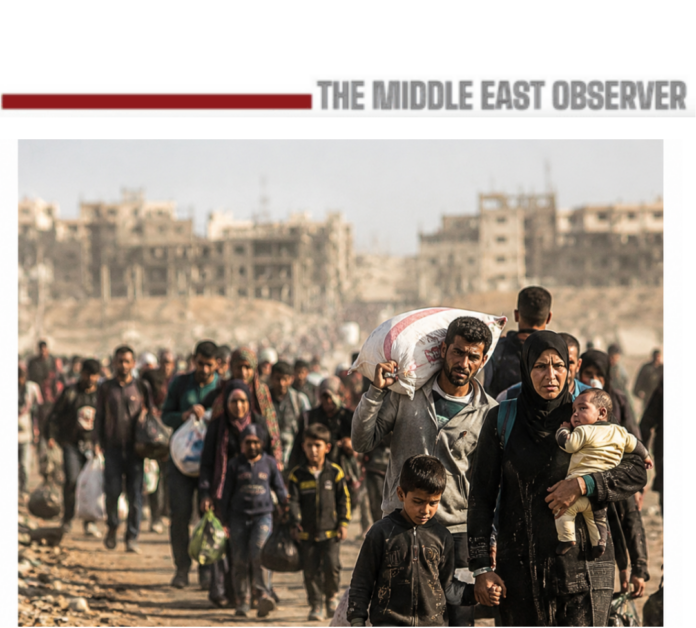
The refugee issue in Egypt has increasingly become one of the country’s most sensitive and complex socio-economic challenges, amid growing public debate over mounting pressures on infrastructure, public services, employment opportunities, and living standards. Almost daily, Egyptian social media platforms witness intense discussions surrounding the refugee situation, reflecting rising frustration among segments of citizens already burdened by difficult economic conditions, inflationary pressures, and declining purchasing power.
According to the latest official data issued by the United Nations High Commissioner for Refugees (UNHCR), the number of registered refugees and asylum seekers in Egypt has surpassed 1.13 million individuals representing more than 60 nationalities. Meanwhile, broader governmental and international estimates indicate that the total number of migrants, residents, and foreign nationals living in Egypt exceeds 9 million people from approximately 133 countries, including refugees, asylum seekers, expatriates, and other migrant communities.
Sudanese and Syrian nationals constitute the largest refugee groups in Egypt, with Sudanese refugees representing the overwhelming majority following the outbreak of conflict in Sudan in April 2023. Syrians remain the second-largest refugee community, alongside growing populations from South Sudan, Eritrea, Ethiopia, Yemen, Somalia, and Iraq.
The UNHCR has operated in Egypt since 1954 under a memorandum of understanding signed with the Egyptian government. Over the decades, the agency has overseen refugee registration, documentation, refugee status determination, protection services, and resettlement efforts for forcibly displaced persons. Following the eruption of war in Sudan, the UNHCR significantly expanded its operations in coordination with Egyptian authorities and humanitarian partners to support the rapidly increasing number of displaced individuals arriving in the country. The agency currently maintains operations across Cairo, Alexandria, and several governorates, providing humanitarian assistance, healthcare support, educational integration programs, and community-based initiatives aimed at supporting both refugees and host communities.
Egypt has also remained a major destination for Syrian refugees since the outbreak of the Syrian conflict in 2011 and the subsequent refugee influx beginning in 2012. The number of Syrians registered with the UNHCR in Egypt rose sharply from approximately 12,800 at the end of 2012 to more than 147,000 by the end of 2014, representing diverse social, economic, and religious backgrounds. Combined with the Sudanese crisis and continued instability across parts of East Africa and the Middle East, Egypt today hosts the largest number of registered refugees and asylum seekers in its modern history.
Continuing political instability and armed conflicts across Sudan, South Sudan, the Horn of Africa, Iraq, and Yemen have further accelerated refugee flows toward Egypt. As of March 31, 2025, UNHCR figures showed that Egypt hosted approximately 672,930 registered refugees from Sudan, 139,384 from Syria, 46,975 from South Sudan, 40,848 from Eritrea, 18,068 from Ethiopia, 8,400 from Somalia, 8,255 from Yemen, and 4,239 from Iraq, in addition to refugees from more than 53 other nationalities.
Most refugees and asylum seekers in Egypt reside within urban communities rather than camps, with significant concentrations across Greater Cairo, Alexandria, Sharqia, Damietta, North Coast cities, and areas surrounding the Suez Canal corridor. However, Egypt’s prolonged economic difficulties in recent years have intensified pressures on both refugees and host communities alike. Annual inflation rates, rising living costs, currency pressures, and increasing demand for housing, healthcare, transportation, and education services have significantly strained already burdened public infrastructure and household budgets. Many refugees continue to struggle to secure stable sources of income or adequately meet basic living requirements.
Egyptian officials have repeatedly emphasized that the country continues to shoulder substantial economic and infrastructure costs associated with hosting millions of foreign nationals amid difficult domestic economic conditions and limited international burden-sharing. Authorities frequently point to mounting pressures on subsidized services, public schools, hospitals, transportation networks, and housing markets, arguing that the scale of displacement flows now exceeds the capacity of many developing economies to absorb without broader international support.
Additional challenges persist in relation to access to sustainable employment opportunities, education, healthcare services, and social integration, particularly for non-Arabic-speaking communities. A considerable number of refugees continue to rely heavily on humanitarian assistance to secure food, healthcare, psychological support, and housing assistance amid worsening economic realities.
At the legal and policy level, the refugee issue has also generated growing international scrutiny. In a report issued in October 2025, several UN Special Rapporteurs expressed concern that Egypt’s new asylum law, enacted in 2024, could conflict with certain international obligations. The report warned that some provisions may create what it described as a “legal vacuum” potentially exposing asylum seekers to detention or deportation under broadly interpreted national security and public order provisions.
Simultaneously, the “Refugee Platform in Egypt,” an independent human rights initiative, documented what it described as thousands of cases involving mass arrests, arbitrary detention, deportation campaigns, and the withdrawal of protection status from some registered refugees over the past three years. According to the platform, approximately 10 per cent of deported Sudanese nationals possessed Egyptian residency permits, while others were reportedly awaiting residency approvals while holding UNHCR-issued documentation commonly referred to as the “yellow card.”
In a subsequent move, Egyptian authorities extended the deadline for regularizing the status of foreigners residing illegally in the country until September 30, 2026. The regulations require individuals to secure an Egyptian sponsor and pay fees amounting to $1,000, while refugees officially registered with the UNHCR remain exempt from these requirements during residency renewal procedures.
The refugee challenge in Egypt therefore reflects a highly delicate balancing act between humanitarian commitments, national security considerations, economic realities, and social stability. While Egypt continues to shoulder one of the region’s largest refugee burdens amid prolonged regional instability, the growing scale of displacement flows increasingly raises difficult questions regarding sustainability, infrastructure capacity, labour-market absorption, and the long-term socio-economic implications for both refugees and Egyptian citizens alike.
Regional conflicts and economic instability across parts of Africa and the Middle East continue to reshape migration patterns at an unprecedented pace, placing Egypt on the frontline of one of the region’s most complex humanitarian and socio-economic challenges. Addressing this issue sustainably may ultimately require broader international burden-sharing mechanisms, stronger economic support frameworks, and carefully balanced domestic policy recalibrations capable of preserving both humanitarian obligations and long-term social stability simultaneously.