
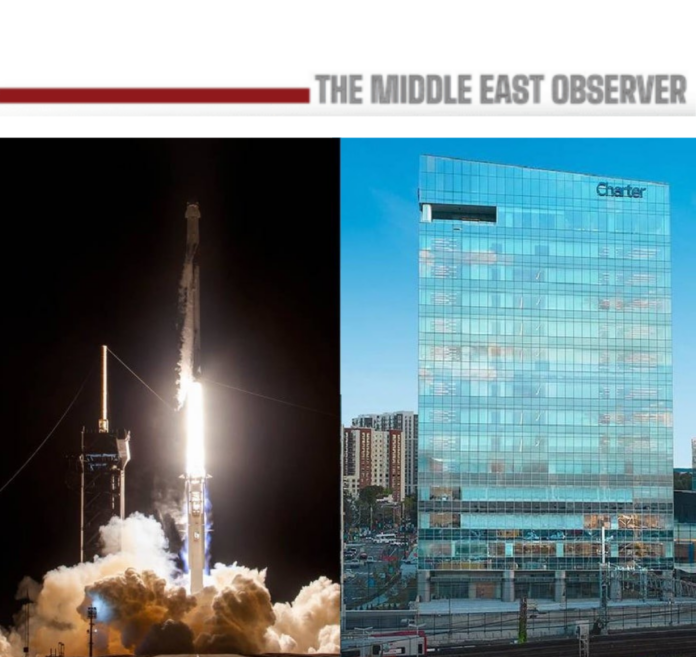
The reported discussions between SpaceX and Charter Communications over a potential mobile partnership may prove more important than the agreement itself. If successful, they could signal the next structural shift in telecommunications, where satellite and terrestrial networks evolve from competing technologies into a single integrated communications platform.
For decades, telecom operators expanded by building more fibre, cell towers and spectrum assets, while satellites served remote markets beyond the reach of conventional infrastructure. That distinction is beginning to fade as three technological advances converge: reusable rockets have sharply reduced launch costs, low-Earth-orbit satellite constellations have improved performance, and artificial intelligence can now manage traffic dynamically across multiple networks in real time.
The model reportedly under discussion would combine Charter’s terrestrial broadband infrastructure with SpaceX’s Starlink satellite network, allowing communications to move seamlessly between ground and orbital systems. Rather than replacing existing mobile networks, satellite connectivity would complement them, extending coverage where terrestrial infrastructure is unavailable, uneconomic or temporarily disrupted.
The implications extend beyond broader coverage. Consumers could eventually experience uninterrupted connectivity as devices automatically switch between fibre, Wi-Fi, cellular and satellite networks without user intervention. For businesses, governments and emergency services, hybrid architecture promises greater network resilience and more reliable communications across remote or disaster-affected areas.
The economic impact could be equally significant. The global telecommunications industry generates more than $2 trillion in annual revenue while investing heavily in network expansion. Hybrid infrastructure could improve capital efficiency by reducing the need for duplicate terrestrial assets in low-density regions, allowing operators to expand coverage at lower long-term cost. Those efficiencies could eventually translate into more competitive pricing through integrated broadband, mobile and satellite service bundles.
Artificial intelligence is likely to become the key differentiator. Instead of relying on fixed network routing, AI will increasingly determine the most efficient path for every data session based on congestion, latency and signal quality, transforming connectivity into a software-managed service rather than a collection of separate networks.
Although the SpaceX-Charter discussions remain preliminary, they reflect a broader strategic direction already emerging across the industry. Satellite connectivity is evolving from a specialist backup technology into an integrated layer of mainstream telecommunications infrastructure.
For investors, the significance extends well beyond a single partnership. If the hybrid model proves commercially successful, it is likely to accelerate similar alliances across the industry as telecom operators, broadband providers and satellite companies seek to remain competitive. Companies that continue to rely solely on traditional network models could face growing pressure from rivals offering broader coverage, greater resilience and lower infrastructure costs.
Whether or not the proposed partnership proceeds, the talks may already have achieved something more important: signalling that the next era of telecommunications will be defined not by competing networks, but by their intelligent integration. For the global telecom industry, that may be the clearest indication yet that the next competitive race has already begun.
Related news:
SpaceX Launches Classified NRO Mission as Washington Accelerates Orbital Intelligence Expansion
SpaceX Starship Set for 2026 Mars Mission with Tesla Robot
Read also:
Egypt’s World Cup Awakening: Why One Victory Means Far More Than Three Points
Zhejiang Hongda Textile Manufacturing Invests $20m in Egypt’s Growing Textile Export Hub
