
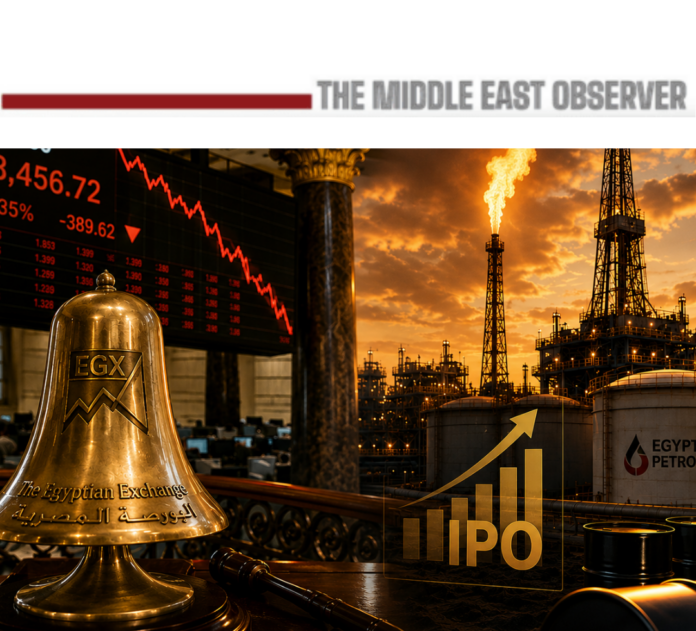
Cairo — Egyptian equities opened the new trading week with broad-based losses as foreign and Arab investors turned net sellers amid weaker regional sentiment and continued pressure on blue-chip stocks. Yet beneath the market’s sharp decline, the Egyptian government accelerated one of its most ambitious capital-market programmes in years, expanding the pipeline of petroleum-sector listings and reinforcing a broader strategy to deepen the country’s equity market.
The benchmark EGX30 fell 2.14% to 50,344.37 points, marking its weakest close in several weeks and extending the correction that gathered pace during the previous week. The EGX33 Shariah Index declined 2.48% to 5,571.32 points, while the EGX35-LV lost 2.94% to 5,787.38 points. Selling spread across the broader market, with the EGX70 falling 2.85% to 15,069.87 points and the EGX100 retreating 2.74% to 20,615.24 points.
Market capitalisation declined to EGP 3.609 trillion, representing a fall of approximately EGP 83 billion from the previous Thursday’s close of EGP 3.692 trillion. The EGX30 also lost around 2.1% over the same period, illustrating that the market remained in a consolidation phase after the volatility that followed recent tax reforms and weaker institutional liquidity.
Foreign Selling Interrupts the Previous Week’s Pattern
Unlike the previous week, when overseas investors consistently absorbed domestic selling, Sunday’s session witnessed a reversal in investor positioning.
Egyptian investors were modest net buyers with purchases of approximately EGP 134.6 million, while Arab and non-Arab foreign investors recorded net sales of around EGP 56.7 million and EGP 77.9 million, respectively.
Although the selling pressure was relatively limited in value, its concentration in large-cap stocks contributed disproportionately to the decline in the benchmark index, underlining the continued sensitivity of blue-chip shares to institutional portfolio adjustments.
The reversal follows several sessions of sustained foreign accumulation, suggesting that investors are reassessing valuations after recent gains rather than fundamentally changing their view of Egypt’s investment outlook.
Government Accelerates Landmark Petroleum IPO Programme
The session’s most significant development came not from the secondary market but from the government’s primary-market strategy.
The government completed the temporary listing of three major petroleum-sector companies on the Egyptian Exchange as part of the State Ownership Policy and the wider government IPO programme. The companies comprise Engineering for Petroleum and Process Industries (ENPPI) with issued capital of $357 million, Egyptian Linear Alkyl Benzene Company (ELAB) with $210 million, and Petroleum Marine Services (PMS) with $120 million. The temporary listings represent the first regulatory stage before public offerings proceed.
The inclusion of three strategically important petroleum companies significantly broadens the sectoral representation of the Egyptian Exchange and supports the government’s objective of creating a more diversified benchmark that better reflects the structure of the Egyptian economy while offering international investors greater exposure to the country’s industrial and energy sectors.
Together with the proposed listings of Banque du Caire, MNT-Halan, ENPPI and additional state-owned enterprises, the latest petroleum-sector additions demonstrate that Egypt’s listing pipeline is becoming increasingly diversified across banking, energy, financial technology, industrial and engineering sectors. That diversification is expected to improve benchmark representation, increase market depth and strengthen the exchange’s appeal to regional and international portfolio managers.
Government officials said the listings form part of a broader strategy targeting approximately 30 state-owned companies, including 10 petroleum-sector firms, while between four and six government companies are expected to complete public offerings during 2026.
Exchange Continues Expanding Market Infrastructure
Alongside the IPO programme, the Egyptian Exchange continues broadening its institutional infrastructure.
EGX Chairman Omar Radwan confirmed that the exchange plans to expand the recently launched single-stock futures market beyond Commercial International Bank (CIB) and Talaat Moustafa Group (TMG) as trading activity and investor familiarity develop.
The exchange is also working with regulators to activate covered short selling following completion of the required technological infrastructure. Meanwhile, authorities are reviewing applications for three to four exchange-traded index funds, while approximately 300,000 new investor accounts had been added by mid-May, highlighting the continued expansion of Egypt’s investor base.
Separately, NI Capital’s Sahmi 70 Fund, Egypt’s first EGX70 index-tracking investment fund, reported a cumulative return of 66.3% during its first year while attracting approximately EGP 750 million in assets, illustrating growing investor appetite for diversified passive investment products.
Market View
The sharp decline at the start of the week reflects continued caution surrounding liquidity, institutional positioning and profit-taking rather than any deterioration in Egypt’s long-term capital-market strategy.
The more significant story lies in the accelerating transformation of the Egyptian Exchange itself. The expansion of the petroleum IPO programme, together with forthcoming listings from banking, financial technology and industrial sectors, the rollout of derivatives, the planned introduction of covered short selling and the development of exchange-traded funds collectively point to a substantially broader and more sophisticated market than existed only a few years ago.
Rather than judging Egypt solely by a single week’s decline in equity prices, institutional investors are increasingly likely to assess the market by the pace at which its investable universe continues to expand.
If successfully executed, the expanding pipeline of petroleum, banking, industrial and private-sector listings could represent the most significant broadening of Egypt’s listed equity market since the economic reforms that followed the 2016 currency liberalisation, providing domestic and international investors with a deeper, more diversified and increasingly competitive capital market over the coming decade.
Related news:
Egyptian Pound Leads Emerging-Market Gains as Oil Prices Ease
Egypt Expands IPO Programme with Six State Firms to Deepen Market Activity
Read also:
Egypt Expands IPO Programme with Six State Firms to Deepen Market Activity
Market Modernisation Push Sends EGX Capitalisation Above EGP 3.29 Trillion
