
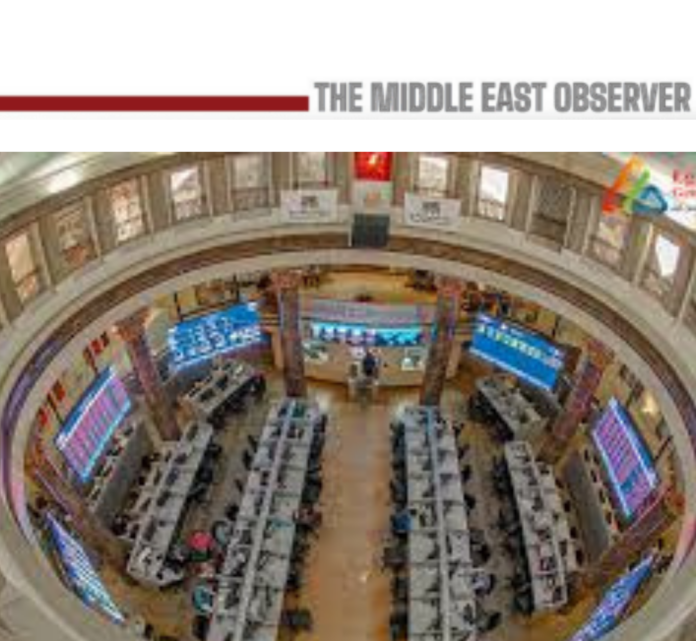
Cairo — Egyptian equities ended the trading week on a weaker note as profit-taking by domestic investors and subdued liquidity continued to weigh on blue-chip shares, while foreign and Arab investors remained net buyers, reinforcing confidence in Egypt’s medium-term investment outlook despite short-term market volatility.
The benchmark EGX30 declined 0.52% to close at 51,443.07 points on Thursday. (Some market reports incorrectly described the index as rising despite the lower closing level.) The EGX33 Shariah Index fell 1.14% to 5,713.07 points, while the EGX35-LV lost 0.76% to 5,962.54 points. The EGX70 index of small and medium-sized companies slipped 0.35% to 15,511.38 points, and the broader EGX100 eased 0.57% to 21,196.51 points.
The Egyptian Exchange’s market capitalisation fell to EGP 3.692 trillion, extending a week in which the benchmark index remained under pressure following the previous session’s break below the 52,000-point threshold.
Foreign Investors Continue to Accumulate Egyptian Assets
Despite the market’s weaker performance, investor flows continued to tell a more encouraging story.
Arab investors recorded net purchases of approximately EGP 10.55 billion, while non-Arab foreign investors bought around EGP 1.94 billion. Egyptian investors remained net sellers, with outflows of roughly EGP 12.49 billion.
Although the reported transaction values appear unusually large relative to normal cash-market turnover and should be interpreted cautiously as exchange classifications, the direction of investor flows has remained remarkably consistent throughout the week.
Foreign and regional investors continued absorbing domestic selling, suggesting that institutional investors remain focused on Egypt’s improving medium-term fundamentals rather than reacting to short-term market weakness.
The divergence between overseas buying and local profit-taking has become one of the defining features of recent trading, indicating differing investment horizons between international institutions and domestic investors.
Weekly Performance Reflects Consolidation Rather Than Capitulation
The week’s trading was characterised by gradual weakness rather than panic selling.
Following Sunday’s modest advance, the EGX30 retreated during the following sessions as investors continued adjusting positions after parliament approved the new stamp-duty framework earlier in the week.
Liquidity in leading stocks remained relatively subdued, while retail participation continued supporting small- and mid-cap companies, limiting broader market losses.
From a technical perspective, the benchmark index’s inability to regain the 52,000-point level leaves investors watching whether institutional buying will be sufficient to stabilise the market in the coming sessions.
Structural Reform Agenda Continues
While equity prices softened, Egypt’s broader capital-market reform programme continued to advance.
Investors remained focused on the exchange’s expanding pipeline of public offerings following ENPPI’s application to join the main market and reports that fintech leader MNT-Halan is studying a potential initial public offering of its Egyptian operations.
Market participants also continued monitoring the early implementation phase of Egypt’s newly launched single-stock futures market, with the exchange expected to gradually expand the range of underlying securities as investor familiarity with derivatives increases.
Regulators are simultaneously completing preparations for the introduction of covered short selling, another important step toward aligning Egypt’s financial markets with international standards.
Together, these initiatives are expected to broaden the Egyptian Exchange’s investable universe, improve market efficiency and attract a wider range of institutional investors over the coming years.
Market View
The week’s trading demonstrated a clear distinction between short-term market sentiment and the longer-term evolution of Egypt’s financial markets.
Equities remained under pressure as domestic investors continued to reduce exposure following recent gains and the introduction of the new transaction-tax framework. Yet foreign and Arab investors consistently accumulated positions throughout the week, suggesting that international institutions continue to view Egyptian assets favourably despite temporary market weakness.
Rather than defining the week by declining index levels alone, investors are increasingly likely to judge Egypt by the pace at which it is modernising its capital markets. The expansion of the IPO pipeline, the introduction of derivatives, forthcoming short-selling mechanisms and continued foreign participation point to a market undergoing structural transformation.
If these reforms are successfully implemented alongside a recovery in market liquidity, the current correction may ultimately be remembered as a transitional phase within a much broader expansion of Egypt’s capital markets. For long-term investors, the resilience of foreign participation remains a more significant indicator than the week’s decline in share prices, reflecting growing confidence in the exchange’s evolution into a deeper, more diversified and internationally competitive investment market.
Related news:
New Administrative Capital to Host Egypt Mining Forum in September
US Gasoline Stocks Fall to 2014 Lows as Prices Near Demand ‘Shock Point’
Read also:
Can Digital Banking Help Expand Financial Inclusion in Egypt?
Bitcoin Slides to Four-Month Low as Investors Favour Gold and Cash Over Crypto