
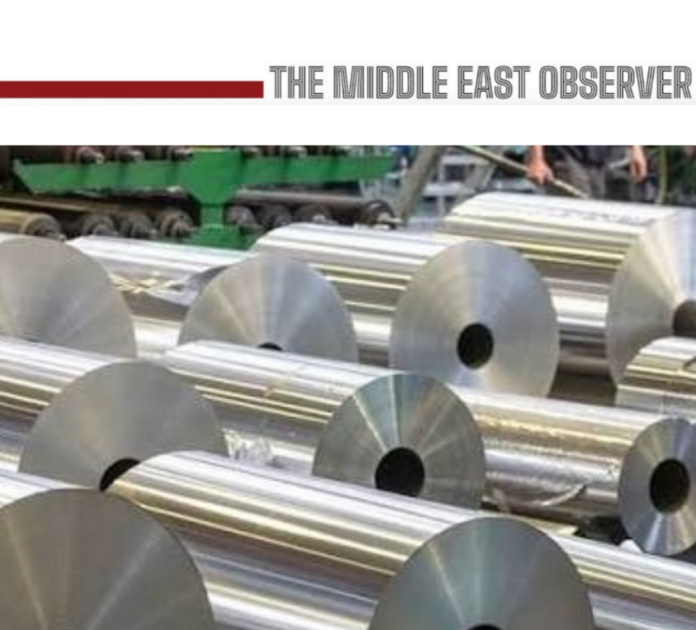
Cairo — Egypt Aluminium is moving ahead with plans to establish the country’s first aluminium foil manufacturing facility, marking a significant step in Egypt’s efforts to deepen industrial value chains, reduce import dependence and expand higher-value manufacturing exports.
According to market reports, the company is seeking financing of approximately $100 million from a consortium of Egyptian and Gulf banks to support the project’s first phase, while already allocating part of its investment budget to launch implementation. The planned facility is expected to begin with annual production capacity of 25,000 tonnes, with total project investments projected to reach $135 million through subsequent expansion phases.
The initiative forms part of a broader transformation strategy at Egypt Aluminium, the country’s largest aluminium producer and one of Egypt’s oldest industrial enterprises. Established in 1969 and commencing production in 1975, the Nagaa Hammadi complex has grown into the Arab world’s largest aluminium smelter, producing more than 320,000 tonnes annually for domestic and export markets.
The project is expected to utilise German technology supplied by Achenbach, a specialist in aluminium rolling and foil production systems. Industry observers view the investment as strategically important because Egypt currently imports virtually all of its aluminium foil requirements despite possessing substantial primary aluminium production capacity. Previous government estimates placed annual foil imports at between $120 million and $140 million.
Industry specialists note that Egypt was previously self-sufficient in aluminium foil production before domestic manufacturing facilities ceased operations due to rising costs and competitiveness pressures. The new project therefore represents not only industrial expansion but also the revival of a manufacturing segment that once existed within Egypt’s industrial base.
Export Potential Beyond the Domestic Market
Beyond replacing imports, the project could create new export opportunities across Africa, the Gulf and Southern Europe. Egypt Aluminium already exports a significant share of its primary metal production and benefits from preferential trade agreements covering Arab, African and European markets.
Industry analysts believe locally produced foil could eventually serve regional packaging, pharmaceutical and industrial customers, positioning Egypt as a competitive supplier within Mediterranean and African manufacturing supply chains. The project’s location and access to Egypt’s expanding logistics infrastructure could further enhance its export competitiveness.
Rising Global Demand
The investment comes at a time when global demand for aluminium foil continues to expand.
Growth is being driven by increasing consumption across food and pharmaceutical packaging, consumer goods, insulation materials and industrial applications. At the same time, the rapid expansion of electric vehicle production is creating additional demand for specialised aluminium foil used in lithium-ion batteries, making the sector one of the fastest-growing segments within the global aluminium industry.
As manufacturers worldwide seek to secure supply chains for both traditional packaging and advanced industrial applications, aluminium foil production has become an increasingly attractive area for investment.
Part of a Wider Industrial Strategy
From a Middle East Observer perspective, the significance of the project extends well beyond aluminium manufacturing.
It reflects a broader shift in Egypt’s industrial strategy from exporting raw materials and semi-finished products towards higher-value manufacturing. Similar localisation efforts are underway in automotive production, battery materials, renewable-energy equipment, textiles and engineering industries as Cairo seeks to expand industrial exports and reduce import dependence.
For Egypt Aluminium, the foil facility represents an opportunity to capture greater value from each tonne of metal produced while deepening domestic industrial supply chains. The project also aligns with the company’s wider investment programme, which aims to expand production capacity and move further downstream in the aluminium value chain.
If successfully implemented, the factory could transform Egypt from a net importer of aluminium foil into a regional production and export centre serving markets across Africa, the Middle East and Southern Europe. More importantly, it would signal Egypt’s growing ability to convert its industrial resources into higher-value manufactured products, supporting the country’s long-term ambition to become a leading industrial and export hub in the region.
