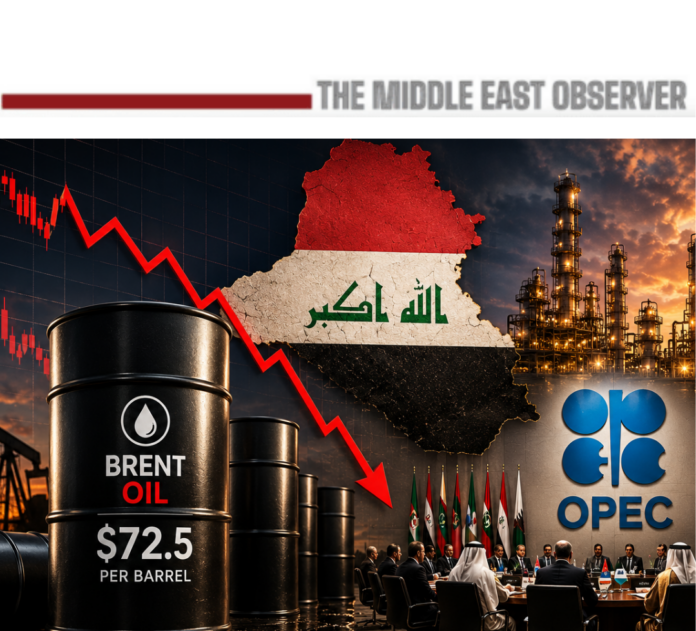
Brent crude’s fall to $72.5 a barrel on Thursday marked more than the disappearance of the geopolitical premium created by the Iran conflict. It signalled the beginning of a new phase for the global oil market in which abundant supply, rather than disrupted exports, is once again driving prices. Yet as Gulf energy flows steadily recover, an equally important development is emerging inside OPEC itself. Iraq’s demand for a substantially higher production quota has exposed growing tensions between national fiscal priorities and collective supply discipline, presenting what could become the producer group’s most significant institutional test in years.
The oil market has undergone a remarkable reversal within days. After trading above $110 per barrel at the height of the conflict, Brent has retreated to levels last seen before hostilities erupted in late February as traders rapidly unwind the geopolitical risk premium that dominated pricing throughout the war.
The immediate catalyst has been the restoration of supply confidence across the Gulf. Tanker traffic through the Strait of Hormuz, the maritime corridor that carries approximately 20 million barrels of crude oil and petroleum products each day—roughly one-fifth of global petroleum consumption—has recovered significantly following the ceasefire agreement between the United States, Israel and Iran. US Energy Secretary Chris Wright said oil flows through the waterway are approaching pre-war levels, although full normalisation will require several more weeks while mine-clearance operations continue.
The recovery has been reinforced by Oman’s introduction of temporary shipping routes to ease tanker departures, improved maritime coordination with international authorities and growing expectations that Iranian crude exports could gradually increase under the temporary sanctions reprieve accompanying the current negotiating framework. Physical crude markets have responded swiftly, with cargo premiums weakening and the Brent forward curve indicating increasingly comfortable short-term supplies.
Most market participants now expect oil prices to continue converging towards pre-war fundamentals, provided negotiations over Iran’s nuclear programme remain on track and maritime security continues improving. Even a sharp decline in US commercial crude inventories to their lowest level since 1984 failed to halt the sell-off, illustrating how completely traders have shifted their attention from inventories to supply restoration.
Ordinarily, that would have concluded the market story.
Instead, the restoration of Gulf exports has revealed a deeper structural challenge that could shape oil markets long after the geopolitical crisis fades.
On Thursday, a senior Iraqi Oil Ministry official warned that Baghdad would consider “all available options” if its OPEC production quota is not significantly increased. Separate sources indicated that Iraqi officials had discussed leaving OPEC altogether, although the government’s current strategy remains to secure a higher production allocation while remaining within the organisation.
The significance extends well beyond Iraq itself.
As one of OPEC’s five founding members and its second-largest producer, Iraq occupies a unique position within the organisation’s history and production structure. The cartel itself was founded in Baghdad in 1960. Any public challenge from Iraq therefore carries institutional significance far beyond a routine quota dispute.
The timing is equally significant.
Like many oil-exporting economies, Iraq is attempting to finance expanding public-sector wages, reconstruction programmes, infrastructure investment and broader economic development largely through hydrocarbon revenues. Lower oil prices immediately reduce government income, while years of production restraint have limited Baghdad’s ability to offset weaker prices through higher export volumes. Iraqi officials therefore argue that the country’s production capacity and investment programme now justify a materially larger quota.
More broadly, similar fiscal pressures are emerging across several producing countries. Governments throughout the Gulf are simultaneously financing ambitious economic diversification strategies, industrial expansion, energy transition projects and large-scale infrastructure programmes. As oil prices retreat, the incentive for individual producers to maximise production volumes inevitably increases, even if collective restraint would generate stronger prices for the group as a whole.
This exposes the central contradiction confronting OPEC.
The organisation was founded on a simple economic principle: coordinated production management delivers higher and more stable revenues than unrestricted competition for market share. That principle has underpinned OPEC’s influence for more than six decades. However, it remains sustainable only while member states conclude that the long-term benefits of collective discipline outweigh the short-term gains from producing additional barrels.
Periods of falling prices place that principle under its greatest strain.
When prices remain elevated, production restraint imposes relatively modest fiscal costs. As prices decline, however, every additional exported barrel becomes increasingly valuable to individual governments attempting to balance budgets and finance development plans. National fiscal priorities begin to diverge from collective market management, creating precisely the tensions the quota system was designed to contain.
For Saudi Arabia, OPEC’s largest producer and principal market stabiliser, this presents a particularly delicate challenge. Any substantial increase in Iraq’s quota would ultimately require either additional production restraint from Saudi Arabia and other core producers or a broader redistribution of quotas across the organisation. Both options carry political and economic costs while potentially encouraging similar demands from other members that have expanded production capacity in recent years.
The issue therefore extends well beyond Iraq.
It concerns whether OPEC’s quota framework can continue evolving without undermining the collective discipline upon which the organisation’s credibility depends.
The numbers illustrate the scale of the challenge. OPEC+ currently accounts for roughly half of global crude oil production, while Iraq produces around 4 million barrels per day, making it one of the alliance’s largest contributors. Any sustained shift in Iraq’s production policy would therefore carry consequences extending far beyond the country’s borders.
The departure of the United Arab Emirates earlier this year had already highlighted growing debate over quota allocations as production capacities evolve. Iraq’s intervention now raises broader questions about whether existing production formulas continue to reflect the economic realities facing major producers in a post-war market.
The immediate risk is not that OPEC faces imminent institutional collapse. The organisation has successfully navigated quota disputes many times throughout its history.
The greater risk is more gradual—and potentially more damaging.
As geopolitical tensions recede and supply constraints ease, competitive pressures among producers may increasingly shift from managing scarcity to defending market share. Should member states conclude that national fiscal pressures outweigh the benefits of coordinated restraint, the market could move towards a period of progressively weaker quota discipline.
History offers a clear warning. Episodes of market-share competition have rarely produced lasting winners among exporters. While individual countries may temporarily increase export volumes, sustained downward pressure on prices typically reduces total oil revenues across the producing bloc. The result is often lower fiscal income for nearly all producers despite higher production.
In that sense, the market’s attention may already be focusing on the wrong risk.
The reopening of the Strait of Hormuz may ultimately prove to have been the easier challenge. Restoring confidence in OPEC’s quota system as abundant supply returns could become considerably more difficult.
The defining question for the remainder of 2026 may therefore no longer be whether Gulf oil can reach global markets, but whether OPEC can preserve the collective discipline that has historically supported those markets. If the organisation successfully manages growing demands for quota redistribution, it could stabilise prices during the post-war recovery. If it fails, the industry risks entering a new phase in which competition for market share gradually replaces coordinated supply management—eroding the very foundation upon which the cartel has built its influence for more than six decades.
Related news:
OPEC Output Falls to 37-Year Low as US Shale Expands
Iraq Begins Trucked Oil Exports via Syria as Hormuz Disruptions Reshape Flows
Read also:
AI Becomes Europe’s New Weapon in Africa’s Critical Minerals Race
A Common Arab Strategic Vision in an Era of Regional Blocs