
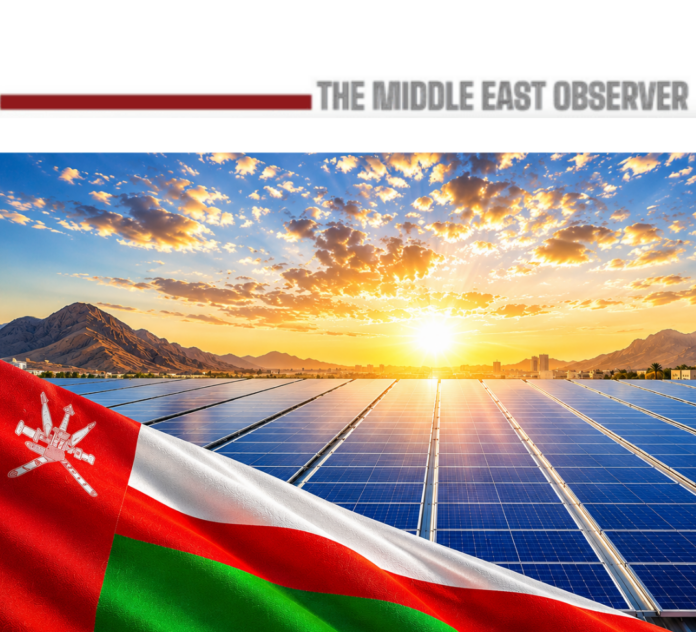
Oman has launched the prequalification process for more than $1 billion of utility-scale solar investments, inviting international developers to compete for two flagship renewable energy projects that will add 1.5 gigawatts (GW) of generating capacity to the Sultanate’s electricity network and accelerate its transition towards a diversified, lower-carbon energy system.
The Nama Power and Water Procurement Company (Nama PWP) has issued a Request for Qualification (RFQ) for the 1,000 MW Adam Solar Independent Power Project (IPP) and the 500 MW Sinaw Solar IPP, marking the first stage of a competitive procurement process that will ultimately select private-sector developers to finance, build, own and operate the facilities under long-term power purchase agreements.
The two projects carry a combined estimated investment of approximately RO398 million ($1.03 billion), reinforcing Oman’s position among Gulf states accelerating renewable energy deployment as governments seek to diversify electricity generation, reduce carbon emissions and optimise the use of natural gas resources.
Developers have until 27 July 2026 to submit Statements of Qualification before shortlisted bidders proceed to the Request for Proposal (RFP) stage.
The larger Adam Solar IPP, located in Al Dakhiliyah Governorate, will combine 1,000 MW of solar photovoltaic generation with a large-scale Battery Energy Storage System (BESS), representing one of Oman’s first utility-scale solar projects to integrate battery storage. Estimated to cost RO287 million ($746 million), the project will occupy approximately 20.5 million square metres and is expected to reduce annual carbon dioxide emissions by more than 1.03 million tonnes, while generating around one million International Renewable Energy Certificates (I-RECs) each year.
The 500 MW Sinaw Solar IPP, located in North Al Sharqiyah Governorate, carries an estimated investment of RO111 million ($288 million). Once operational, it is projected to reduce annual carbon emissions by approximately 566,600 tonnes and generate nearly 500,000 I-RECs annually.
Together, the projects are expected to eliminate almost 1.6 million tonnes of carbon emissions each year while producing 1.5 million renewable energy certificates, strengthening Oman’s environmental credentials and supporting the development of voluntary carbon and renewable certificate markets.
The investments form part of Oman Vision 2040, under which the Sultanate aims to increase renewable energy’s contribution to the national electricity mix to 30% by 2030. The projects also support the country’s long-term economic diversification strategy by reducing reliance on gas-fired generation, freeing additional natural gas for higher-value industrial uses, including petrochemicals, manufacturing and the rapidly expanding green hydrogen sector.
Electricity demand in Oman continues to grow alongside industrial expansion, new economic zones and large-scale hydrogen developments, increasing the need for additional generation capacity while improving the resilience of the national grid. Utility-scale renewable projects therefore play an increasingly important role in meeting future electricity demand without proportionately increasing domestic gas consumption.
The inclusion of battery energy storage at Adam reflects a broader transformation across global electricity markets. Rapid declines in battery costs have made integrated storage economically viable, allowing surplus solar electricity generated during daylight hours to be dispatched during evening peak demand. This improves grid stability, reduces dependence on gas-fired peaking plants and enables significantly higher penetration of intermittent renewable energy.
The procurement also demonstrates Oman’s growing attractiveness to international infrastructure investors. The Sultanate has established one of the Gulf’s most transparent Independent Power Producer (IPP) frameworks, underpinned by competitive procurement, predictable regulation and long-term power purchase agreements that provide stable, inflation-linked revenues. Such structures have consistently attracted leading international utilities, infrastructure funds and institutional investors seeking long-duration infrastructure assets.
Regionally, Oman is intensifying competition with neighbouring Gulf economies pursuing ambitious renewable energy programmes. While Saudi Arabia continues to develop one of the world’s largest solar pipelines under Vision 2030 and the United Arab Emirates expands gigawatt-scale clean energy projects, Oman is differentiating itself through a steadily expanding IPP programme and early adoption of integrated battery storage technologies that enhance system flexibility.
The Adam and Sinaw developments also reflect broader global investment trends. According to the International Energy Agency, annual investment in clean energy now substantially exceeds investment in fossil fuel supply, with utility-scale solar remaining one of the fastest-growing infrastructure asset classes owing to declining technology costs, low operating expenses and predictable long-term cash flows.
As Projects 11 and 12 within Nama PWP’s renewable energy programme, the two developments represent another significant milestone in Oman’s energy transition. Beyond expanding renewable generation capacity, they strengthen the country’s investment appeal, support domestic economic diversification and position the Sultanate as an increasingly important participant in the Gulf’s evolving clean energy landscape. At the same time, they demonstrate how hydrocarbon-producing economies are leveraging renewable infrastructure not only to decarbonise electricity generation, but also to improve fiscal resilience, maximise the value of natural gas resources and build more diversified, competitive economies for the decades ahead.
Related news:
Egypt Accelerates Renewable Energy Target to 45% by 2028, Backed by EGP 160bn Grid Investment
Read also:
Scatec to Invest EGP 5 Billion in Egypt Renewable Energy Grid Infrastructure
South Korea’s EL B&T to Build $250mn EV and Battery Hub in Duqm
