
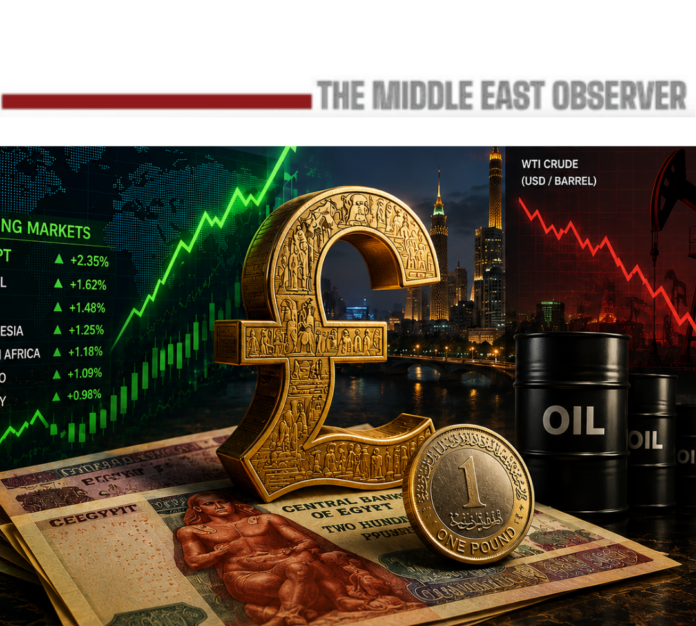
Currency trades below EGP 50 per dollar as lower energy costs, portfolio inflows and IMF-backed reforms lift sentiment
The Egyptian pound has emerged as one of the strongest-performing emerging-market currencies in recent days, supported by falling oil prices, renewed foreign investor demand for local debt and growing confidence in Egypt’s exchange-rate reforms.
According to Bloomberg, the pound became the world’s best-performing currency against the US dollar after oil prices dropped sharply following a US-Iran agreement to reopen the Strait of Hormuz. The currency gained about 4% since last Friday and more than 7% since early May, outperforming major and emerging-market peers.
By Wednesday, the dollar had fallen below EGP 50 in Egyptian banks for the first time since March, with average rates around EGP 49.85 for buying and EGP 49.95 for selling.
The rally reflects a combination of external relief and domestic policy credibility. Lower oil prices reduce pressure on Egypt’s energy import bill, while the country’s flexible exchange-rate regime has helped restore investor confidence since the March 2024 reform package.
Foreign investors have also returned to Egyptian treasury bills and local-currency debt, attracted by high real yields and improving foreign-exchange liquidity. Egypt’s net international reserves rose to $53.13bn at the end of May, while remittances continued to recover strongly, strengthening the country’s external position.
The pound’s performance contrasts with several emerging-market currencies still vulnerable to global risk aversion and capital-flow volatility. While lower oil prices benefit many energy-importing economies, Egypt’s gains have been amplified by portfolio inflows, stronger remittances and investor confidence in its IMF-supported reform programme.
The appreciation could help ease imported inflation by reducing the local-currency cost of fuel, food and industrial inputs. However, analysts remain cautious, noting that Egypt’s outlook is still exposed to oil-price volatility, regional geopolitical risks and the need to sustain reform momentum.
For now, the pound’s rally offers one of the clearest signals yet that investors are reassessing Egypt’s external position. Lower energy costs, stronger hard-currency inflows and exchange-rate flexibility are helping improve confidence in one of the Middle East’s most closely watched currency markets.