
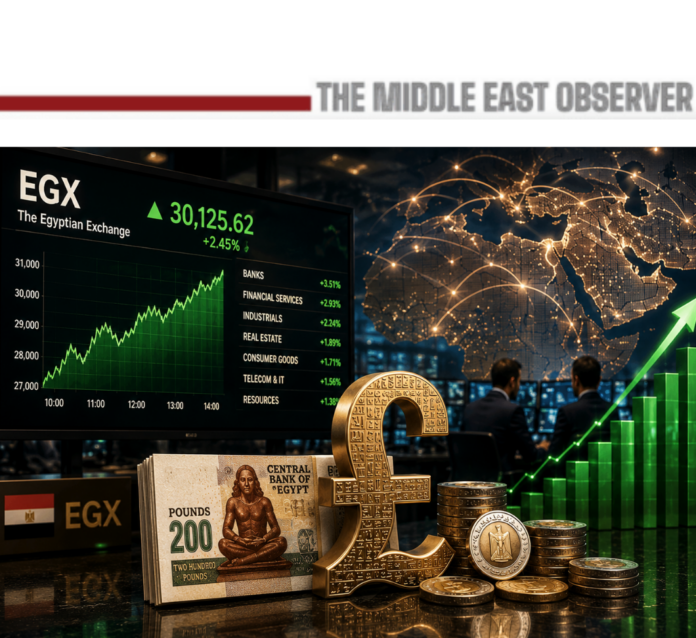
Stronger Pound, Robust Debt Demand and Regional Buying Support Egyptian Assets
Cairo — Egyptian equities extended their recovery on Monday as Arab investors returned decisively to the market, helping lift major indices amid improving sentiment toward Egyptian assets following a stronger currency, continued demand for government debt and easing geopolitical concerns across the region.
The advance followed Sunday’s broad-based rebound and reinforced a growing market narrative that investors are increasingly focusing on Egypt’s improving external position rather than the volatility that dominated regional markets earlier this month.
The benchmark EGX30 index rose 0.60% to close at 52,306.66 points, while the EGX33 Sharia Index gained 0.86% to 5,832.63 points. The EGX35-LV advanced 0.24% to 6,065.59 points, while the EGX70 index of small- and mid-cap shares added 0.33% to 15,447.28 points. The broader EGX100 climbed to 21,231.48 points, reflecting continued resilience across most market segments.
Market capitalization increased to approximately EGP 3.727 trillion, adding more than EGP 11 billion in value and extending the market’s recovery following last week’s correction.
Arab Investors Drive the Rally
The defining feature of Monday’s session was the return of Arab investors as the market’s sole significant net buyers.
Arab investors recorded net purchases of approximately EGP 1.42 billion, offsetting net sales by Egyptian investors of around EGP 1.08 billion and non-Arab foreign investors of approximately EGP 337 million.
The pattern highlights the increasingly important role of regional capital in supporting Egyptian equities. While both domestic and international investors remained cautious, Arab investors appeared willing to increase exposure to Egyptian assets amid signs of improving macroeconomic conditions and a more stable regional backdrop.
The rally therefore depended largely on regional inflows rather than broad-based participation across investor groups, underscoring the selective nature of the current recovery.
Stronger Pound Reinforces Confidence
Investor sentiment also benefited from the continued appreciation of the Egyptian pound.
According to Central Bank of Egypt data, the dollar fell below the EGP 51 threshold, trading at approximately EGP 50.32 for purchase and EGP 50.46 for sale, extending a downward trend that has accelerated since geopolitical tensions in the region began to ease.
Market participants cited strong demand for Egyptian treasury bills and government securities as a key driver behind the currency’s appreciation. Egypt continues to attract international investors seeking comparatively high real yields, while rising foreign-exchange reserves and sustained Gulf support have strengthened perceptions of macroeconomic stability.
The improvement in the currency has helped reduce concerns over imported inflation and has provided investors with greater confidence regarding earnings visibility and financial planning across a range of sectors.
Easing Geopolitical Risks Improve Sentiment
The market also drew support from improving regional sentiment following the US-Iran ceasefire agreement.
While investors remain cautious regarding the durability of the agreement and broader regional developments, the reduction in immediate geopolitical risks has encouraged a reassessment of risk premiums across Middle Eastern markets.
For Egypt, which has spent much of the past year navigating external shocks linked to regional conflicts and shipping disruptions, any sustained improvement in regional stability could support capital flows, tourism revenues and broader investor confidence.
Financial and Industrial Shares Lead Advances
Among the session’s strongest performers, Tycoon Holding Company for Financial Investments surged 19.99%, extending one of the market’s most notable rallies in recent weeks.
Mansourah Poultry gained 12.36%, while South Valley Cement rose 8.27%, reflecting renewed investor interest in companies linked to domestic consumption, agriculture and construction activity.
The strength in financial-investment stocks is particularly significant as investors continue positioning for a potentially more active capital-markets environment. Expectations surrounding future IPOs, state-ownership offerings and private-sector listings remain important drivers of sentiment toward brokerage, investment and financial-services companies.
On the downside, Arab Valves Company fell 7.5%, while Misr Oils & Soap declined 5.9% after recording sharp gains during the previous session. Subscription Rights of Aspire Capital Holding for Financial Investments-3 lost 5.77%, extending a period of heightened volatility.
Capital Markets and Debt Flows Remain Aligned
Beyond daily trading activity, investors continue to monitor a growing pipeline of capital-market transactions expected to deepen liquidity and broaden investment opportunities over the coming year.
Prospective listings involving state-owned enterprises, Banque du Caire and private-sector issuers remain central to the market’s longer-term growth story. These developments coincide with record foreign-exchange reserves, continued Gulf financial support and resilient foreign participation in Egypt’s debt market.
Recent trading patterns suggest international investors continue to favour Egyptian government debt, while regional investors are increasingly re-entering equities and domestic investors are selectively rebuilding positions following the market’s correction. Together, these trends point to improving confidence across different segments of Egyptian assets rather than reliance on a single source of capital inflows.
Market View
The key takeaway from Monday’s session was not simply the rise in share prices, but the growing alignment between improving macroeconomic indicators and investor behaviour.
A stronger pound, resilient treasury-bill demand and renewed Arab buying all point to strengthening confidence in Egypt’s external position. While participation remains uneven across investor groups, capital flows increasingly suggest investors are becoming more constructive on Egyptian assets as concerns over regional instability begin to recede.
Recent trading patterns indicate regional investors are returning to Egyptian equities while international investors continue favouring government debt. Together with record reserve levels and improving liquidity conditions, those flows reinforce the view that investors are increasingly focusing on Egypt’s fundamentals rather than short-term geopolitical uncertainty.
If sustained, this combination of stronger external balances, renewed regional investment and an expanding capital-markets pipeline could provide a more durable foundation for the Egyptian Exchange’s next phase of growth in the second half of 2026.