
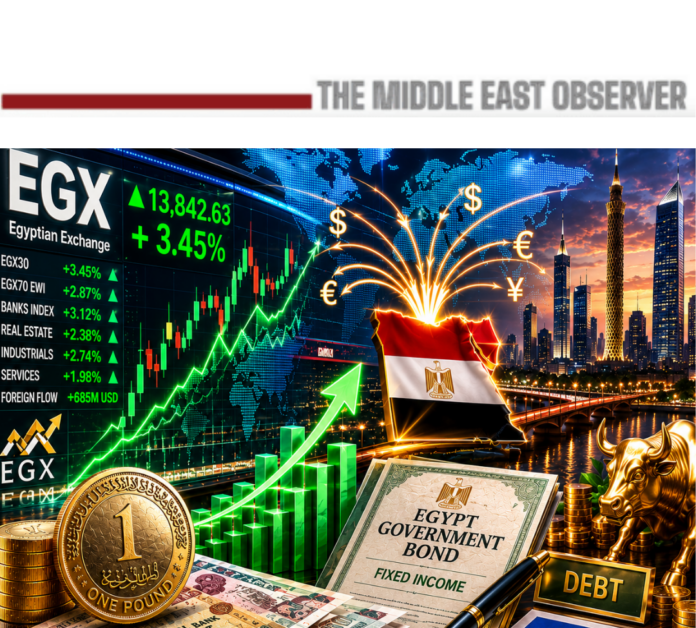
Strong Week for Egyptian Assets as Record Debt Inflows, Equity Gains and Futures Launch Signal Market Deepening
Cairo — Egyptian equities ended a shortened trading week on a positive note as foreign investors increased exposure to both government debt and equities, while the launch of the country’s first single-stock futures contracts marked another milestone in the development of Egypt’s capital markets.
The benchmark EGX30 rose 1.10% on Wednesday to close at 52,621.84 points, bringing its gain since the previous week’s close to approximately 3.5% after recovering from 50,818.84 points on 11 June. The broader market also remained firmly positive, with the EGX70 advancing 0.39%, the EGX100 gaining 0.43%, and the EGX33 Sharia Index rising 0.56%.
Market capitalization climbed to approximately EGP 3.741 trillion, compared with EGP 3.648 trillion at the end of the previous week, representing an increase of nearly EGP 93 billion and reflecting a broad recovery in investor sentiment following earlier profit-taking.
Foreign Buying Supports Market Recovery
The week’s recovery was accompanied by continued foreign participation in Egyptian assets.
Exchange data indicated substantial foreign and Arab buying activity offset by Egyptian selling, although the reported transaction values appeared unusually large relative to typical cash-market turnover and may reflect broader transaction classifications rather than conventional net cash flows.
Nevertheless, the direction of investor flows remains consistent with broader trends observed across Egyptian financial markets, where overseas investors have increasingly returned following improvements in external liquidity, a stronger currency and easing regional tensions.
The pattern suggests international investors are becoming more comfortable rebuilding exposure to Egyptian assets even as domestic investors continue to lock in gains following the market’s strong rally earlier in the year.
Among the week’s strongest performers, Tycoon Holding Company for Financial Investments surged 20% to EGP 41.40, extending a remarkable rally that has made it one of the exchange’s best-performing stocks in June. Rowad Tourism rose 19.98%, while brokerage firm Themar gained 15.96%, reflecting growing investor interest in companies linked to capital-market activity and domestic economic recovery.
Record Debt Inflows Reinforce Confidence
The equity rally coincided with a sharp rebound in foreign demand for Egyptian government debt.
According to local financial-market data, foreign investors’ net purchases of government debt instruments through the secondary market reached approximately $4 billion during the previous week, representing the strongest buying activity since the outbreak of the US-Iran conflict and a significant rebound from the preceding week.
The surge followed renewed confidence in Egypt’s macroeconomic outlook, a strengthening Egyptian pound and expectations that regional geopolitical risks could gradually ease following the ceasefire agreement between Washington and Tehran.
The Central Bank of Egypt has continued to capitalize on improving market conditions, offering EGP 35 billion in treasury bonds this week, including three-year fixed-income securities and 10-year floating-rate instruments, alongside an additional EGP 1.5 billion sukuk issuance.
For investors, the debt-market story remains critical. Strong demand for Egyptian government securities has helped support the pound, strengthen reserve accumulation and improve liquidity conditions throughout the financial system.
Futures Trading Opens New Chapter
The week also marked a significant structural development for Egypt’s financial markets with the introduction of the country’s first single-stock futures contracts.
Trading began on futures linked to Commercial International Bank (CIB) and Talaat Moustafa Group Holding (TMG), Egypt’s two most liquid and institutionally owned stocks.
The launch represents the latest stage in the Egyptian Exchange’s efforts to modernize market infrastructure, broaden investment products and attract a wider range of institutional investors.
Futures contracts allow investors to hedge risks, gain leveraged exposure and improve price discovery while contributing to deeper market liquidity. Their introduction brings the Egyptian market closer to international standards and provides professional investors with additional tools for portfolio management.
Capital Markets Are Becoming More Diversified
The week’s developments highlight a broader transformation underway in Egypt’s financial markets.
While foreign investors have largely favored government debt in recent months, the launch of stock futures, expectations for additional IPOs and planned state-ownership offerings suggest policymakers are gradually building a more diversified capital-market ecosystem capable of attracting different pools of domestic, regional and international capital.
Investors continue to monitor prospective listings involving Banque du Caire, petroleum-sector companies and private-sector issuers, alongside ongoing efforts to expand market liquidity and increase institutional participation.
The simultaneous strengthening of debt inflows, equity performance and derivatives infrastructure suggests Egypt’s capital markets are evolving from a predominantly cash-equity market into a broader financial ecosystem with multiple channels for investment and risk management.
Market View
The key takeaway from the week was not simply that the EGX ended higher, but that foreign capital returned across multiple asset classes simultaneously.
Foreign investors increased exposure to government debt, participated selectively in equities and entered a market that has now begun offering derivative products for the first time. Combined with a stronger pound, record foreign-exchange reserves and an expanding pipeline of listings, these developments point to improving confidence in Egypt’s broader financial architecture.
If sustained, the combination of record debt inflows, expanding derivatives trading, rising foreign participation and a growing IPO pipeline could mark the most significant broadening of Egypt’s capital markets since the reform cycle that followed the 2016 currency float.
For investors, the emerging story is increasingly clear: Egypt’s capital markets are no longer being driven solely by equity performance. Debt inflows, derivatives expansion and a growing issuance pipeline are creating a deeper and more sophisticated financial ecosystem capable of attracting increasingly diverse pools of capital in the years ahead.