
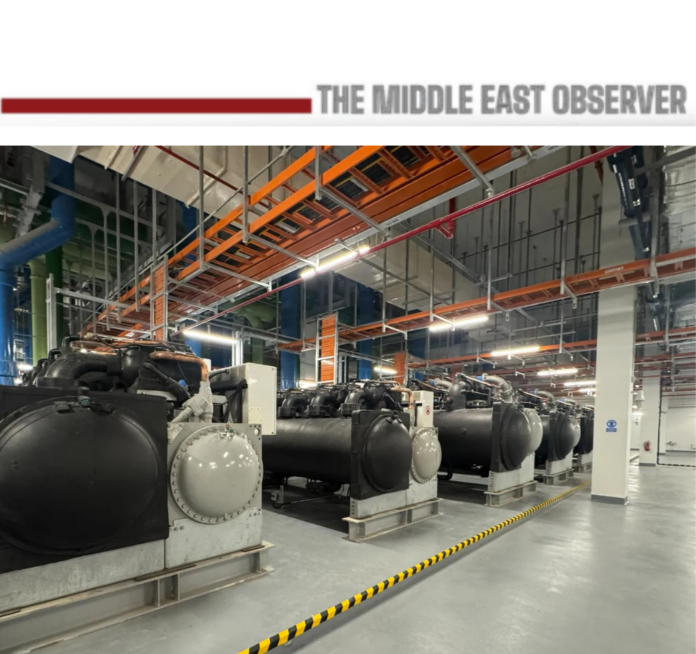
Singapore is expanding its use of District Cooling systems as part of a broader strategy to improve energy efficiency, strengthen climate resilience and manage rising cooling demand in one of the world’s most densely populated tropical economies.
The city-state has increasingly turned to centralized cooling networks that circulate chilled water through underground pipelines to cool offices, universities, residential developments and commercial districts. While the technology dates back more than a century, policymakers and energy planners are giving it renewed attention as rising temperatures place growing pressure on electricity systems and urban infrastructure.
The approach is gaining momentum at a time when countries across Asia and the Middle East are searching for ways to reduce energy consumption while adapting to hotter climates and growing urban populations. Singapore’s average temperature has risen at nearly twice the global rate over recent decades, reinforcing the urgency of climate-adaptation measures and urban heat-management strategies.
A Century-Old Technology Returns
Singapore’s best-known district cooling network began operations in the Marina Bay area in 2006 and has since become one of the world’s largest underground cooling systems. Additional networks have been developed in districts such as Punggol, where energy companies are expanding centralized cooling services for offices, educational facilities and residential communities.
The technology works by producing chilled water at a central plant and distributing it through insulated pipelines to connected buildings. Supporters argue that centralized systems consume significantly less electricity than conventional building-based cooling systems because of economies of scale and more efficient operations.
Industry estimates suggest district cooling can reduce electricity consumption by between 30% and 50% compared with traditional air-conditioning systems, making it increasingly attractive for cities facing rising power demand.
Singapore’s market for district cooling currently stands at approximately 323,000 refrigeration tons and could double over the next decade, according to industry projections. Globally, the district-cooling industry is expected to approach $60 billion by 2034 as urbanization, climate change and rising temperatures drive demand for more efficient cooling solutions.
Cooling as Critical Infrastructure
The renewed focus on district cooling reflects a broader shift in how governments view urban cooling. Historically treated as a building utility, cooling is increasingly regarded as a component of critical infrastructure linked to energy security, economic competitiveness and climate adaptation.
Air conditioning accounts for a substantial share of electricity consumption in tropical economies. In Singapore, one of the highest per-capita users of air conditioning in Asia-Pacific, policymakers are seeking ways to reduce the feedback loop in which increased cooling demand raises electricity consumption, which in turn contributes to higher emissions and greater heat stress.
The government has committed around S$100 billion ($77 billion) over the coming decades to climate adaptation measures, including coastal protection, flood resilience and urban heat management. District cooling forms part of this wider strategy.
For energy-importing economies such as Singapore, reducing electricity demand also carries strategic value by limiting exposure to volatile international energy markets and strengthening long-term energy security.
AI and Data Centers Add New Demand
The rise of artificial intelligence, cloud computing and hyperscale data centers is creating an additional dimension to the cooling challenge. Data centers require large and continuous cooling capacity to maintain performance and reliability, making efficient cooling systems increasingly important to national digital-economy strategies.
Singapore, which hosts one of Asia’s most advanced digital infrastructure ecosystems, is already balancing data-center growth with sustainability objectives. As AI workloads expand globally, district cooling could play a growing role in reducing the energy footprint of digital infrastructure while supporting economic growth.
The trend is likely to extend beyond Singapore as governments seek to accommodate expanding digital economies without placing excessive strain on electricity networks.
Growth Opportunities and Emerging Challenges
The growing adoption of district cooling presents opportunities for infrastructure investors, utilities, engineering companies and technology providers. Energy companies such as ENGIE have expanded operations in Singapore’s cooling market, while similar systems continue to gain traction across the Gulf region.
The Middle East has emerged as one of the world’s largest district-cooling markets, particularly in the United Arab Emirates, Saudi Arabia and Qatar, where centralized cooling has become an integral component of large-scale urban developments.
However, challenges remain. Building district cooling networks requires substantial upfront investment, often running into hundreds of millions of dollars for large projects. Water availability is another concern, particularly as climate change, urban growth and the expansion of water-intensive industries place additional pressure on resources.
Operational issues can also arise during deployment. Singapore’s first district cooling system for public housing encountered technical problems shortly after launch, highlighting the importance of maintenance, monitoring and system reliability.
A Model for Hotter Cities
As temperatures continue to rise across Asia and the Middle East, cooling demand is expected to become one of the fastest-growing drivers of electricity consumption. This trend is particularly significant for rapidly urbanizing economies seeking to balance economic growth with sustainability goals.
Singapore’s experience suggests that older technologies may play an increasingly important role in addressing modern climate challenges. By treating cooling infrastructure as part of broader urban planning rather than an isolated building function, governments may be able to reduce energy consumption, improve resilience and support long-term environmental objectives.
Cities that can cool themselves more efficiently are likely to gain a competitive advantage as climate pressures, electricity demand and energy costs continue to rise. If current expansion plans succeed, district cooling could evolve from a niche infrastructure solution into a core pillar of future smart-city development, offering lessons for energy-constrained and climate-vulnerable economies worldwide.
Related news:
Climate Crisis Escalates: Earth Enters Era of Near-Permanent Heat Records
Plastic: Yesterday’s Friend, Today’s Environmental Enemy
Read also:
Egypt Bets on Battery Storage and Manufacturing to Power Next Energy Phase
SANY Project Signals Egypt’s Shift from Renewable Energy Buyer to Manufacturer