
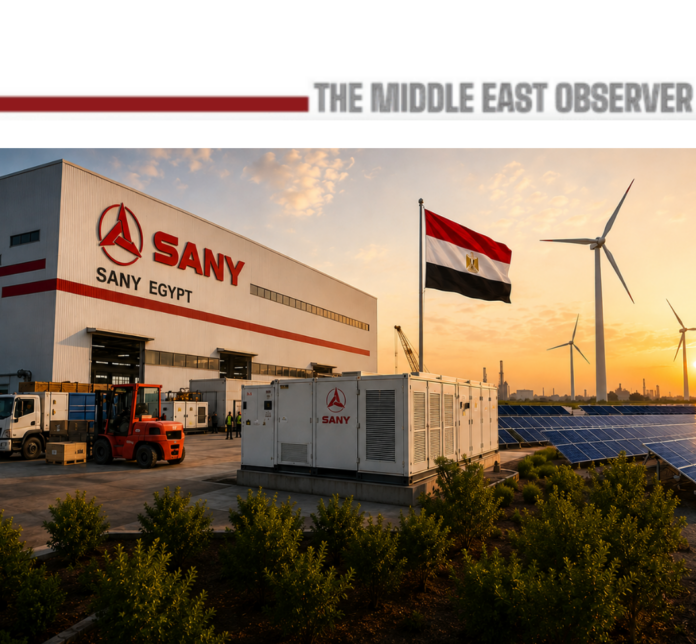
Cairo — Egypt’s discussions with China’s SANY Group have evolved beyond plans for a wind turbine factory to encompass renewable-energy projects with a combined capacity of up to 2,000 MW, as Cairo seeks to build a domestic clean-energy industrial base and position itself as a regional manufacturing and export hub.
While Media reports have valued the proposed investment in a wind turbine manufacturing facility at more than $300 million, Egyptian government statements have focused on a broader agenda that includes technology transfer, industrial localisation and support for large-scale renewable-energy deployment.
At the centre of the initiative is a proposed manufacturing facility in the Suez Canal Economic Zone, expected to supply equipment for a planned 1,000 MW wind project in the Gulf of Suez. Yet the strategic significance of the project lies less in the factory itself than in what it represents for Egypt’s industrial policy.
For years, Egypt’s rapid expansion of renewable-energy capacity has relied heavily on imported turbines, specialised components and engineering systems. Local manufacturing would allow the country to retain a greater share of the economic value generated by clean-energy projects, reduce foreign-currency expenditure on equipment imports and create opportunities for higher-value industrial exports.
The initiative reflects a growing shift in government policy towards linking renewable-energy deployment with domestic manufacturing. Rather than viewing wind and solar projects solely as sources of electricity, policymakers are increasingly treating them as catalysts for industrial development, technology acquisition and supply-chain creation.
Discussions with SANY have therefore focused not only on assembly operations but also on localising advanced wind turbine technologies and building a domestic ecosystem of suppliers capable of supporting future projects. Such an ecosystem could benefit Egyptian manufacturers of steel structures, towers, electrical equipment, control systems, cables and specialised engineering services.
The timing is significant. Egypt’s Gulf of Suez region is widely regarded as one of the world’s most attractive onshore wind corridors, attracting billions of dollars in planned investments from international developers. At the same time, markets across the Middle East, Africa and Southern Europe are accelerating renewable-energy deployment, creating a growing market for turbine equipment and associated components.
A domestic wind-manufacturing industry could therefore position Egypt not only to meet local demand but also to supply renewable-energy projects across North Africa, the Gulf and selected African markets, leveraging the Suez Canal Economic Zone’s strategic location and trade connectivity.
For SANY, the project builds on substantial global experience in renewable energy and industrial manufacturing. The Chinese group is one of the world’s largest heavy-equipment manufacturers and has expanded aggressively into clean-energy technologies through its wind-energy division. The company develops and supplies onshore wind turbines ranging from approximately 3 MW to 6 MW capacity and has participated in utility-scale wind projects across China and international markets. Its expertise spans turbine manufacturing, wind-farm engineering, grid integration and lifecycle maintenance services.
The proposed investment would also deepen SANY’s long-standing presence in Egypt. The company has operated in the Egyptian market since 2007 and has collaborated with local partners on infrastructure, construction, industrial and energy projects. Establishing a manufacturing base in Egypt would strengthen its access to regional markets while supporting Beijing’s broader industrial and investment engagement across Africa and the Middle East.
The project comes amid a wider influx of Chinese investment into Egypt’s manufacturing sector, particularly in industries linked to energy transition, industrial localisation and export-oriented production. The Suez Canal Economic Zone has emerged as a focal point for that strategy, attracting manufacturers seeking access to African, Arab and European markets.
While final investment terms and construction timelines have yet to be announced, the broader policy direction is becoming increasingly clear. Egypt is no longer focusing solely on generating renewable electricity; it is seeking to manufacture the technologies that make the energy transition possible.
If realised, the SANY initiative would represent more than a new industrial facility. It would mark a structural shift in Egypt’s role within the global renewable-energy value chain — from a purchaser of clean-energy technology to a manufacturer, technology partner and potential exporter of it.