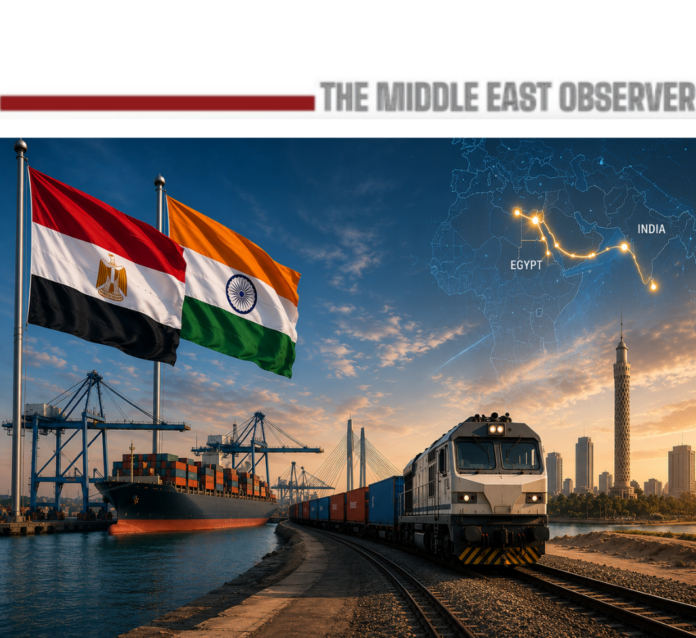
Egypt and India are intensifying efforts to transform their expanding political partnership into a broader geoeconomic corridor linking Asia, the Middle East and Africa, as both countries seek stronger positioning within evolving Global South trade networks and the wider BRICS economic framework.
The renewed momentum was highlighted during meetings held in New Delhi on the sidelines of the BRICS foreign ministers’ gathering, where Egyptian Foreign Minister Badr Abdelatty reaffirmed Cairo’s objective of increasing bilateral trade with India to $12 billion over the coming five years. The discussions with Indian Prime Minister Narendra Modi reflected the accelerating pace of relations since both countries elevated ties to a strategic partnership during Modi’s landmark visit to Cairo in 2023.
While bilateral trade previously surpassed $7 billion, recent fluctuations in global trade activity, coupled with disruptions affecting Red Sea shipping routes, have impacted commercial flows between the two economies. Nevertheless, Cairo increasingly views India as one of its most significant Asian economic partners and a major pillar within Egypt’s broader diversification strategy aimed at expanding ties beyond traditional Western markets.
Egyptian and Indian officials stressed that the newly launched Egypt–India Strategic Dialogue mechanism, inaugurated in 2025, is expected to provide a permanent framework for deepening coordination across trade, industrial investment, logistics, technology, renewable energy and development cooperation. The institutionalisation of the dialogue reflects growing recognition in both capitals that the relationship is gradually evolving beyond traditional diplomacy toward a more structured long-term economic partnership.
Trade between the two countries is becoming increasingly diversified, extending beyond conventional commodity exchange toward manufacturing integration and industrial cooperation. Egyptian exports to India continue to include fertilizers, petroleum-related products, agricultural commodities and chemicals, while Indian exports to Egypt range from engineering products and pharmaceuticals to textiles, machinery and consumer goods.
Indian investments have meanwhile expanded steadily across the Egyptian market, particularly within manufacturing, chemicals, packaging, food processing and industrial production sectors. More than 450 Indian companies are now registered in Egypt, including major firms such as Dabur India, TCI Sanmar, Flex P Films, Mahindra and Godrej, reflecting growing Indian confidence in Egypt’s industrial and logistical positioning.
At the center of Cairo’s long-term vision lies the Suez Canal Economic Zone, which Egyptian officials increasingly promote as a strategic manufacturing and logistics gateway connecting Indian production networks with African, Arab and European markets. Discussions surrounding the potential establishment of a dedicated Indian industrial zone within the SCZone highlight Egypt’s ambitions to position itself as a regional export and re-export platform integrated into global supply chains increasingly being reshaped by geopolitical fragmentation and industrial diversification trends.
For India, Egypt offers strategic geographic advantages extending far beyond market access alone. Cairo provides proximity to Mediterranean trade routes, African consumer markets, Gulf connectivity and European logistics corridors, at a time when global manufacturers are seeking to diversify supply chains beyond excessive concentration within East Asia. For Egypt, deeper Indian industrial participation supports Cairo’s wider objectives of attracting foreign direct investment, increasing export-oriented manufacturing and strengthening foreign currency inflows amid ongoing economic reforms.
Renewable energy and green hydrogen are rapidly emerging as among the most promising pillars of future cooperation. Indian renewable-energy companies have signed framework agreements linked to major green hydrogen and green ammonia projects in Ain Sokhna and the Suez Canal Economic Zone, with projected investments reaching billions of dollars. Egyptian policymakers increasingly view such projects as essential components of Cairo’s ambition to establish itself as a future regional hub for renewable-energy exports and low-carbon industrial production targeting European and international markets.
Connectivity and trade logistics also featured prominently during the discussions, particularly as Egypt continues to navigate the economic repercussions of instability affecting Red Sea shipping traffic and Suez Canal revenues. Abdelatty highlighted Egypt’s modern infrastructure network and the strategic importance of the Suez Canal as a critical artery linking the Red Sea with the Mediterranean and wider global trade routes.
Financial cooperation is similarly gaining importance within the wider BRICS context. Egyptian and Indian officials have explored mechanisms for expanding bilateral trade settlement in local currencies and reducing exposure to exchange-rate volatility and dollar-denominated transaction costs. While such initiatives remain at exploratory stages, they reflect wider efforts among emerging economies to strengthen South–South financial coordination and develop alternative commercial frameworks within an increasingly multipolar economic landscape.
For Cairo, the partnership with India aligns closely with Egypt’s broader economic strategy focused on attracting industrial investment, strengthening manufacturing competitiveness, expanding exports and positioning the country as a strategic logistics and energy hub connecting Asia, Africa and Europe. For New Delhi, Egypt increasingly represents a strategic gateway into African and Middle Eastern markets, while also supporting India’s broader efforts to expand economic influence across emerging economies and secure diversified trade and energy partnerships.
As The Middle East Observer observes, the evolving Egypt–India relationship increasingly reflects a wider transformation underway across the Global South, where emerging economies are seeking deeper industrial integration, diversified trade corridors and more balanced economic partnerships outside traditional geopolitical alignments. The challenge ahead for both Cairo and New Delhi will be translating growing political momentum into sustainable industrial projects, efficient logistics integration and measurable private-sector-led growth capable of transforming the partnership into a durable transregional economic corridor.