
Cairo — Egypt’s capital markets are facing two potentially significant tests after the government moved to restore a stamp tax on stock-market transactions and S&P Dow Jones Indices launched a consultation on whether the country should retain its emerging-market status, developments that could influence liquidity, foreign participation and the long-term competitiveness of the Egyptian Exchange.
The developments came as Egyptian equities closed modestly higher on Tuesday, 2 June. The benchmark EGX30 rose 0.14% to 52,927.02 points, according to Egyptian Exchange data, while broader indices outperformed. The EGX70 index of small and medium-sized companies gained 0.95%, the EGX100 advanced 0.69%, and the EGX35-LV rose 1.03%. Market capitalisation increased to approximately EGP 3.79tn.
Investor flows reflected continued foreign interest in Egyptian equities. According to EGX data, non-Arab foreign and Arab investors were net buyers during the session, while Egyptian investors were net sellers, extending a pattern seen in several recent sessions in which foreign participation has helped support market performance despite periods of local profit-taking.
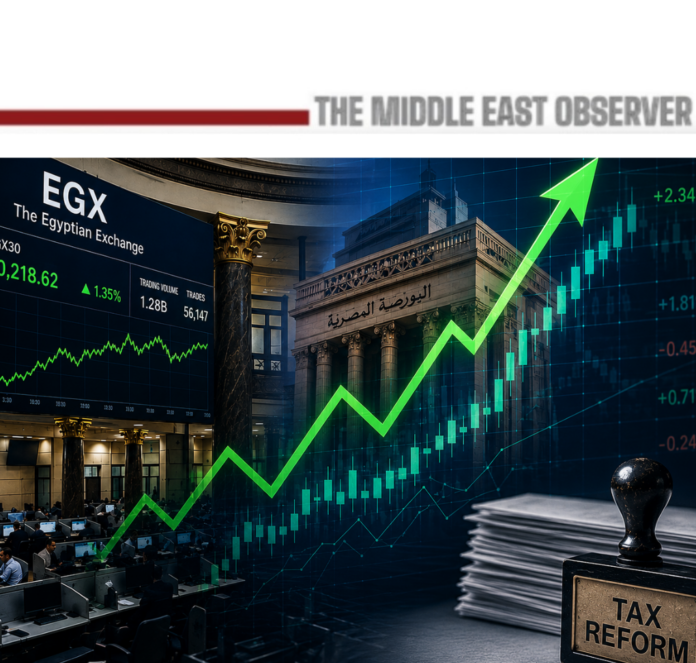
At the centre of investor attention is a government bill submitted to parliament that would replace the capital gains tax framework with a revised stamp-duty system on stock transactions. Under the proposal, buyers and sellers of listed securities would each pay 0.5 per thousand on transactions, while same-session trades would be subject to a reduced rate of 0.25 per thousand per side.
The proposal revives a mechanism that was suspended in 2020 and reopens a long-running debate over the most effective taxation model for Egypt’s capital markets. Supporters argue that transaction-based taxation offers greater predictability and administrative simplicity than capital gains taxation. Critics, including market participants and brokerage firms, have historically argued that higher transaction costs can discourage trading activity, reduce turnover and weaken liquidity, particularly among institutional investors and active traders.
The second issue attracting market attention may carry even broader implications. S&P Dow Jones Indices has opened its annual market-classification consultation and is considering whether Egypt should be reclassified from an Emerging Market to a Frontier Market, citing concerns over market accessibility and the consistency of economic and institutional conditions, according to the consultation document released by the index provider.
The distinction is significant because emerging-market benchmarks are followed by substantially larger pools of global institutional capital than frontier-market indices. A downgrade could therefore affect Egypt’s visibility within benchmark-driven portfolios and influence future passive and active investment allocations. While Egypt’s weighting in major emerging-market benchmarks remains relatively small, the classification serves as an important signal for international investors assessing market accessibility, regulatory conditions and long-term investment prospects.
Market opinion remains divided. Ahmed Abou El Saad, chief executive of Azimut Egypt, warned that a reclassification could weaken Egypt’s standing among international investors whose mandates are restricted to emerging markets. Others, including Hassan Shoukry, managing director of HC Securities, argue that Egypt’s current weighting in emerging-market indices is limited and that a stronger position within frontier-market benchmarks could offset part of the impact by increasing Egypt’s relative visibility among specialist frontier-market funds.
The consultation process is expected to continue through July, with any formal decision unlikely to take effect before September 2027, giving regulators, policymakers and market participants time to address concerns raised by the index provider.
In trading, investors continued to favour domestically oriented sectors. El Shams Housing & Urbanization surged 19.94%, Prime Holding gained 14.98%, and Mena Touristic & Real Estate Investment rose 14.62%, reflecting continued interest in property and investment-related stocks. Losses were concentrated in selected industrial and financial shares.
Recent macroeconomic data have been more supportive. Annual core inflation slowed to 13.8% in April from 14.0% in March, while urban inflation eased to 14.9%, reinforcing expectations of greater macroeconomic stability. The developments come as Egyptian authorities continue efforts to attract foreign portfolio investment, deepen capital-market liquidity and strengthen the investment environment following recent economic and monetary reforms.
However, investors remain sensitive to external risks, including oil-price volatility and regional geopolitical tensions, particularly developments affecting trade and shipping through the Strait of Hormuz. Any sustained increase in energy costs could place renewed pressure on inflation and foreign-investor sentiment across regional markets.
While Tuesday’s market gains were modest, investor focus has shifted beyond short-term trading performance. For investors, the debate is increasingly less about daily market moves and more about whether Egypt can preserve its attractiveness to international capital while maintaining liquidity, accessibility and competitiveness within global equity benchmarks. The outcome of the stamp-duty debate and the S&P review is likely to influence perceptions of Egypt’s investment case long before any formal decisions take effect.