
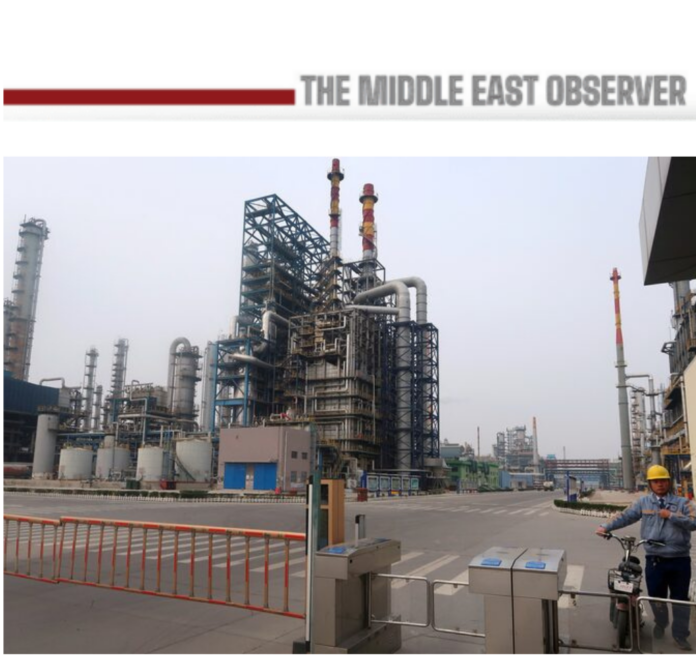
The Middle East fuel shock is exposing a weakness in the global energy system that crude prices alone cannot capture: the world has too little spare refining capacity in the right places, just as demand for diesel, jet fuel and gasoline enters its most politically sensitive season.
Executives at the S&P Global Middle East Petroleum and Gas Conference in London warned this week that disruption across Gulf energy flows has turned a regional conflict into a wider test of the downstream oil system. While crude supply remains the headline risk, the sharper squeeze is increasingly appearing in refined products — the fuels that power aircraft, trucks, factories, farms and summer travel.
Musab Al-Mulla, Saudi Aramco’s vice-president for market analysis and sustainability, said the current crisis had revealed chronic underinvestment in refining. Around 3mn barrels a day of refining capacity was shut between 2020 and 2023, he said, a volume equivalent to nearly 3 percent of global refining capacity. Had some of those plants remained in operation, he argued, the industry would have been better placed to absorb today’s disruption.
That figure matters because global refining capacity was estimated by the US Energy Information Administration at about 103.5mn barrels a day in 2023. Although new projects are expected through 2028, the bulk of additions are concentrated in Asia-Pacific and the Middle East. The system is therefore not only capacity-constrained, but geographically exposed: some of the regions adding the most refining capacity are also those closest to current shipping and geopolitical risk.
The first impact has been felt in diesel and aviation fuel. Gulf producers exported roughly 3.3mn barrels a day of refined products and 1.5mn barrels a day of LPG in 2025, according to the International Energy Agency. As the Strait of Hormuz disruption restricts flows, refiners in the US, Asia and elsewhere have raised runs and adjusted yields to produce more diesel and jet fuel. But refining is a trade-off business. Pushing harder for one product usually means producing less of another.
That is why gasoline is now moving onto the risk list.
Bader Noureddine, Vitol’s regional head of research in Bahrain, warned that pressure may naturally shift from diesel and jet fuel into gasoline. As refiners prioritise distillates, gasoline supply becomes more vulnerable just as the northern hemisphere enters the summer driving season. US and global gasoline inventories are already below normal seasonal levels, according to Vitol, leaving little margin if demand accelerates.
The market signals are increasingly visible. Reuters reported that North West European jet fuel crack spreads reached more than $121 a barrel in March, compared with about $30 before the Iran war began in late February. In the US, refinery utilisation has climbed to 94.7 per cent, while crude exports surged to 5.9mn barrels a day, the second-highest level on record, as Asian and European buyers sought alternatives to Middle Eastern supply.
For US Gulf Coast refiners, this is a moment of exceptional pricing power. They can process domestic and imported crude, sell into tight Atlantic Basin markets and benefit from elevated margins on transport fuels. Reuters reported in April that US refiners including Phillips 66, Valero and Marathon Petroleum were expected to benefit from stronger diesel and jet fuel margins after the closure of Hormuz disrupted supply.
But the same dynamics create losers elsewhere. Airlines face higher jet fuel costs at the start of the summer travel season. IATA has warned that many carriers are exposed to fuel-price volatility and that not all airlines can hedge effectively. European fuel importers must compete more aggressively for cargoes. Emerging markets in Africa and Asia, where diesel is central to transport, agriculture and power generation, are more exposed to price spikes and shortages. Logistics companies face a double squeeze from higher fuel bills and rising freight costs.
The shipping and insurance market has become the transmission mechanism. Even when crude or refined products are physically available, war-risk premiums, tanker delays and security uncertainty increase the delivered cost of fuel. Insurance markets are therefore acting as a form of geopolitical tariff, raising the cost of energy trade before outright shortages appear at the pump.
This is the new refining premium: an additional surcharge attached not merely to crude oil, but to the ability to transform crude into usable fuels and move those fuels safely across the world.
The roots of the problem predate the current conflict. During the pandemic, weak demand and poor margins pushed older refineries into closure. In Europe and parts of North America, environmental rules, decarbonisation targets and investor reluctance to finance long-life fossil-fuel assets accelerated the rationalisation. Some closures were economically unavoidable. Others reflected a bet that oil demand would decline fast enough to make future refining capacity less valuable.
That bet now looks premature. The energy transition is advancing, but the present economy still depends heavily on refined petroleum products. Aircraft still burn jet fuel, trucks still run on diesel, and summer mobility still depends heavily on gasoline. Until alternatives reach scale, refinery underinvestment will continue to magnify geopolitical shocks.
There is a clear historical echo. After Russia’s invasion of Ukraine in 2022, Europe discovered that crude supply was only part of its vulnerability; diesel, refinery feedstocks and product logistics mattered just as much. The current Middle East disruption is repeating that lesson on a wider scale. Oil security is no longer simply about barrels produced. It is about barrels refined, insured, shipped and delivered.
The winners are becoming clearer. US Gulf Coast refiners, Indian processors with access to alternative crude supplies, Chinese export-oriented refiners, independent storage operators and product tanker owners all stand to benefit from wider spreads and disrupted trade flows. The losers are equally visible: airlines, fuel-importing governments, European distributors, road-haulage operators and lower-income economies with limited fiscal room to absorb higher pump prices.
The International Energy Agency has warned that global inventories are drawing rapidly and that further volatility is likely before peak summer demand. It has also said that the market is expected to remain in deficit until the final quarter of the year if flows through Hormuz recover only gradually. That means temporary fuel stock builds in the US may offer limited comfort if demand rebounds and trade routes remain disrupted.
The lesson is uncomfortable for policymakers. For much of the past decade, energy security debate focused on upstream supply, spare crude capacity and the pace of the energy transition. But the current crisis shows that refining capacity is now a strategic asset. A country may secure crude and still face shortages if it lacks access to the refineries, shipping, storage and insurance needed to turn that crude into usable fuel.
Oil markets traditionally priced geological scarcity. Today they are increasingly pricing processing scarcity. The strategic value of a barrel of crude now depends less on where it is produced than on whether it can be refined, insured and delivered. In an era of geopolitical fragmentation, refining capacity is becoming the new strategic commodity.