
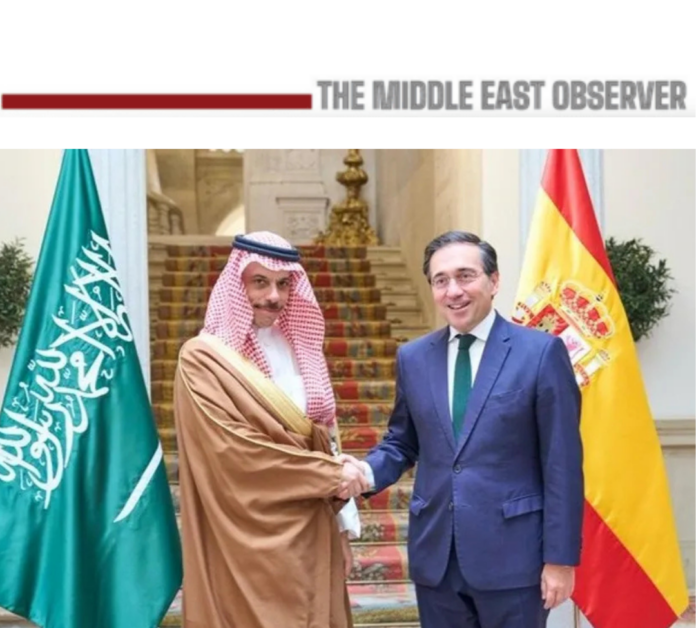
Saudi Arabia and Spain have moved to significantly broaden bilateral cooperation through the establishment of a new Saudi–Spanish Strategic Partnership Council, reflecting accelerating Gulf-European engagement across infrastructure, defense, investment, logistics and regional diplomacy at a time of mounting geopolitical and economic transformation.
The agreement was signed during Saudi Foreign Minister Prince Faisal bin Farhan’s official visit to Madrid, where he held talks with Spain’s Minister for Foreign Affairs, European Union and Cooperation José Manuel Albares. The discussions marked one of the most comprehensive recent efforts by Riyadh and Madrid to institutionalise long-term coordination across political, economic and strategic sectors as both countries seek to strengthen their positioning within rapidly evolving global trade, energy and industrial networks.
According to official Saudi and Spanish statements, the visit concluded with the signing of a memorandum establishing the Strategic Partnership Council alongside a reciprocal visa exemption agreement covering holders of diplomatic, special and service passports. The framework is expected to create a structured mechanism for advancing cooperation in areas including infrastructure development, transportation systems, renewable energy, defense industries, investment flows, tourism and multilateral coordination.
The expanding relationship reflects a broader shift underway between Gulf economies and several European states as both sides pursue deeper strategic and commercial integration amid industrial transformation, energy-market restructuring and growing geopolitical fragmentation. For Saudi Arabia, the partnership forms part of Riyadh’s wider diversification strategy under Vision 2030 aimed at expanding industrial capabilities, attracting foreign investment and strengthening international economic alliances beyond traditional security partnerships. For Spain, deeper engagement with Gulf markets offers expanding opportunities tied to infrastructure exports, transport engineering, renewable-energy cooperation and long-term industrial contracts.
Economic relations between Riyadh and Madrid have steadily expanded in recent years, particularly across transport infrastructure, construction, engineering and energy sectors. Spanish companies have secured a growing presence within Saudi Arabia’s industrial and infrastructure landscape, especially in projects linked to Vision 2030’s ambitious economic transformation agenda.
Spanish rail manufacturer Talgo participated in major railway initiatives connected to the Haramain High-Speed Railway project linking Makkah and Madinah, while infrastructure and engineering groups including Acciona and Técnicas Reunidas have expanded activities across water infrastructure, industrial facilities and energy-related projects within the Kingdom. Spain’s growing role within Saudi Arabia’s infrastructure modernization efforts reflects Riyadh’s continued push to integrate international expertise into large-scale transport and urban-development initiatives.
Defense-industrial cooperation has similarly emerged as a central pillar of the evolving relationship. Spanish naval company Navantia has strengthened cooperation with Saudi Arabia through corvette and naval systems agreements tied to the Royal Saudi Naval Forces, including localization initiatives designed to support the Kingdom’s domestic military-industrial ambitions under Vision 2030. Recent developments involving additional Avante 2200 corvettes further underline Riyadh’s broader strategy of combining defense procurement with technology transfer, local industrial participation and maritime-security expansion.
The discussions in Madrid also highlighted the growing importance of logistics and connectivity cooperation linking Europe, the Mediterranean and the Gulf region. Saudi Arabia’s large-scale infrastructure and logistics ambitions, including projects connected to NEOM and Red Sea trade corridors, increasingly intersect with European interests in maritime trade, supply-chain diversification and regional transport connectivity.
NEOM has recently accelerated efforts to position itself as a major logistics and connectivity platform linking Gulf, Egyptian and European trade routes through multimodal transport corridors spanning the Red Sea region. Such projects are gaining additional strategic relevance amid continuing disruptions affecting global shipping routes and mounting international focus on securing alternative trade corridors connecting Europe, Asia and the Middle East.
Regional developments featured prominently during the talks, with both sides expressing concern regarding escalating tensions across the Middle East and emphasizing the importance of diplomacy, international law and de-escalation efforts aimed at preserving regional stability. The discussions also underscored the strategic importance of maintaining freedom of navigation through the Strait of Hormuz amid continuing geopolitical volatility affecting global energy and shipping markets.
Spain reaffirmed support for Saudi Arabia, Gulf Cooperation Council countries and Jordan regarding regional security concerns while commending Riyadh’s diplomatic approach and repeated calls for restraint and negotiated solutions. Saudi Arabia meanwhile welcomed Spain’s support for diplomatic engagement, regional de-escalation and efforts backing a two-state solution regarding the Palestinian issue.
The evolving relationship also reflects wider European efforts to strengthen strategic engagement with Gulf economies as Europe navigates energy transition pressures, industrial competitiveness challenges and shifting global investment patterns. Gulf markets have become increasingly important for European infrastructure firms, renewable-energy developers, defense manufacturers and logistics operators seeking long-term growth opportunities linked to the region’s large-scale economic transformation programs.
As The Middle East Observer observes, the Saudi–Spanish Strategic Partnership Council signals a broader transformation underway in Gulf-Europe relations, where cooperation is progressively moving beyond traditional oil and trade relations toward deeper industrial, logistical and geopolitical integration. For Riyadh, the partnership supports Saudi Arabia’s ambitions to position itself as a central hub within emerging global trade and investment corridors. For Spain, stronger engagement with the Gulf reflects a wider European recognition that the Middle East is becoming an increasingly important arena for infrastructure expansion, industrial cooperation and long-term strategic economic alignment in an evolving multipolar global order.
