
Egypt Retains Africa’s Crown, Saudi Arabia Climbs Globally, UAE Leads MENA
The Middle East and North Africa (MENA) emerged as one of the world’s fastest-growing investment destinations in 2025, as international capital increasingly shifted towards economies offering technological capability, industrial transformation and large-scale infrastructure, according to the UNCTAD World Investment Report 2026.
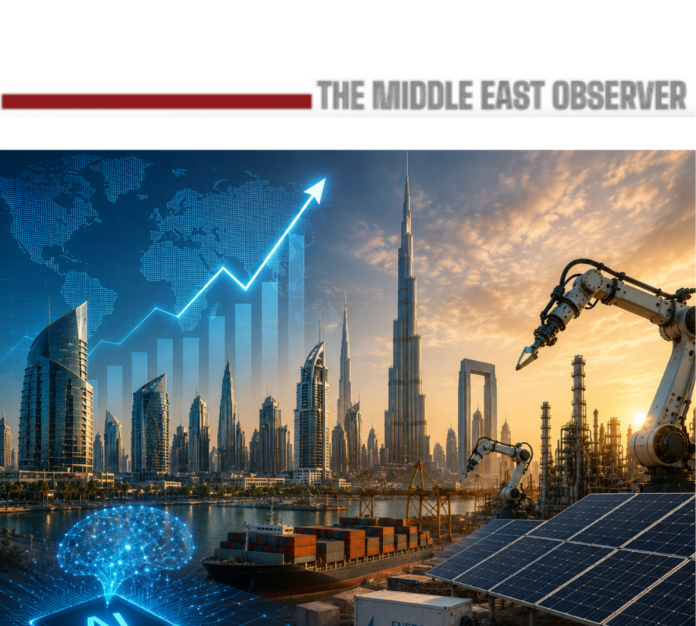
Global foreign direct investment (FDI) rose 6% to US$1.6 trillion, recovering after two consecutive years of decline. However, UNCTAD cautioned that the rebound masks a more fragile investment environment, with much of the increase generated by a relatively small number of mega-projects and cross-border mergers, while conventional greenfield investment remained comparatively subdued. Capital increasingly flowed into artificial intelligence infrastructure, hyperscale data centres, semiconductor manufacturing, renewable energy and strategic supply chains, signalling a structural shift away from labour-intensive manufacturing towards technology-intensive industries.
The United States remained the world’s largest FDI recipient with US$277 billion, followed by China, including Hong Kong, with a combined US$196 billion, Singapore, Brazil, Canada, Germany, France, the United Arab Emirates, Mexico and India. The report concludes that global investment is becoming increasingly concentrated in economies combining advanced digital infrastructure, industrial policy, innovation ecosystems and resilient supply chains, reinforcing competition for high-value investment worldwide.
Against this backdrop, the Middle East delivered one of the strongest regional performances globally, with FDI inflows rising by 21% to US$111 billion, compared with US$92 billion in 2024—more than three times the global growth rate. The region accounted for almost 7% of global FDI inflows, reflecting accelerating economic diversification, industrial localisation, digital transformation and record investment in infrastructure across the Gulf.
The United Arab Emirates reinforced its position as a global investment powerhouse, ranking ninth worldwide in attracting FDI with approximately US$48 billion, while simultaneously remaining among the world’s ten largest outward investors. The dual ranking highlights the country’s emergence as both a major destination for international capital and an increasingly influential exporter of investment through sovereign wealth funds, multinational corporations and private enterprise, strengthening its role in shaping global capital flows.
Saudi Arabia climbed to 13th globally, attracting approximately US$33 billion in FDI as investors increasingly recognised the Kingdom’s transformation into a diversified industrial and technology economy. Vision 2030 reforms, together with substantial investment in manufacturing, mining, logistics, tourism, renewable energy and digital infrastructure, have significantly broadened Saudi Arabia’s investment profile beyond hydrocarbons.
Egypt retained its position as Africa’s largest recipient of foreign direct investment, attracting approximately US$15 billion despite a moderation from the exceptional inflows recorded in 2024 following the Ras El-Hekma development agreement. The performance confirms Egypt’s role as the continent’s principal destination for large-scale industrial, logistics and infrastructure investment while helping North Africa retain its position as Africa’s leading FDI sub-region despite lower continental inflows.
Performance across the remainder of MENA remained more varied. Morocco continued to outperform many regional peers by leveraging export-oriented automotive, aerospace and renewable energy industries, while Algeria recorded gradual improvement as investment reforms gained traction, although inflows remained below the country’s considerable economic and resource potential. Among the smaller Gulf economies, Oman, Qatar and Bahrain continued to attract specialised investment centred on energy, logistics, financial services and downstream industries, reflecting the scale and maturity of their economies rather than weakening investor confidence. Jordan and Tunisia maintained moderate investment inflows supported by ongoing structural reforms, although constrained by relatively smaller domestic markets and slower economic growth.
By contrast, conflict-affected economies—including Iraq, Syria, Yemen, Libya, Lebanon, the Palestinian territories and Sudan—continued to face substantial obstacles to attracting long-term productive investment. UNCTAD attributes their weaker performance to persistent geopolitical instability, damaged infrastructure, institutional fragility, elevated sovereign risk and prolonged security challenges, factors that continue to discourage major international investors despite isolated improvements in selected markets.
The report also highlights the growing international influence of Gulf sovereign wealth funds and state-backed multinational companies, which are expanding investments across energy, infrastructure, telecommunications, logistics and technology. Increasingly, the region is not only attracting global capital but also exporting it, reinforcing its role in reshaping international investment patterns.
UNCTAD concludes that MENA has entered a new phase of investment-led transformation. Rather than competing primarily on hydrocarbon wealth or low production costs, the region is increasingly competing on industrial capability, digital infrastructure, technological innovation and policy execution. The report suggests that future competition for global investment will increasingly depend on technology ecosystems, regulatory certainty, skilled human capital and geopolitical stability—a transition that currently favours the Gulf economies while presenting a broader reform agenda for the rest of the MENA region.
Related news:
Egypt–World Bank Align on FDI Strategy as Growth Target Set at 5.4%
Oman Advances $1bn Solar Expansion with Adam and Sinaw Projects
Read also:
Cairo Ranked Fourth Globally as Egypt’s Tourism Strategy Gains Recognition
Egypt–Russia Maritime Deal Signals Strategic Shift Toward Integrated Logistics Power
