
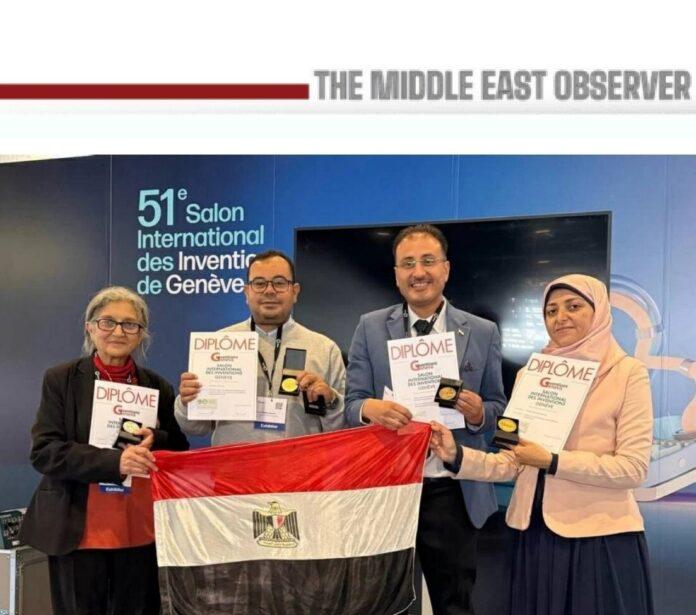
Cairo — Egyptian researchers have secured five medals across diverse scientific disciplines at the 51st Geneva International Exhibition of Inventions, reinforcing the country’s growing presence in global research and innovation. The annual event, held in Geneva under the patronage of the World Intellectual Property Organization (WIPO), convenes thousands of inventors and institutions worldwide to showcase cutting-edge technological advancements.
Two Egyptian researchers were awarded gold medals for pioneering contributions. Dr. Rabie Younes Abdel Fattah, a nanotechnology professor representing Zewail City of Science and Technology, was recognised for developing a nano-sensor-based diagnostic platform capable of early detection of diseases including cancer, Alzheimer’s, and viral conditions. The system utilises advanced nanomaterials to analyse biomarkers from minimal blood samples, enabling high-precision, early-stage diagnosis.
A second gold medal was awarded to Dr. Manar Yehia Ismail of the National Research Centre for her innovation in textile-reinforced rods for concrete applications, offering enhanced durability and structural performance in construction.
Silver medals were granted to Dr. Eman Salah El-Din of Cairo University for a novel deep-drawable steel production technique, already applied within industrial manufacturing, and to Engineer Mohamed Al-Moatasem for an AI-integrated biomanufacturing system designed to optimise pharmaceutical and vaccine production through advanced machine learning models.
Meanwhile, Dr. Tarek El-Bashir of the National Institute for Standards earned a bronze medal for developing a miniaturised acoustic chamber, engineered to deliver ultra-precise industrial measurements in noise-isolated environments, with applications in product testing and calibration technologies.
The results reflect a broad spectrum of innovation spanning healthcare, advanced materials, industrial engineering, and artificial intelligence, highlighting Egypt’s scientific capabilities at an international level. Industry observers note that such achievements—while significant—underscore the importance of sustained investment in research and development ecosystems to translate individual successes into scalable national impact.
Egypt has a track record of participation at the Geneva exhibition, with prior recognitions in agriculture and medical robotics. This year’s multi-disciplinary wins, however, signal a more diversified and technologically advanced research pipeline, positioning Egyptian institutions as increasingly competitive contributors to global innovation.
