
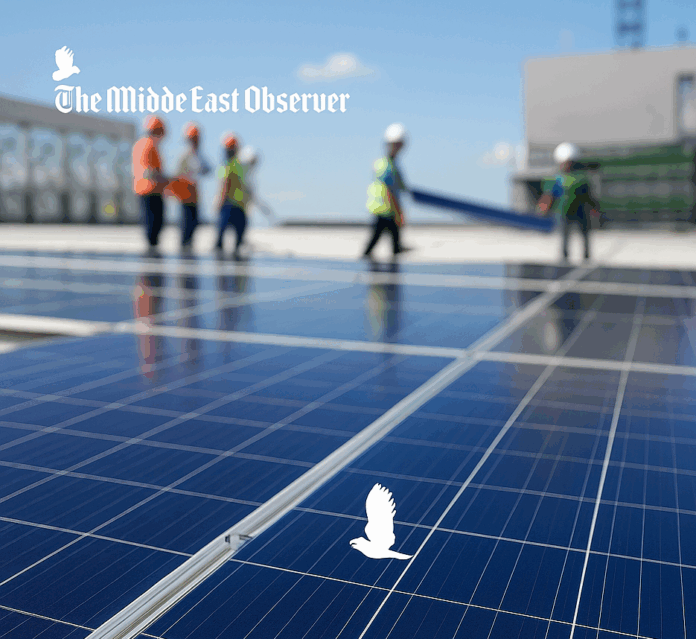
Egyptian integrated energy solutions provider Elsewedy Electric has entered into a partnership with E‑Point Zero to jointly develop a large-scale solar photovoltaic (PV) project in Zambia with an installed capacity of up to 300 megawatts. The agreement was disclosed via an official announcement by Elsewedy, which clarified that the collaboration is currently limited to the project’s development phase and that further details will be published as available.
While the formal contract still appears to be in its “heads of terms” stage—as highlighted in a Reuters-syndicated listing of the deal—the agreement signifies Elsewedy’s continued pivot toward Africa’s renewable energy market and its intention to expand beyond its core Egyptian and Middle-Eastern markets.
The partnership highlights several strategic dimensions. Firstly, it places Egypt’s renewables industry outward into Sub-Saharan Africa—an area with increasing demand for clean power and solar build-out. Elsewedy already holds a prominent position in the Middle-East and North Africa (MENA) regions; the Zambia deal suggests a step-change into pan-African geographies. Secondly, the scale—300 MW—is meaningful by Zambian standards (the country currently hosts multiple solar farms in the tens of MW range). Implementation of such a large-scale solar project could contribute meaningfully to Zambia’s grid diversification and renewable-energy ambitions.
Elsewedy’s statement emphasised that the firm remains in the development phase and that further milestones—such as power-purchase agreement (PPA) signatures, financing, site evaluation, or engineering contracts—are yet to be announced. This cautious phrasing suggests that while the deal is real, it still requires execution risk elements: land or site access, regulatory approvals, financing, EPC contracting, grid-tie arrangements and local‐partner coordination in Zambia.
For Zambia, the project aligns with wider national priorities to boost non-hydro renewables and diversify the power mix amid drought risks affecting hydropower. If fully realised, the 300 MW plant will become one of the country’s larger solar installations, complementing smaller plants built in recent years. Analysts will monitor whether the project secures government guarantees, grid access via the state utility ZESCO, and financing from development banks or multilateral lenders.
From an investment perspective, the partnership signals Elsewedy’s position as a cross-border integrator of renewable energy in Africa—which may enhance its profile, raise its appeal to international financiers, and create a pipeline of project-flow beyond Egypt. However, the execution path will be critical: timing, cost control, off-taker credit risk, and local regulatory/regime stability will determine whether “development agreement” becomes “construction start” and eventually “commercial operations.”
In conclusion, the Elsewedy Electric and E-Point Zero partnership on a 300 MW solar project in Zambia reflects a meaningful expansion of an Egyptian energy firm into Sub-Saharan Africa’s solar market and highlights broader trends: cross-border renewables development, Egypt-based firms exporting their capabilities, and African countries scaling up solar capacity. While the announcement is headline‐worthy, the next 12–24 months will reveal whether the project transitions from ambition to construction and eventually to power generation.
