
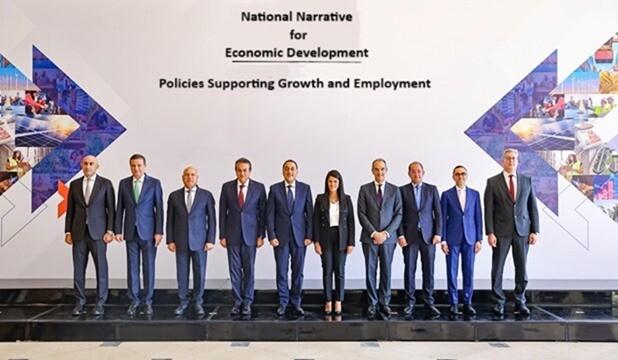
In a move framed as a cornerstone of Egypt’s long-term reform agenda, the government on Sunday launched the National Economic Development Narrative: Policies to Support Growth and Employment, a comprehensive framework designed to align policy with Egypt Vision 2030.
The initiative, announced under the patronage of Prime Minister Mostafa Madbouly and led by Minister of Planning, Economic Development, and International Cooperation Rania Al-Mashat, seeks to chart a clear roadmap for growth, job creation, and private sector participation. The narrative, Al-Mashat emphasized, is “not a separate strategy but a unifying framework” that integrates ongoing national initiatives and structural reforms into measurable targets through 2030.
The timing of the launch is politically and economically significant. It precedes the arrival this month of an IMF mission tasked with reviewing Egypt’s $8 billion Extended Fund Facility and the newly approved $1.3 billion Resilience and Sustainability Facility (RSF). Successful reviews could unlock around $2.7 billion in financing, critical for maintaining Egypt’s fiscal and external balance.
“This narrative is as much about signaling confidence to international partners as it is about domestic policy coordination,” said Dr. Salma Hassan, a senior economist at the Egyptian Center for Economic Studies. “It tells the IMF, investors, and the Egyptian people that the government has a structured plan to stabilize and grow the economy despite global headwinds.”
According to Al-Mashat, the framework rests on three pillars:
Strengthening the national economy through export-oriented, high-productivity sectors
Improving competitiveness and the business climate to attract investment and unlock private sector potential
Advancing a gradual green transition, aligning Egypt with global sustainability commitments
The narrative will remain open for public consultation until November 2025, marking a rare attempt to build consensus around long-term policy priorities.
The framework builds on the October 2024 cabinet reshuffle, which merged the planning and international cooperation portfolios, and is underpinned by Law 18/2022 on National Planning and Law 6/2022 on Unified Public Finance. These laws mandate ministries to align programs, projects, and performance indicators with national objectives, strengthening policy discipline.
Al-Mashat highlighted that the government is shifting towards a medium-term fiscal planning model, covering the current fiscal year plus three years ahead, to ensure budgetary alignment with strategic goals.
The narrative builds heavily on Egypt’s infrastructure boom under President Abdel-Fattah El-Sisi. Investments in road networks, ports, energy facilities, smart transport, and economic zones are presented as the foundation for a “dynamic economy capable of absorbing external shocks.”
Equally significant is the emphasis on redefining the state’s role—transitioning from direct economic actor to enabler of private enterprise. Officials stressed that the private sector will be the “primary driver of growth,” a message aimed at both domestic businesses and foreign investors wary of state dominance in key sectors.
Government sources speculate that the narrative will prioritize manufacturing, ICT, green energy, and agro-industrial exports in the 2025 investment cycle, sectors expected to generate both jobs and foreign exchange. A draft Foreign Direct Investment Strategy and National Employment Strategy are expected to be released alongside the narrative’s consultation phase.
Al-Mashat noted that Egypt is pursuing a “balanced, flexible planning approach” to respond to global challenges ranging from geopolitical tensions and protectionist trade policies to inflation volatility. “This is not a rigid blueprint,” she said, “but a living framework designed to adapt as circumstances shift.”
Analysts agree the balancing act is delicate. “Egypt must show the IMF and investors it can commit to reform while cushioning its population from inflation and unemployment shocks,” said Karim Lotfy, a London-based MENA economist. “The narrative provides a storyline, but execution will determine credibility.”