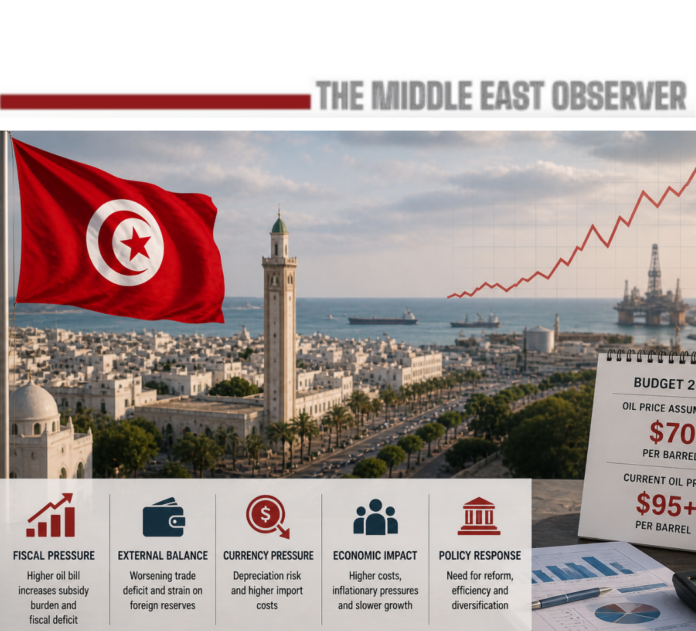
Tunisia is facing mounting fiscal and inflationary pressures as rising global energy prices, driven by ongoing geopolitical tensions, place increasing strain on its import-dependent economy, according to regional economic reporting and official data.
The country’s 2026 budget was based on an oil price assumption of $63 per barrel, but global prices have since surged beyond $110 per barrel, significantly increasing the cost of energy imports. Tunisia relies on imports for approximately 65% of its energy needs, making it particularly vulnerable to external shocks .
Energy imports remain the primary contributor to the trade deficit, which reached around 2.9 billion dinars (approximately $1 billion) in the first quarter, based on data from Tunisia’s National Institute of Statistics. Rising shipping and insurance costs, linked to regional instability, have further increased import expenses and disrupted supply chains, contributing to shortages of some basic goods .
Fiscal indicators point to a widening budget gap, with the deficit expected to rise from 5.5% of GDP last year to around 6% in 2026, driven largely by higher energy costs. Despite these pressures, authorities have not raised domestic fuel prices, which is increasing the burden on public finances, with energy subsidies projected to reach 5 billion dinars ($1.7 billion) this year .
Economic risks extend beyond fiscal balances. Analysts warn that prolonged uncertainty could weigh on foreign investment flows and remittances, both key sources of foreign currency. Although foreign investment rose by over 30% in 2025, sustaining this momentum may depend on global stability and investor confidence.
Recent financing support includes $472 million in World Bank funding, aimed at strengthening social protection systems, improving water services, and enhancing agricultural resilience, according to official announcements .
Growth expectations are also being revised downward. The International Monetary Fund has lowered Tunisia’s growth forecast to 2.1% for 2026, with inflation projected to rise toward 6.5%, reflecting the pass-through effects of higher energy costs on consumer prices.
As The Middle East Observer notes, Tunisia’s economic outlook highlights the structural vulnerability of energy-importing economies to global price shocks, where rising fuel costs quickly translate into fiscal pressure, inflation, and external imbalances. The Middle East Observer adds that policy choices in the coming months—particularly regarding subsidies, financing, and fiscal adjustments—will be critical in determining the country’s ability to stabilise its macroeconomic trajectory.