
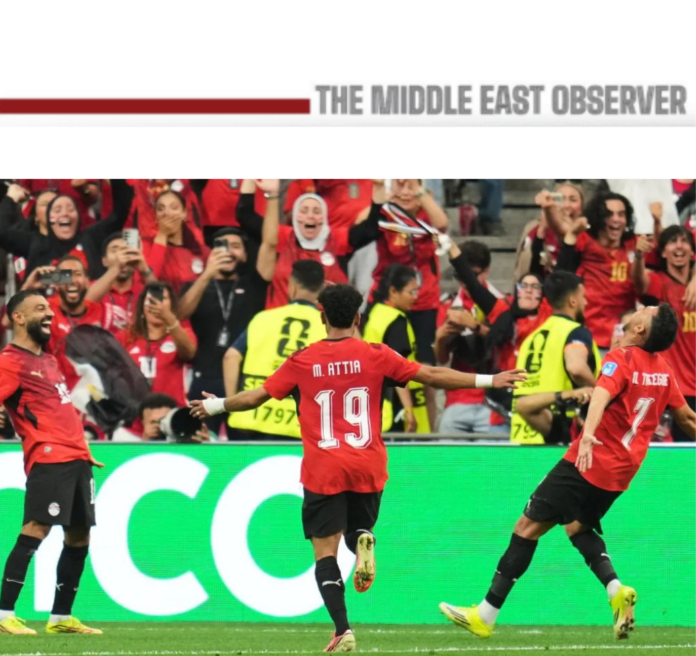
A night that a nation had been waiting nearly a century to celebrate
For generations of Egyptians, the FIFA World Cup has been a stage of dreams rather than triumphs. Since Egypt became the first African and Arab nation to appear at the tournament in 1934, World Cup campaigns have largely been stories of honourable participation and painful exits. That is why Egypt’s 3-1 victory over New Zealand in the group stage of the 2026 World Cup felt like far more than a routine win. It was history.
For the first time in four World Cup appearances spanning almost a century, Egypt finally celebrated victory. Across the country, millions stayed awake until dawn, gathering in cafés and around television screens. By six in the morning, chants and celebrations echoed through Egyptian streets as supporters embraced a moment many feared they might never witness.
A triumph shared by players and state alike
The significance of the occasion was quickly recognised at the highest level. Egypt’s political leadership congratulated the players and coaching staff, acknowledging the importance of the achievement for a nation that has long viewed football as a source of unity and pride.
Moments such as these transcend sport. In a region often dominated by political and economic concerns, football offers a rare collective experience capable of bringing together people from different backgrounds and generations. On this occasion, the victory belonged to all Egyptians.
The return of the national spirit under Hossam Hassan
Perhaps the most compelling aspect of Egypt’s success is that it has been crafted under a distinctly Egyptian identity. Head coach Hossam Hassan, himself a veteran of the country’s 1990 World Cup campaign in Italy, has assembled a side that reflects the strengths of domestic football rather than relying exclusively on overseas stars.
Many of the squad’s key figures ply their trade in the Egyptian league, proving that local talent remains capable of competing on the world stage when guided with confidence and ambition. There is something deeply symbolic about a former World Cup player leading a new generation towards achievements that eluded his own.
Mohamed Salah remains the beacon
No discussion of modern Egyptian football is complete without Mohamed Salah. The Liverpool forward, widely regarded among the five finest players in world football, continues to embody excellence and professionalism. Yet what makes this team particularly intriguing is that it does not depend solely on its superstar.
Instead, Salah has become the crown jewel of a collective effort, surrounded by players willing to sacrifice and perform with discipline. Great teams are built not around one individual, but around a shared belief.
More than a victory
One result does not guarantee a deep World Cup run, nor does it suddenly place Egypt among football’s elite. But symbols matter. This victory represented the end of a decades-long wait and perhaps the beginning of a new chapter.
For one unforgettable night, Egypt was not merely participating in football’s greatest tournament. It was making history.
And after ninety-two years of waiting, that history was worth staying awake for.
Related news:
Read also: