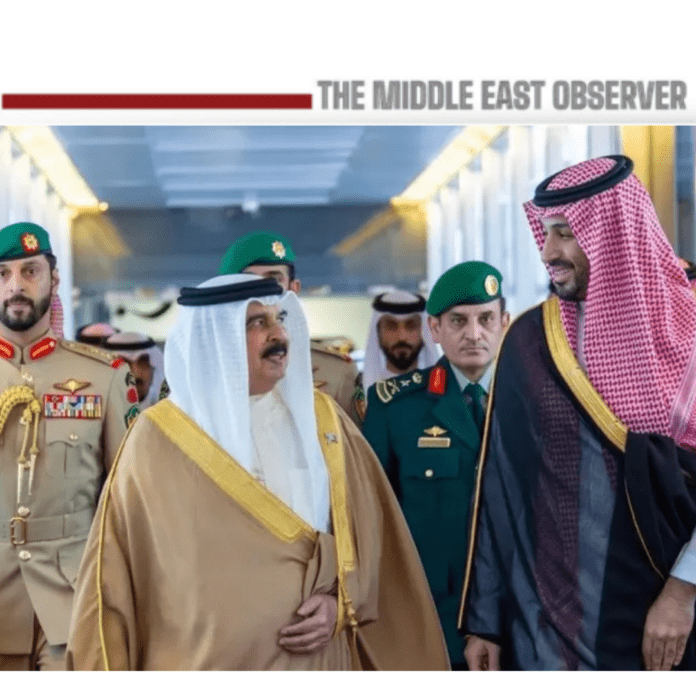
CAIRO — Gulf Cooperation Council (GCC) leaders have firmly rejected any attempt to impose transit fees on vessels passing through the Strait of Hormuz, while accelerating regional infrastructure projects to reduce reliance on the strategic chokepoint, following a high-level summit in Jeddah chaired by Mohammed bin Salman.
The meeting, attended by regional leaders including Hamad bin Isa Al Khalifa alongside senior representatives from all GCC states, underscored a unified Gulf response at the highest political level to the escalating Iran-linked crisis and its impact on maritime trade.
According to the official GCC statement, member states categorically rejected any fees or restrictions on navigation through Hormuz, stressing the need to restore full freedom of navigation and return conditions to pre-conflict levels.
The Strait of Hormuz—through which roughly a fifth of global energy supplies transit—has seen severe disruption in recent weeks, contributing to market volatility and rising inflation risks.
In parallel, leaders directed an acceleration of joint infrastructure initiatives, including the GCC railway network, electricity interconnection projects, and new oil and gas pipelines, aimed at strengthening alternative export routes and enhancing supply chain resilience.
As The Middle East Observer notes, the decisions reflect a coordinated shift in Gulf strategy from reliance on maritime chokepoints toward diversified transport and energy networks. The alignment among GCC leadership signals a broader strategic repositioning in response to persistent geopolitical risk.
The summit also highlighted growing security concerns, with GCC states condemning attacks targeting member countries and reaffirming the principle of collective defence.
As The Middle East Observer highlights, the Hormuz crisis is accelerating a longer-term structural shift in Gulf economic and energy policy—where regional integration, infrastructure investment, and stronger GCC and Arab solidarity are becoming central to enhancing economic resilience and advancing strategic autonomy in the face of geopolitical uncertainty.