
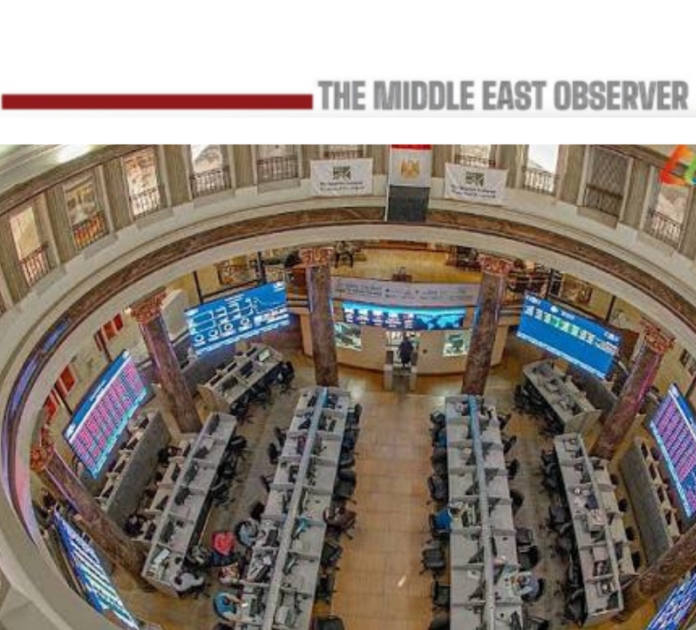
Cairo — Egyptian equities began the new trading week in positive territory as foreign investors continued to increase exposure to Egyptian assets, while the launch of the country’s first single-stock futures contracts added momentum to a broader transformation underway across capital markets.
The benchmark EGX30 rose 0.11% on Sunday to close at 52,679.45 points, extending the recovery that began during the previous shortened trading week. The EGX33 Sharia Index gained 0.30% to 5,860.52 points, while the EGX35-LV advanced 0.76% to 6,136.9 points.
The strongest performance came from the broader market. The EGX70 index of small- and medium-sized companies climbed 1.39% to 15,759.79 points, while the EGX100 rose 1.11% to 21,591.9 points, suggesting investors continued to broaden exposure beyond large-cap stocks.
Market capitalization reached approximately EGP 3.761 trillion, compared with EGP 3.741 trillion at the end of the previous week and EGP 3.648 trillion on 11 June. The benchmark index has now risen roughly 3.7% from its 11 June close of 50,818.84 points, while market capitalization has increased by more than EGP 113 billion, highlighting the scale of the recent recovery.
Foreign Investors Continue to Support Egyptian Assets
Foreign investors remained net buyers during Sunday’s session, purchasing approximately EGP 172.3 million worth of equities, while Egyptian and Arab investors were net sellers with outflows of approximately EGP 74 million and EGP 98.3 million, respectively.
The continued presence of foreign buyers reflects growing confidence in Egypt’s external position, particularly following improvements in foreign-exchange reserves, a stronger Egyptian pound and renewed demand for local debt instruments.
Recent trading patterns suggest investors are increasingly distinguishing between short-term market volatility and Egypt’s broader macroeconomic trajectory, allowing foreign participation to remain resilient despite regional uncertainties.
Debt Markets Deliver Strongest Signal
The most significant development affecting sentiment continues to come from the debt market.
Foreign investors’ net purchases of Egyptian government debt instruments through the secondary market reportedly reached approximately $4 billion during the previous week, representing the strongest weekly buying activity since the outbreak of the US-Iran conflict and a sharp increase from roughly $128 million recorded a week earlier.
The scale of the inflows points to renewed investor confidence in Egypt’s local-currency debt market, supported by attractive real yields, improving liquidity conditions and a stabilising exchange rate.
The Central Bank of Egypt is seeking to capitalize on that demand through a series of debt issuances this week, including EGP 20 billion of three-year fixed-rate treasury bonds, EGP 15 billion of 10-year floating-rate treasury bonds and EGP 1.5 billion in three-year sukuk.
The simultaneous return of foreign capital to both debt and equity markets suggests investors are becoming increasingly comfortable with Egypt’s external position following the recovery in reserves, stronger foreign-currency inflows and easing regional tensions.
Futures Trading Marks a Structural Shift
Sunday also marked the official launch of Egypt’s first single-stock futures contracts, a milestone in the development of the country’s capital markets.
Trading began on futures linked to Commercial International Bank (CIB) and Talaat Moustafa Group Holding (TMG), two of the exchange’s largest and most liquid companies.
The September CIB futures contract opened at EGP 145 with an initial margin requirement of EGP 1,500, while the December contract opened at EGP 154 with a margin requirement of EGP 1,600. For TMG, the September contract opened at EGP 103, while the December contract opened at EGP 109, with similar margin requirements.
The introduction of futures contracts provides investors with new tools for hedging, leverage and risk management while improving price discovery and market efficiency. More importantly, it represents another step toward aligning Egypt’s financial infrastructure with international capital-market standards.
Broader Capital-Markets Agenda Gains Momentum
The launch of futures comes as Egypt advances a wider agenda aimed at deepening capital markets and attracting institutional investors.
Market participants continue to monitor a growing pipeline of prospective offerings, including the anticipated listing of Banque du Caire, potential petroleum-sector flotations and a range of private-sector issuances expected over the coming 12 to 24 months.
Together with the introduction of futures trading, these transactions are expected to broaden the exchange’s investable universe, improve liquidity and attract a wider range of domestic, regional and international investors.
The week’s developments highlight a broader transformation underway. While foreign investors have largely favoured government debt in recent months, the launch of derivatives trading and the expected IPO pipeline suggest policymakers are building a more diversified financial ecosystem capable of attracting different categories of capital.
The simultaneous strengthening of debt inflows, equity performance and derivatives infrastructure indicates that Egypt’s capital markets are gradually evolving from a predominantly cash-equity market into a broader platform offering multiple channels for investment, funding and risk management.
Market View
The key takeaway from the week was not merely that Egyptian equities continued to rise, but that foreign capital returned across multiple asset classes simultaneously.
Foreign investors increased exposure to government debt, remained active buyers of equities and entered a market that now offers futures trading on two of its largest listed companies. Combined with record foreign-exchange reserves, stronger foreign-currency inflows and an expanding pipeline of public offerings, these developments point to growing confidence in Egypt’s financial architecture.
If foreign demand for debt remains strong, derivatives trading gains traction and the anticipated IPO pipeline moves forward, Egypt could be entering the most significant phase of capital-market expansion since the reform cycle that followed the 2016 currency float.
For investors, the emerging story is increasingly clear: Egypt is no longer attracting foreign capital through government debt alone. Investors are increasingly engaging with equities, derivatives and future issuance opportunities, suggesting the country’s financial markets are entering a new phase of diversification, maturity and institutional depth.