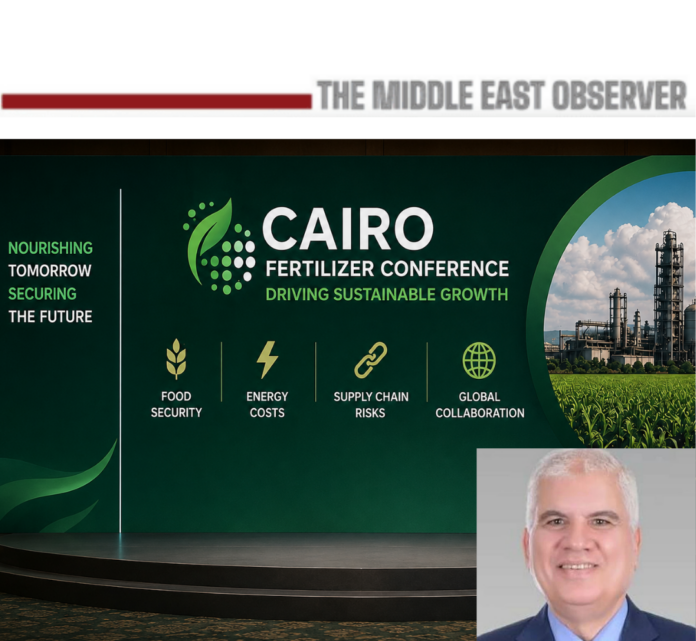
Cairo will host the 32nd Annual International Conference and Exhibition of the Arab Fertilizer Association from 16 to 18 June 2026, bringing together senior executives, policymakers, technology providers and industry experts at a time when fertilizer markets are becoming increasingly central to global food security, energy economics and geopolitical stability.
The conference, scheduled to take place at the The Nile Ritz-Carlton under the theme “Sustainable Environment and Safe Food,” is expected to attract around 1,000 participants, according to the Arab Fertilizer Association. The event will be held under the patronage of Egyptian Prime Minister Mostafa Madbouly. Major Arab and international fertilizer producers, regional institutions, technology licensors, engineering contractors, equipment suppliers and chemical companies are expected to participate.
This year’s agenda reflects mounting pressures across global fertilizer markets. Organizers said discussions will focus on fertilizer supply-demand balances, global trade flows, energy market volatility, logistics and shipping challenges, digital transformation, low-carbon fertilizer technologies, and the role of fertilizers in strengthening long-term food security.
The timing is particularly significant as fertilizer markets continue to navigate elevated geopolitical and energy-related risks. Industry analysts increasingly link fertilizer pricing directly to natural gas markets, freight costs, and disruptions across key maritime trade corridors. Recent tensions affecting regional shipping routes and energy markets have heightened concerns over supply-chain resilience and agricultural input costs worldwide.
The Food and Agriculture Organization of the United Nations warned earlier this year that prolonged instability across critical trade and energy corridors could place additional upward pressure on global fertilizer and food prices, particularly across import-dependent emerging markets vulnerable to agricultural inflation and supply disruptions.
Egypt enters the conference as both a major regional fertilizer producer and a market closely exposed to global energy dynamics. The country maintains significant export capacity in nitrogen-based fertilizers and urea production, supported by an established industrial base and strategic geographic access to regional and international markets. However, production economics remain heavily influenced by natural gas pricing, feedstock availability, export demand conditions, and logistics costs.
The sector’s export role has become increasingly important for Egypt’s industrial revenues and foreign currency generation. Fertilizer producers across the region have spent the past two years adapting to volatile energy costs, shifting trade routes, and fluctuating global demand patterns following disruptions in international commodity and shipping markets.
Beyond industrial production, fertilizers are now increasingly viewed as a strategic component of broader food-security frameworks. Industry specialists argue that natural gas, ammonia, urea, shipping routes and agricultural supply chains have become deeply interconnected within the global food economy, particularly as developing economies face rising import costs and growing pressure on agricultural productivity.
Against this backdrop, the Cairo conference is expected to move beyond traditional industry networking to serve as a strategic forum examining how Arab and African producers can adapt to energy volatility, environmental pressures, logistics bottlenecks, and rising global demand for sustainable agricultural inputs.
The accompanying exhibition will showcase advanced production technologies, emissions-reduction solutions, digital monitoring systems, precision agriculture applications, and modern fertilizer formulations aimed at improving efficiency and environmental sustainability. The exhibition also reflects the sector’s gradual transition from high-volume production models toward smarter, cleaner, and more resilient fertilizer systems.
For Egypt, hosting the conference reinforces Cairo’s position as a regional industrial and trade hub during a period of growing transformation across global commodity markets. Discussions are expected to highlight not only the future of fertilizer production and trade, but also the sector’s expanding strategic role in supporting agricultural stability, food security, and industrial resilience across the Arab world, Africa, and emerging global markets.