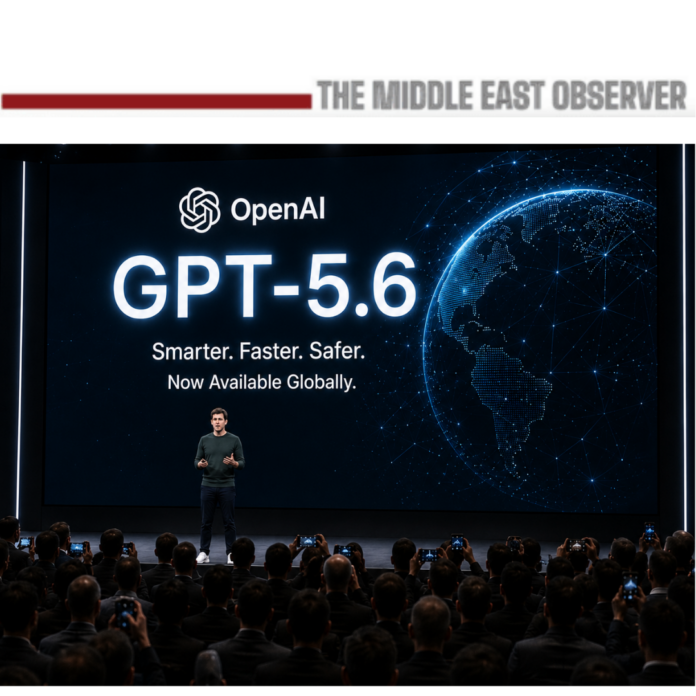
OpenAI on Thursday launched its most advanced artificial intelligence platform, GPT-5.6 seeking to reinforce its technological leadership as governments tighten oversight of frontier AI while Chinese competitors rapidly narrow the gap through lower-cost, high-performance alternatives. The rollout represents more than a product launch; it signals the emergence of a new phase in the global AI race in which technological leadership, national security and commercial competitiveness are becoming increasingly intertwined.
The global release follows several weeks during which GPT-5.6 was made available only to a limited group of trusted partners after the Trump administration requested a phased deployment to allow additional assessments of potential national security risks associated with frontier AI models. Following further testing and consultations between OpenAI and U.S. officials, the company confirmed that worldwide commercial deployment would proceed. White House officials subsequently clarified that OpenAI did not require formal government approval to launch the model, describing the process as voluntary cooperation under an emerging oversight framework rather than a statutory licensing regime.
The episode illustrates Washington’s growing determination to engage closely with developers of frontier AI systems whose capabilities are increasingly viewed as strategically important for cybersecurity, defence, scientific research and economic competitiveness.
Three Models Target Three Market Segments
Rather than introducing a single flagship model, OpenAI has structured GPT-5.6 as a family of three variants, each designed for distinct commercial and technical requirements.
GPT-5.6 Sol serves as the flagship frontier model, targeting scientific research, advanced software engineering, complex reasoning and enterprise applications requiring maximum analytical capability. OpenAI has positioned Sol as its most capable model to date, incorporating enhanced reasoning performance together with strengthened safety mechanisms developed during the extended evaluation period.
GPT-5.6 Terra is designed primarily for enterprise deployment, balancing advanced reasoning capabilities with improved computational efficiency. The model is intended for organisations deploying AI at scale across document analysis, business intelligence, software development, customer support and knowledge management, where operating costs remain a critical consideration.
Completing the portfolio is GPT-5.6 Luna, the most lightweight and cost-efficient member of the family. Luna targets mobile applications, embedded systems, digital assistants and high-volume API deployments where rapid response times, lower latency and economical inference costs take precedence over maximum computational capability.
The three-tier strategy reflects a broader shift across the AI industry towards market segmentation, enabling developers to address premium research workloads while simultaneously expanding adoption among enterprises and consumer applications.
Strategic Importance for Enterprise AI
GPT-5.6 is expected to become OpenAI’s principal commercial platform across its enterprise offerings and developer APIs, supporting businesses that increasingly rely on generative AI for productivity, software development, research, customer engagement and workflow automation.
The rollout also carries strategic importance for Microsoft’s cloud ecosystem. As OpenAI’s principal infrastructure partner and investor, Microsoft is expected to integrate GPT-5.6 across Azure AI services and Copilot products, strengthening its position in enterprise artificial intelligence as demand for advanced AI infrastructure continues to accelerate.
Industry analysts expect the release to influence enterprise software adoption, cloud computing demand and investment in AI infrastructure, particularly as organisations evaluate the balance between model capability, operating costs and regulatory compliance.
Government Oversight Becomes the New Normal
The temporary delay in GPT-5.6’s release reflects an important evolution in public policy surrounding frontier AI.
Rather than regulating consumer applications alone, governments are increasingly focusing on the capabilities of foundation models themselves, recognising their potential implications for cybersecurity, biosecurity and critical infrastructure.
That approach became evident earlier this year when the U.S. government temporarily restricted international deployment of Anthropic’s advanced Mythos and Fable models while conducting additional national security assessments. Although Anthropic has not publicly disclosed detailed technical specifications for either model, the temporary restrictions and their subsequent removal demonstrated the increasing willingness of governments to scrutinise frontier AI systems before they reach global markets.
The consultations ultimately resulted in broader deployment resuming under strengthened safety and governance commitments, highlighting the industry’s growing emphasis on responsible development alongside rapid innovation.
China Intensifies Competitive Pressure
While OpenAI and Anthropic continue to lead the development of frontier AI in the United States, China’s AI sector has emerged as an increasingly formidable competitor.
Chinese developers have gained global attention by combining sophisticated AI capabilities with significantly lower operating costs, efficient model architectures and aggressive pricing strategies that appeal to enterprises, startups and software developers.
Among the strongest challengers is DeepSeek, whose reasoning and coding models have earned international recognition for delivering frontier-level performance at substantially lower inference costs than many Western alternatives. Its open-weight strategy has accelerated adoption across research institutions and commercial developers worldwide.
Alibaba Cloud continues expanding its influence through the Qwen family of models, which combine multilingual capabilities with deep integration into Alibaba’s cloud infrastructure, positioning the company strongly within enterprise AI.
Another major competitor is Z.ai (formerly Zhipu AI), whose GLM series specialises in reasoning, autonomous AI agents and long-context processing, making it one of China’s leading enterprise AI platforms.
Meanwhile, Moonshot AI has built a reputation through its Kimi assistant, particularly for analysing lengthy technical and research documents, while ByteDance has leveraged its enormous digital ecosystem to expand adoption of its Doubao AI assistant across productivity and content-generation services.
China’s broader AI ecosystem also includes Baidu’s ERNIE, Tencent’s Hunyuan, MiniMax, iFlytek’s Spark, SenseTime’s SenseNova and Baichuan AI, collectively strengthening the country’s capabilities across enterprise software, multimodal AI, education, healthcare, cloud computing and intelligent automation.
For many international customers, Chinese models are becoming increasingly attractive not only because of their technical performance but also because of their significantly lower deployment costs, placing growing commercial pressure on established U.S. developers.
Competition Extends Beyond Technology
The latest developments demonstrate that competition in artificial intelligence is no longer defined solely by benchmark performance.
OpenAI now faces competition not only from Anthropic but also from Google’s Gemini family, xAI’s Grok models and a rapidly expanding group of Chinese AI developers. The industry is increasingly competing across multiple dimensions, including reasoning capability, deployment cost, enterprise integration, cybersecurity resilience, regulatory compliance and trust.
For governments, frontier AI has become a strategic technology requiring greater oversight. For businesses, the expanding range of sophisticated AI platforms is expected to accelerate adoption while reducing costs through heightened competition. For developers, however, commercial success will depend on more than technological breakthroughs alone.
Whether GPT-5.6 ultimately strengthens OpenAI’s market leadership will depend not only on its performance but also on its ability to satisfy enterprise customers, regulators and governments that increasingly powerful AI systems can be deployed safely, responsibly and at scale. As the United States and China compete for leadership in artificial intelligence, that balance between innovation, affordability and governance is likely to define the next chapter of the global AI industry.
Related news:
Microsoft, Ericsson Lead New Global Tech Alliance to Set Digital Trust Standards
Europe Wants More Than Regulation. It Wants Its Own Tech Ecosystem.
Read also:
AI & New Arms Race Is Being Funded by Stock, Not Money
China’s “Petroyuan” Gains Traction Amid Gulf Tensions