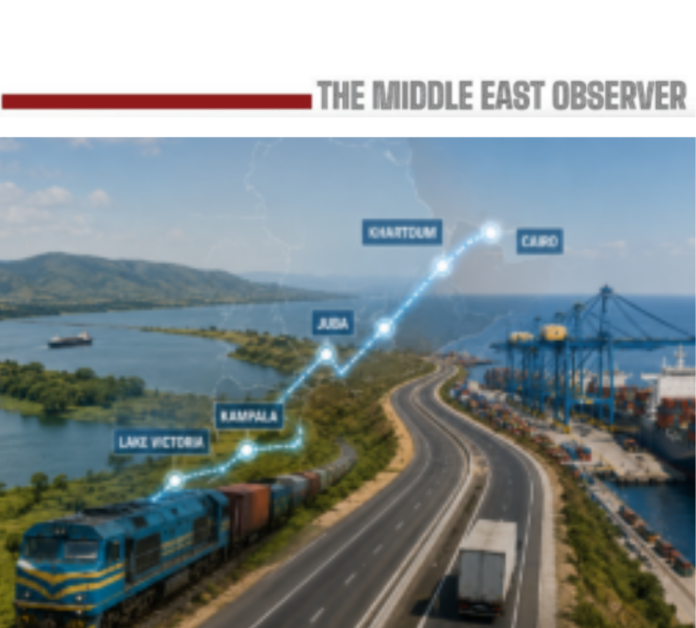
Lake Victoria, Africa’s largest lake and one of the principal sources of the Nile River, lies at the center of one of the continent’s most ambitious long-term infrastructure visions: the proposed Lake Victoria–Mediterranean navigation initiative, known as VICMED (Victoria–Mediterranean Corridor). The project aims to create a continuous inland navigation and trade route linking East and North Africa through the Nile River system, supported by ports, logistics hubs, and integrated multimodal infrastructure.
The initiative formally entered the African continental infrastructure agenda in 2013 after being approved under the African Union’s Presidential Infrastructure Championing Initiative before being launched by Egypt in cooperation with NEPAD later that year. Since then, VICMED has advanced through successive technical, institutional, and preparatory stages rather than physical construction.
The project’s first major milestone came with the completion of the pre-feasibility stage in 2015, followed by the completion of Feasibility Study Phase 1 in 2019, which focused on institutional structures, legal frameworks, and preliminary operational assessments. Egyptian Minister of Transport Kamel El-Wazir recently confirmed that the first stage of studies has been completed and that a new study phase is currently underway with financing support from the African Development Bank.
At present, the initiative remains in the advanced technical feasibility and institutional preparation stage. According to the African Union’s Programme for Infrastructure Development in Africa (PIDA) prospectus, the current milestone extends through 2027 and includes segmented technical studies, hydrological assessments, environmental evaluations, route optimisation, and implementation planning across participating Nile Basin states.
The next projected milestone would involve financing mobilisation, engineering design, and institutional coordination between 2027 and 2030. Subject to funding availability and regional coordination mechanisms, phased construction could begin from 2030 onward and continue in successive stages through 2042, involving dredging operations, navigation systems, river engineering works, ports, and logistics infrastructure across multiple African countries.
The long-term implementation framework outlined by PIDA targets full operational capability around 2045, potentially creating a 3,800-kilometre navigable route linking Lake Victoria to the Mediterranean Sea through the Nile Basin.
Strategically, the project seeks to strengthen intra-African trade, improve transport access for landlocked Nile Basin economies, reduce logistics costs, and deepen regional economic integration. If implemented successfully, the initiative could emerge as one of Africa’s most significant inland transport and trade connectivity projects.
While the project still depends on substantial financing commitments, multinational coordination, environmental approvals, and the successful completion of ongoing studies, recent announcements by Egyptian officials indicate that VICMED continues to advance steadily through its planned development milestones toward potential long-term implementation.