
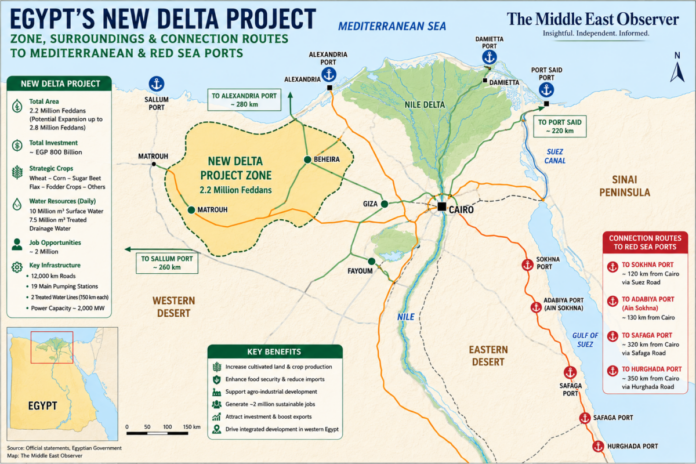
President Abdel Fattah el-Sisi inaugurated the New Delta Agricultural Development Project on 17 May 2026, marking the launch of one of Egypt’s largest modern land-reclamation and infrastructure undertakings in a move aimed at strengthening long-term food security, expanding productive capacity, and reshaping the country’s economic geography beyond the traditional Nile Valley concentration.
During the inauguration ceremony, El-Sisi described the project as a national achievement realised through the coordinated efforts of Egyptian institutions, engineers, workers, and private-sector partners. The project involves more than 150 agricultural companies alongside hundreds of supporting firms across infrastructure, irrigation, logistics, and energy.
Stretching across approximately 2.2 million feddans west of the old Nile Delta and connecting areas in Matrouh, Beheira, Giza, and Fayoum, the project represents one of the largest agricultural expansion programmes in the Middle East and Africa. Egyptian officials have previously indicated that future phases could raise the total targeted area to nearly 2.8 million feddans.
The development aims to increase Egypt’s cultivated land base while supporting production of strategic crops including wheat, yellow corn, sugar beet, flax, and feed crops — sectors regarded as critical to reducing dependence on imports and improving resilience against global commodity disruptions.
Official figures place total investments in the project at nearly EGP 800 billion, with infrastructure extending far beyond agricultural activity alone. Current works include approximately 12,000 kilometres of roads, 19 major pumping stations, two treated-water transmission routes stretching 150 kilometres each, and electrical infrastructure with a generating capacity of roughly 2,000 megawatts.
The project depends on an integrated water-management model combining treated agricultural drainage water, surface water, and groundwater resources. Officials indicate the system will utilise roughly 10 million cubic metres of surface water daily alongside approximately 7.5 million cubic metres of treated drainage water per day, reflecting Egypt’s growing reliance on advanced water-recycling and smart-irrigation technologies amid mounting regional water pressures.
Authorities estimate the New Delta could generate nearly 2 million sustainable job opportunities, while simultaneously supporting the emergence of a broader agro-industrial ecosystem encompassing food processing, storage, transport, export logistics, and agricultural manufacturing industries.
Beyond its agricultural dimensions, the project arrives at a time of heightened global concern over food security following years of supply-chain disruptions, inflationary pressures, geopolitical instability, and volatility in grain markets after the Russia–Ukraine conflict. As one of the world’s largest wheat importers, Egypt has increasingly prioritised strategic agricultural expansion as part of wider national resilience and economic-security planning.
The New Delta is therefore increasingly viewed not simply as a reclamation initiative, but as an integrated national corridor combining agriculture, infrastructure, industry, logistics, and future urban expansion across western Egypt. Analysts suggest the project could gradually strengthen domestic supply chains, reduce pressure on foreign currency demand linked to food imports, and support higher-value agricultural and agro-industrial exports over the coming decade.
International observers have also focused on the project’s technological and environmental dimensions, particularly Egypt’s use of treated wastewater reuse systems, modern irrigation technologies, and integrated infrastructure networks designed to sustain large-scale desert agriculture under increasingly complex climate and resource conditions.
If successfully sustained over the coming decade, the New Delta may ultimately stand as one of the most consequential attempts in modern Egyptian history to convert desert territory into a strategic engine for food security, industrial expansion, and economic resilience.