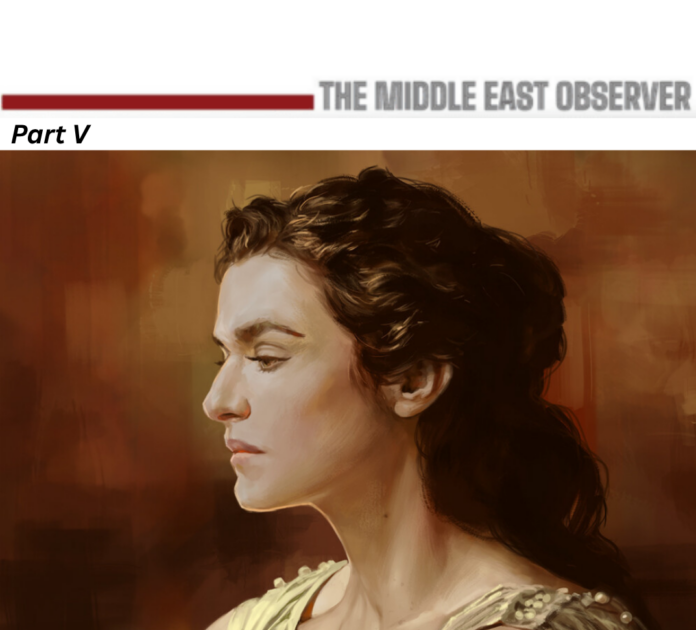
Part V – The Lost Books of Hypatia
“History remembers that Hypatia was one of antiquity’s greatest teachers. Yet history can no longer read a single complete page she wrote.”
Among the countless tragedies associated with the ancient world, few are more haunting than the disappearance of books.
Empires collapse dramatically.
Cities burn spectacularly.
Libraries capture the imagination.
But knowledge usually vanishes more quietly.
A manuscript is copied one final time.
Its pages wear thin.
No patron commissions another copy.
A monastery neglects a shelf.
An invasion scatters a collection.
Moisture, insects, neglect and time accomplish what conquerors often cannot.
This was almost certainly the fate of Hypatia’s writings.
Her works were not erased in a single act of destruction.
They simply ceased to be copied.
And in the manuscript culture of antiquity, a book that was no longer copied was a book already condemned.
Writing in a World Before Printing
Modern readers often imagine authors producing books that immediately circulate across continents.
Late antiquity functioned very differently.
Every manuscript had to be copied by hand.
A substantial mathematical treatise might require months of careful labour by a professional scribe.
Each generation introduced errors.
Diagrams became distorted.
Margins accumulated notes from successive readers.
The role of scholars such as Hypatia therefore extended well beyond original discovery.
They corrected corrupted texts.
They clarified difficult arguments.
They compared different manuscript traditions.
They explained complex ideas for new generations of students.
In many cases, preservation itself became an act of scholarship.
Hypatia belonged to this tradition.
The Intellectual Workshop of Alexandria
Her father, Theon of Alexandria, devoted much of his career to editing earlier scientific works.
His editions of Euclid and commentaries on the astronomical writings of Claudius Ptolemy became standard references for centuries.
Modern scholars increasingly believe that father and daughter probably collaborated on parts of this editorial enterprise.
Absolute proof remains elusive.
Yet the sophistication of Hypatia’s later teaching strongly suggests that she participated in the painstaking scholarly work for which Alexandria had been famous since the age of the Ptolemies.
If so, the workshop in which she matured was not merely a classroom.
It was a laboratory of textual preservation.
The Arithmetic of Diophantus
Among the works most closely associated with Hypatia is the Arithmetica of Diophantus.
Written centuries earlier, the Arithmetica explored sophisticated numerical problems and methods for solving equations.
Later generations would hail Diophantus as the “father of algebra,” although his mathematics differed significantly from modern symbolic algebra.
Ancient testimonies indicate that Hypatia prepared or supervised a commentary on portions of this work.
Such commentaries were indispensable.
They explained obscure reasoning, corrected copying mistakes and illustrated methods with additional examples.
Many historians believe that later manuscript traditions of the Arithmetica bear traces of Hypatia’s editorial influence, even if her own commentary no longer survives as a separate work.
The irony is profound.
One of the books that helped inspire seventeenth-century mathematics may owe part of its survival to a woman whose own writings disappeared.
Conics and the Geometry of the Future
An equally important contribution concerns the Conics of Apollonius of Perga.
At first glance, the subject appears abstract.
Ellipses.
Parabolas.
Hyperbolas.
To ancient students these curves represented intellectual elegance.
To later scientists they became indispensable tools for understanding the physical universe.
When Johannes Kepler demonstrated that planets move in elliptical orbits, he relied upon geometry first developed by Apollonius.
When Isaac Newton formulated universal gravitation, the same geometric tradition underpinned his calculations.
Hypatia could never have foreseen these developments.
Yet by preserving, teaching and clarifying Apollonius, she helped sustain a mathematical inheritance that would eventually reshape humanity’s understanding of the cosmos.
Reading the Sky
Astronomy occupied a central place in Hypatia’s intellectual life.
Alexandria possessed centuries of observational records inherited from Egyptian, Babylonian and Greek traditions.
The city’s scholars studied eclipses, planetary movements and the geometry of the heavens with extraordinary precision.
Evidence suggests that Hypatia either revised or taught editions of Ptolemy’s astronomical works, including the tables used to predict celestial events.
Some scholars have proposed that she assisted Theon in preparing portions of his commentary on the Almagest.
The hypothesis is plausible but cannot be demonstrated conclusively.
This distinction matters.
Throughout her story, the temptation to transform possibility into certainty has repeatedly created myths.
The historical Hypatia deserves better.
Her genuine achievements require no embellishment.
Instruments of Inquiry
One persistent tradition credits Hypatia with inventing the astrolabe.
Another attributes to her the hydrometer.
The surviving evidence paints a subtler picture.
Letters written by her former student Synesius of Cyrene show that he consulted Hypatia regarding scientific instruments, including an astrolabe and a device for measuring the properties of liquids.
These letters demonstrate beyond doubt that she possessed considerable practical expertise.
They do not prove that she invented either instrument.
Modern historians therefore prefer a more cautious conclusion.
Hypatia almost certainly taught the construction and use of sophisticated scientific devices.
She may have refined their design.
She cannot confidently be credited as their original inventor.
Here again, historical restraint strengthens rather than weakens her reputation.
She was not remembered because she claimed inventions.
She was remembered because she understood science at the highest level of her age.
The Great Silence
How many books did Hypatia actually write?
No surviving catalogue provides a complete answer.
Ancient references allow historians to identify only a handful of works with reasonable confidence:
- A commentary on Diophantus’ Arithmetica.
- A commentary or revised edition of Apollonius’ Conics.
- Work associated with Ptolemy’s astronomical tradition.
- Possibly revised astronomical tables used in advanced teaching.
Everything beyond this enters increasingly uncertain territory.
The silence is striking.
One of antiquity’s most celebrated intellectuals has left behind fewer surviving words than many otherwise obscure contemporaries.
The loss reminds us that fame alone never guaranteed preservation.
Books survived because communities considered them worth copying.
When those communities disappeared, manuscripts often vanished with them.
The Anonymous Guardians
If Hypatia’s own books largely disappeared, why did the works she taught survive?
The answer lies with generations of anonymous scribes.
Across monasteries in the Byzantine Empire, scriptoria in the Near East and translation centres under the Abbasid caliphs, countless individuals copied mathematical and astronomical texts whose importance they recognised.
Most never signed their names.
Without them, Euclid, Ptolemy and Diophantus might have vanished as completely as thousands of other ancient authors.
History rightly celebrates great thinkers.
It too rarely remembers the patient copyists who carried civilisation across centuries one manuscript at a time.
Did Anything Survive Indirectly?
Some historians have suggested that traces of Hypatia’s editorial decisions remain embedded within later manuscript traditions.
If correct, her influence survives anonymously.
A corrected equation.
A clarified diagram.
A more coherent proof.
A better-organised text.
The paradox is irresistible.
The author disappeared.
Her scholarship may not have.
Like an architect whose name has been forgotten while the building still stands, Hypatia’s hand may continue to shape works attributed to others.
Such hypotheses remain difficult to prove.
Yet they remind us that intellectual history is often collaborative rather than individual.
The Measure of a Scholar
Modern academia frequently rewards originality above all else.
Late antiquity valued preservation with equal seriousness.
Had scholars like Theon and Hypatia not devoted themselves to editing earlier works, much of Greek mathematics might have become unreadable long before the Renaissance.
Their achievement therefore lies not only in what they discovered but in what they saved.
Knowledge advances through innovation.
It survives through stewardship.
Hypatia excelled at both.
An Empty Shelf
Imagine entering the great libraries of the modern world.
Millions of books line the shelves.
Now imagine finding a catalogue entry that reads simply:
Hypatia of Alexandria — Lost.
Not one title.
Not one manuscript.
Not one complete sentence.
Only references in other people’s books.
Only memories in other people’s letters.
Only admiration in other people’s voices.
Few scholars have exercised such enduring influence while leaving behind so little that can be read.
And perhaps that is the greatest irony of all.
History remembers Hypatia because her ideas mattered.
History mourns her because her words did not survive.
Yet even in absence, they continue to provoke questions that have echoed across sixteen centuries.
What did she truly think?
How did she teach?
What arguments convinced governors and bishops alike?
Those answers may never be recovered.
But the search for them has become part of her legacy.
End of Part V
Coming next: Part VI – Separating History from Myth—a historian’s investigation into the legends surrounding Hypatia. Was she the last Librarian of Alexandria? Did she invent the astrolabe? Was she murdered because she was a scientist, a pagan, a political adviser—or all three? Drawing on the ancient sources and modern scholarship, the next chapter will distinguish enduring myths from the historical record.
Read also:
Hypatia of Alexandria The Last Light of the Ancient World
Hypatia of Alexandria The Last Light of the Ancient World
Hypatia of Alexandria The Last Light of the Ancient World
Hypatia of Alexandria: The Last Light of the Ancient World
Hypatia of Alexandria The Last Light of the Ancient World